Introduction to the Returned Goods to Supplier Register
Use this register when you need to return goods that you have received to the Supplier. A record in the Returned Goods to Supplier register is always connected with a Purchase Order, and it can be either a full Return or a part Return. You cannot use the Returned Goods to Supplier register if you do not have the Purchase Orders module: use the Stock Depreciation register to remove Items from stock in this situation.The difficulty with the returning of goods to their Suppliers is to establish the actual value of the goods being returned. When you remove Items from stock using Deliveries or the Stock Depreciation register, the cost of those Items will be calculated using your usual Cost Model. When you use the Returned Goods to Supplier register, you have the choice of using your usual Cost Model or you can use the actual cost of the Item, as recorded in the original Goods Receipt. Make this choice using the Original Cost on Returned Goods to Supplier option in the Cost Accounting setting.
When you approve and save the Return, the stock levels of the Items used will be amended accordingly as will the Nominal Ledger stock valuation (if you have chosen in the Sub Systems setting in the Nominal Ledger and in the Number Series - Returned Goods to Supplier setting to have such Transactions created). You can then raise another Goods Receipt (if you receive a replacement) or a Credit Note (if you have already received a Purchase Invoice and no replacement is required) from the Purchase Order screen. You can also raise a Credit Note from the Returned Goods to Supplier screen, providing that only one Invoice has been created from the Purchase Order, and providing you are not using the Consolidate Items to Supplier Cost Account option in the Purchase Invoice Settings setting in the Purchase Ledger. If more than one Invoice has been created from the Purchase Order, you must issue the Credit Note using the 'Create Credit Note' function from the original Purchase Invoice, or return to the Purchase Order to create a Purchase Invoice for a negative quantity.
To view Returns already entered, ensure you are in the Stock module and click the [Ret. Goods to Supplier] button in the Master Control panel. The 'Returned Goods to Supplier: Browse' window is opened. Returns are normally shown in number order. For each is shown a Return Number, an indication of whether the Return has been approved in the OK column, Date and Comment. As in all browse windows, you can re-sort the list and search for particular records.
Entering a Returned Goods to Supplier record
You cannot enter records directly to the Returned Goods to Supplier register. Instead, you must create a new Return using one of two methods:- With a Purchase Order open, select the 'Create Returned Goods' command from the Operations menu. This creates a new record in the Returned Goods to Supplier register. For the command to have any effect, you must first save all changes to the Purchase Order (use the [Save] button) and you must have issued and approved at least one Goods Receipt from the Order.
- With a Goods Receipt open, select the 'Create Returned Goods' command from the Operations menu. This creates a new record in the Returned Goods to Supplier register. For the command to have any effect, you must have saved all changes to the Goods Receipt (use the [Save] button) and it must have been approved.
You must originally have created the Goods Receipt from a Purchase Order to be able to create a Returned Goods to Supplier record from it. If you did not create the Goods Receipt from a Purchase Order, you will not be able to create a Returned Goods to Supplier record, so you will need to remove the returned Item from stock using the Stock Depreciation register.
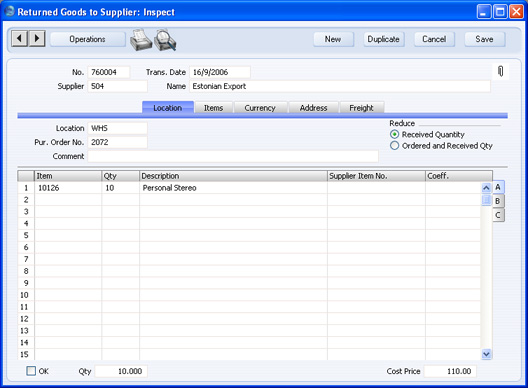
Entering a Returned Goods to Supplier record - Header
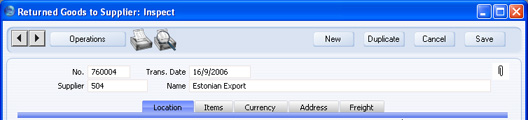
- No.
- Paste Special
Select from another Number Series
- The serial number of the current Return. The default is the first unused number in the first valid number sequence in the Number Series - Returned Goods to Supplier setting. You may change this number, but not to one that has already been used. If you are working in a multi-user environment, the Returns Number is assigned when you first save the record.
- Trans. Date
- Paste Special
Choose date
- The date of the Return. The default is the current date.
- Supplier
- The Supplier Number from the Purchase Order or Goods Receipt.
- Name
- The Supplier Name, taken from the Purchase Order or Goods Receipt.
Entering a Returned Goods to Supplier record - Location Card

- Location
- Paste Special
Locations setting, Stock module
- Default taken from Purchase Order or Goods Receipt
- The Location from which the Items are to be returned. If you have specified a Main Location in the Stock Settings setting, leaving the field blank means that the Main Location will be used.
- This field must contain a value if you are using the Require Location option in the Stock Settings setting.
- The Location from which the Items are to be returned. If you have specified a Main Location in the Stock Settings setting, leaving the field blank means that the Main Location will be used.
- Pur. Order No.
- The serial number for the Purchase Order from which the Returns record was created. This field cannot be changed.
- Comment
- Any comment entered here (perhaps the reason for the return) will be shown in the 'Returned Goods to Supplier: Browse' window.
- Reduce
- Use these choices to control the effect of the Return on the Purchase Order from which it was created.
- Received Quantity
- This option reduces the Recv 1 and Recv 2 quantities only. You should use it when goods are returned because they are faulty (i.e. you require a replacement). Then, after approving the Returned Goods to Supplier record and when the replacement arrives, you can return to the Purchase Order to raise another Goods Receipt for the appropriate quantity to fulfil the Order.
- Ordered and Received Qty
- This option reduces the Recv 1 and Recv 2 quantities and the Order quantity. You should use it when you return goods without requiring a replacement. If you have received a Purchase Invoice for the Order has been invoiced, selecting 'Create Credit Note' from the Operations menu of the Returned Goods to Supplier record will create a Credit Note with appropriate Payment Terms. If more than one Invoice has been created from the Purchase Order, you will not be able to create the Credit Note from the Returned Goods to Supplier record and instead will need to do so from the Order or from the Invoice to be credited.
- Received Quantity
Entering a Returned Goods to Supplier record - Items Card
Use the grid on the 'Items' card to list the Items being returned. This information is taken from the Purchase Order or the Goods Receipt from which the Return was created, and the default quantity for each Item is that already received. Items on the Purchase Order with a delivery quantity of zero will not be shown. Plain and Service Items on the Purchase Order or Goods Receipt will not be transferred to the Returned Goods to Supplier record. Enter the returned Quantity for each Item and remove any Items not returned by clicking on the row number to the left and pressing the Backspace key.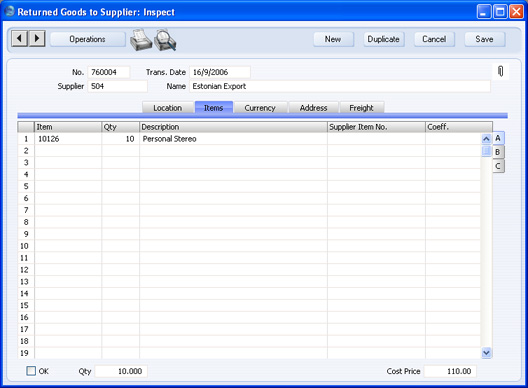
- Item
- The Item Number from the Purchase Order or Goods Receipt. This field can't be changed.
- Qty
- Enter the quantity returned. The default is that received, providing it is still in stock. Any quantity that is no longer in stock (e.g. it has been delivered to a Customer) will not be included in the Returned Goods to Supplier record. You can change this figure, but not to a quantity greater than that originally received (or remaining in stock if some of those originally received have been delivered to a Customer or otherwise removed from stock).
- Description
- The Item Name from the Purchase Order or Goods Receipt.
- Supplier Item No.
- The code allocated to the Item by the Supplier.
- Coeff
- Default taken from
Item - The Unit Coefficient of the Item is shown here, taken from the 'Stock' card of the Item. If you are maintaining stock quantities using different units of measurement, this coefficient is the ratio between those units of measurement.
- Price Variance
- Please refer to the Price Variances page for details of this field.
- FIFO
- The unit value of the Item, to be subtracted from your Nominal Ledger Transaction stock valuation. If the Quantity is greater than one, this field will show the average unit cost value. The total value is shown in the Row FIFO field to the right.
- This figure will be brought in automatically when you approve and save the Returned Goods to Supplier record. The calculation of this figure will usually depend on the Original Cost on Returned Goods to Supplier option in the Cost Accounting setting. If you are not using this option, this figure will be calculated using the Cost Model specified in the relevant Item or Item Group record. If that Cost Model is Default, the Primary Cost Model specified in the Cost Accounting setting will be used. In other words, this figure will be calculated as though this were a normal removal from stock. If you are using the Original Cost on Returned Goods to Supplier option, the cost of the Item will be taken from the original Goods Receipt. The exception is when the Item requires Serial Numbers and you are using the Cost Price for Serial Number option in the Cost Accounting setting: please refer to the description of the Serial No. field on flip C below for details.
- Row FIFO
- The total stock value of the Items on this row (unit cost from the FIFO field multiplied by quantity). This figure is brought in automatically when you approve and save the Returned Goods to Supplier record.
- When you approve the Returned Goods to Supplier record, this figure will be credited to the Stock Account and debited to the Purchase Accruals or Returned Goods Account. If you create a Credit Note from the record, this figure will be copied to the Credit Note, where you will be able to change it if necessary.
- Serial No.
- Paste Special
Serial Numbers of Items in stock - If the Item uses Serial Numbers or batch numbers, you must enter a valid number here.
- For Items with Serial Numbers at the Unit level, if the quantity returned is greater than 1, the Returned Goods to Supplier record will automatically contain an appropriate number of separate rows each with a Quantity of one to allow you to enter Serial Numbers individually.
- If you have not specified a Location, the 'Paste Special' list will show the Serial Numbers of Items in all Locations, with an indication of the Location in which each Item is stored. However, if you have specified a Location on the 'Location' card, only those Serial Numbers stored in that Location will be shown.
- If you would like Best Before dates to be shown in the 'Paste Special' list, switch on the Show Best Before Dates option in the Item Settings setting in the Sales Ledger. Best Before Dates are entered using the Batch Specifications setting in the Stock module and the Batch Quality Control setting in the Service Orders module.
- The 'Paste Special' list will not be shown if you are using the No Serial No. on Goods Receipts option in the Stock Settings setting, and you will not need to enter a Serial Number. If you do enter a Serial Number, no check will be carried out that the Serial Number you have used is valid (i.e. one that is currently in stock).
- If you created the Returned Goods to Supplier record from a Purchase Order, no default Serial Numbers will be offered, so you will need to enter them yourself. There is no automatic FIFO or LIFO allocation. If you created the record from a Goods Receipt, Serial Numbers will be copied from there.
- The Cost Price for Serial Number option in the Cost Accounting setting in the Stock module controls how the choice of Serial Number affects the FIFO and Row FIFO fields on flip B and the value of any cost accounting element in the Nominal Ledger Transaction resulting from the Returned Goods to Supplier record. If you are not using this option, a Cost Price calculated using the usual Cost Model will be placed in the FIFO and Row FIFO fields, even though this may not be appropriate for the Serial Number chosen (e.g. if you are using the FIFO Cost Model, the oldest Cost Price will be placed in the FIFO and Row FIFO fields, even if the chosen Serial Number is not the oldest one). If you are using this option, the actual Cost Price of the selected Serial Number will be placed in the FIFO and Row FIFO fields.
- For Items with Serial Numbers at the Unit level, if the quantity returned is greater than 1, the Returned Goods to Supplier record will automatically contain an appropriate number of separate rows each with a Quantity of one to allow you to enter Serial Numbers individually.
- Width, Height, Depth
- Default taken from
Item - These fields contain the dimensions of the Item.
Entering a Returned Goods to Supplier record - Currency Card

- Currency
- Paste Special
Currency register, System module
- The Currency of the Return.
- Exchange Rates
- Default taken from
Base Currency Rates setting and/or Exchange Rate register, System module
- The current exchange rate will be entered by HansaWorld Enterprise.
- One of two conversion methods will be used. The Dual-Base system will be useful for companies that have offices in two countries that need to report in both Currencies, for companies operating in countries where there is a second Currency (usually the US Dollar or Euro) in common use in addition to the national one, and for companies in the Euro zone who retain their old national Currency for comparison purposes. The second method is a simple conversion from the foreign Currency to the home Currency, applicable to the majority of worldwide Currency transactions. These are described below.
- Exchange Rates (Dual-Base System)
- If you are using the Dual-Base system, the Base Currency 1 and 2 fields on the left show in the form of a ratio the exchange rate between the two base Currencies (taken from the latest record in the Base Currency Rates setting).
- Note that European Monetary Union (EMU) regulations specify that the ratios must always show how many units of the home or foreign Currency can be bought with one Euro.
- Note that European Monetary Union (EMU) regulations specify that the ratios must always show how many units of the home or foreign Currency can be bought with one Euro.
- Exchange Rates (Simple Currency Conversion System)
- In the case of a simple currency conversion system, the Rate and right-hand Base Currency 1 fields are used to show a simple exchange rate between the foreign and home Currencies.
- One of two conversion methods will be used. The Dual-Base system will be useful for companies that have offices in two countries that need to report in both Currencies, for companies operating in countries where there is a second Currency (usually the US Dollar or Euro) in common use in addition to the national one, and for companies in the Euro zone who retain their old national Currency for comparison purposes. The second method is a simple conversion from the foreign Currency to the home Currency, applicable to the majority of worldwide Currency transactions. These are described below.
Entering a Returned Goods to Supplier record - Extra Costs Card
This page describes the fields on the 'Extra Costs' card in the Returned Goods to Supplier record window. Please follow the links below for descriptions of the other cards:- Header
- 'Terms' card
- 'Items' card
- 'Currency' card
- 'Extra Costs' card
- 'Address' card
- 'Freight' card
- 'Comment' card

- Plan. Sent Date
- Paste Special
Choose date
- Plan. Sent Time
- Paste Special
Current time
- Use these fields to specify when you plan to send the Items in the Return to the Supplier.
- In Portugal (i.e. if the VAT Law in the Company Info setting is "Portuguese"), SAF-T reporting requirements demand that a Planned Sent Date and Time must be recorded for each Return. Use these fields to record the Planned Sent Date and Time, with these controls:
- If you make an entry in one field, you cannot then leave the other field empty. For example, if you specify a Planned Sent Date, you must also specify a Planned Sent Time.
- The Planned Sent Date cannot be earlier than the Return Date.
- If the Planned Sent Date and the Return Date are both today, the Planned Sent Time cannot be earlier than the current time.
- In all other countries, these fields are optional, and there are no controls over how you use them.
- If you need this information printed on your Returned Goods to Supplier documentation, include the "Planned Sent Date" and "Planned Sent Time" fields in your Form Template designs.
- In Portugal (i.e. if the VAT Law in the Company Info setting is "Portuguese"), SAF-T reporting requirements demand that a Planned Sent Date and Time must be recorded for each Return. Use these fields to record the Planned Sent Date and Time, with these controls:
- Plan. Arrival Date
- Paste Special
Choose date
- Plan. Arrival Time
- Paste Special
Current time
- Use these fields to specify when you expect the Items in the Return will arrive with the Supplier.
The Returned Goods to Supplier register in Standard ERP:
- Introduction
- Entering a Returned Goods to Supplier record , including:
- Header
- 'Terms' card
- 'Items' card
- 'Currency' card
- 'Extra Costs' card
- 'Address' card
- 'Freight' card
- 'Comment' card
- Header
- Nominal Ledger Transactions from Returned Goods to Supplier Records
- Returned Goods to Supplier Variance
- Returning Goods to a Supplier when there is no Purchase Order
- Operations Menu
- Create Menu
- Row Menu
- Home page for Stock Module manual
- Home page for Standard ERP manual
Entering a Returned Goods to Supplier record - Address Card
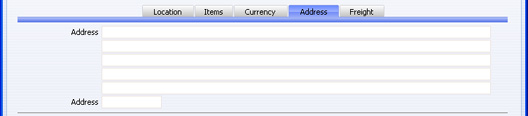
- Address
- Default taken from
Contact (Delivery Address)
- Enter the Supplier Address to which the goods are to be returned.
- If the Supplier is one with several Delivery Addresses (e.g. it has several branches), these can be recorded in the Delivery Addresses setting in the Sales Orders module. Use the 'Paste Special' list to select the correct one. The full Delivery Address will be brought in to the fields above. Usually, only Delivery Addresses for this Supplier and those with no Contact specified will be included in the 'Paste Special' list. If you would like the 'Paste Special' list to contain every Delivery Address, check the Paste All Delivery Addresses box in the Order Settings setting in the Sales Orders module.
Entering a Returned Goods to Supplier record - Freight Card
- Freight Code
- Paste Special
Freight Companies setting, Stock module
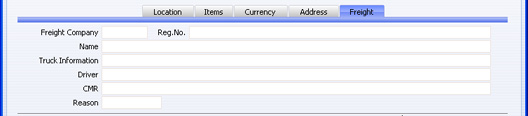
- The Freight Code refers to a record in the Freight Companies setting where information is stored regarding the courier or haulage companies that your business uses to transport goods.
- Enter the appropriate Freight Code of the Freight Company used for this Return. The Freight Company Registration Number, Freight Company, Truck Information, Driver and CMR Text will then be brought in from the Freight Companies setting. You can change them here for this Return only. For descriptions of these fields, please refer to the page describing that setting here.
- Enter the appropriate Freight Code of the Freight Company used for this Return. The Freight Company Registration Number, Freight Company, Truck Information, Driver and CMR Text will then be brought in from the Freight Companies setting. You can change them here for this Return only. For descriptions of these fields, please refer to the page describing that setting here.
- Reason
- Specify the reason for the Return.
Entering a Returned Goods to Supplier record - Comment Card
This page describes the fields on the 'Comment' card in the Returned Goods to Supplier record window. Please follow the links below for descriptions of the other cards:- Header
- 'Terms' card
- 'Items' card
- 'Currency' card
- 'Extra Costs' card
- 'Address' card
- 'Freight' card
- 'Comment' card

- Comment
- Any comment entered here (perhaps the reason for the return) will be shown in the 'Returned Goods to Supplier: Browse' window.
- The Comment field will remain editable after marking a Return as OK and saving.
The Returned Goods to Supplier register in Standard ERP:
- Introduction
- Entering a Returned Goods to Supplier record , including:
- Header
- 'Terms' card
- 'Items' card
- 'Currency' card
- 'Extra Costs' card
- 'Address' card
- 'Freight' card
- 'Comment' card
- Header
- Nominal Ledger Transactions from Returned Goods to Supplier Records
- Returned Goods to Supplier Variance
- Returning Goods to a Supplier when there is no Purchase Order
- Operations Menu
- Create Menu
- Row Menu
- Home page for Stock Module manual
- Home page for Standard ERP manual
Nominal Ledger Transactions from Returned Goods to Supplier transactions
When you approve and save a Returned Goods to Supplier record, a Nominal Ledger Transaction will be generated automatically if you have so determined in the Sub Systems setting in the Nominal Ledger and in the Number Series - Returned Goods to Supplier setting.The Stock Account credited by such Transactions is determined as follows:
- The Stock Account for the specified Location will be credited.
- If this is blank or if you have not specified a Location, and if you are using the Use Item Groups for Cost Accounts option in the Cost Accounting setting, the Stock Account for the Item Group to which the Item belongs will be credited.
- In all other cases, the Stock Account in the Account Usage Stock setting will be credited.
- If you are not using the Ret. Goods to Supplier A/C from Goods Receipt option in the Account Usage Stock setting, it will be the Ret. Goods to Suppliers Account in the same setting.
- If you are using the Ret. Goods to Supplier A/C from Goods Receipt option, it will be the Purchase Accruals Account from flip E of the relevant Goods Receipt row.
- If this is blank, you are using the Use Item Groups for Cost Accounts option in the Cost Accounting setting and the Item belongs to an Item Group, it will be the Purchase Accruals Account in the Item Group record. The appropriate Account for the Zone of the Supplier will be used.
- If you are not using the Use Item Groups for Cost Accounts option, the Item Group does not have a Purchase Accruals Account and/or the Item does not belongs to an Item Group, it will be the Purchase Accruals Account from the Account Usage Stock setting. The appropriate Account for the Zone of the Supplier will be used.
Objects are not shown in a Returned Goods to Supplier record, but those in the originating Purchase Order or Goods Receipt (both those on the 'Date' or 'Comment' cards respectively representing the Supplier and those on flips B or E respectively of the 'Items' card representing the Item) will be assigned to the debit posting to the Purchase Accruals or Returned Goods to Supplier Account and to the credit posting to the Stock Account.
Below is shown an example of a Nominal Ledger Transaction created from a Returned Goods to Supplier record:
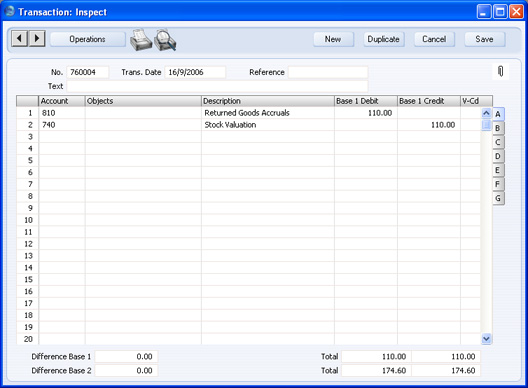
Once the Transaction has been generated, you can look at it straight away using the 'Open NL Transaction' function on the Operations menu (subject to access rights set in the Access Groups setting in the System module).
Returned Goods to Supplier Variance
When you return an Item to a Supplier, the calculation of the cost value of that Item should ideally satisfy two requirements:- The cost should be the same as the original purchase cost. This will be the value of any Credit Note that the Supplier sends you, and is the value that will allow the Purchase Accruals Account to balance,
- Returning an Item to its Supplier is one way of removing that Item from stock. The value of all removals from stock should be calculated using the usual Cost Model.
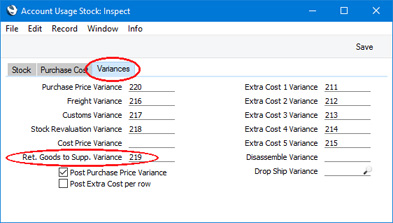
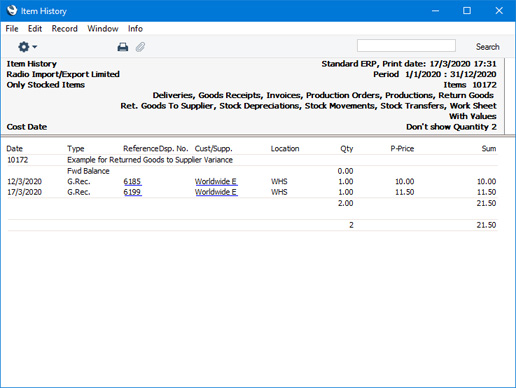
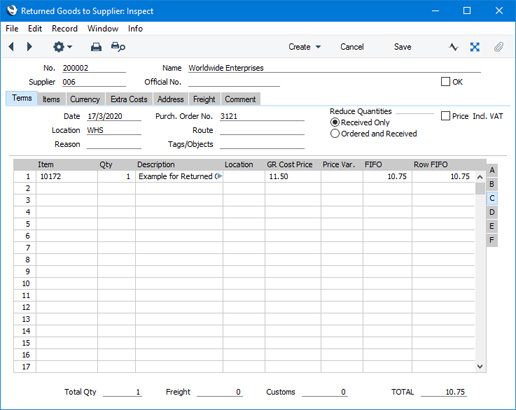
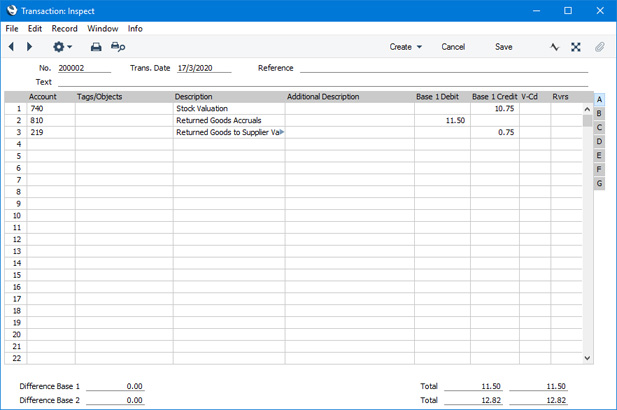
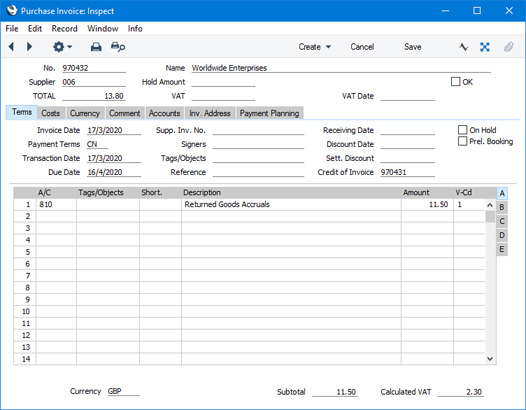
In a Credit Note created from the Returned Goods to Supplier record, the value will be the original purchase cost:
The Returned Goods to Supplier register in Standard ERP:
- Introduction
- Entering a Returned Goods to Supplier record
- Nominal Ledger Transactions from Returned Goods to Supplier Records
- Returned Goods to Supplier Variance
- Returning Goods to a Supplier when there is no Purchase Order
- Operations Menu
- Create Menu
- Row Menu
- Home page for Stock Module manual
- Home page for Standard ERP manual
Returning Goods when there is no Purchase Order
You can receive goods into stock by entering a Goods Receipt directly to the Goods Receipt register (i.e. without a Purchase Order). In this circumstance, because of the lack of a Purchase Order, if you return such goods to the Supplier, you cannot use the Returned Goods to Supplier register. Instead, you will have to remove the Items from stock using the Stock Depreciation register.Operations Menu
Operations Menu - Open NL Transaction
When you approve and save a Return, if so defined in the Sub Systems setting in the Nominal Ledger and in the Number Series - Returned Goods to Supplier setting, a Nominal Ledger Transaction will be created. This function allows you to view that Transaction.When you select this function, the Transaction will be opened in a new window.
You can use Access Groups to control who can use this function. To do this, deny access to the 'Open Transactions from Operations Menu' Action.
Create Menu - Returned Goods to Supplier
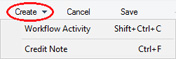
Please follow the link below for details about the function on this menu.
The Returned Goods to Supplier register in Standard ERP:
- Introduction
- Entering a Returned Goods to Supplier record
- Nominal Ledger Transactions from Returned Goods to Supplier Records
- Returned Goods to Supplier Variance
- Returning Goods to a Supplier when there is no Purchase Order
- Operations Menu
- Create Menu
- Row Menu
- Home page for Stock Module manual
- Home page for Standard ERP manual
Operations Menu - Create Credit Note
When you have created a Purchase Invoice from a Purchase Order and you then return the goods without requiring a replacement, use this function to create a Credit Note. You must first have approved and saved the Return, and you must first have created an approved Purchase Invoice from the Purchase Order.When you select the function, a new record will be created in the Purchase Invoice register and opened in a new window, entitled 'Purchase Invoice: Inspect'. This means that it has been created and saved and is being opened for amendment and approval.
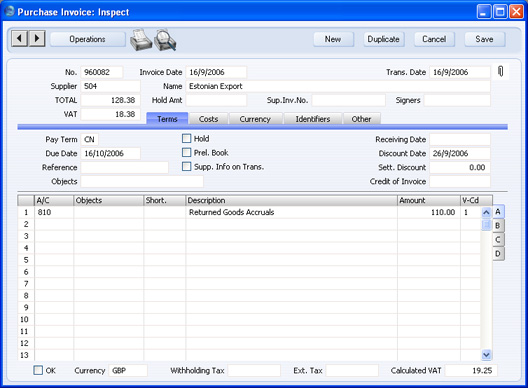
The Creditor Account will be taken from the original Purchase Invoice. The VAT Code on each row will be taken from the appropriate Purchase Order row (flip A). The value in the Calc VAT field in the footer will be calculated using the VAT Codes from each row.
As soon as you create the Credit Note, the invoiced quantity on flip C of the originating Purchase Order will be updated.
When the Credit Note is complete, click the OK check box and save. This signifies that the Credit Note has been approved. Associated transactions in the Nominal Ledger will now be raised and you will no longer be able to modify the Credit Note.
You cannot use this function to create a Credit Note in the following circumstances:
- You have created more than one Purchase Invoice from a Purchase Order. In this case, you cannot use this function to create a Credit Note, because HansaWorld Enterprise will not be able to establish which Purchase Invoice is to be credited. Instead, you should enter the Credit Note directly to the Purchase Invoice register, perhaps by using the 'Create Credit Note' Operations menu function from the original Purchase Invoice: this will create a Credit Note with appropriate Payment Terms and a reference to the Purchase Invoice being credited.
- You are using the Consolidate Items to Supplier Cost Account option in the Purchase Invoice Settings setting. Again, use the 'Create Credit Note' function from the Operations menu of the original Purchase Invoice. Alternatively, use the 'Create Purchase Invoice' function from the Operations menu of the Purchase Order screen to create an Invoice for a negative quantity, effectively crediting the original Invoice.
To close the screen and return to the Return, click the close box. You will be asked if you want to save any changes.
Row Menu - Returned Goods to Supplier
The matrix in the Returned Goods to Supplier window has its own menu, which contains a function that refers to or affects an individual row in the matrix. This is sometimes known as the "Row Menu".If you are using Windows or macOS, you can open the Row menu by first clicking in any field in the row in question (i.e. the row to which the function is to be applied), and then right-clicking (Windows) or Ctrl-clicking (macOS) the row number (on the left of the row). A menu will appear, where you can select the function:
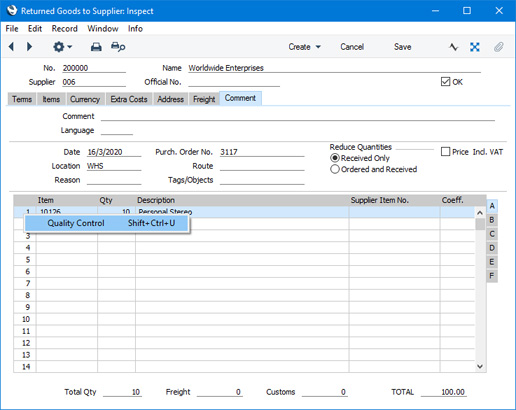
Please follow the links below for details about the function on the Row menu:
The Returned Goods to Supplier register in Standard ERP:
- Introduction
- Entering a Returned Goods to Supplier record
- Nominal Ledger Transactions from Returned Goods to Supplier Records
- Returned Goods to Supplier Variance
- Returning Goods to a Supplier when there is no Purchase Order
- Operations Menu
- Create Menu, including:
- Row Menu
- Home page for Stock Module manual
- Home page for Standard ERP manual
Row Menu - Returned Goods to Supplier - Quality Control
This page describes the 'Quality Control' function on the Row menu in the Returned Goods to Supplier record window. If you are using iOS or Android, the 'Quality Control' function is on the Tools menu (with 'wrench' icon).---
One reason for needing to return an Item with a Serial Number and a Best Before Date to its Supplier might be because it failed a quality control test. You can use the 'Quality Control' function to record the result of this test.
To use this function, first place the insertion point in the Return row containing the Item that has been tested. Then open the Row menu by right-clicking (Windows) or ctrl-clicking (macOS) the row number. When the Row menu opens, select 'Quality Control'. If you are using iOS or Android, select 'Quality Control' from the Tools menu (with 'wrench' icon). A 'Batch Quality Control: New' window will open, allowing you to enter the details of the test. In particular, use the Result field to connect the Batch Quality Control record to a record in the Batch Status setting. After you mark the Batch Quality Control record as OK and save, this Batch Status record will determine whether you will be warned when using the Item/Serial Number combination in an outgoing stock transaction, or whether you will be prevented from using the Item/Serial Number altogether (in the case of a Return you will usually choose a Batch Status that prevents the sale of the Item/Serial Number combination).
Please refer here for more details about the 'Quality Control' function and about alternative methods that you can use to record the result of a quality control test on the Item/Serial Number.
---
The Returned Goods to Supplier register in Standard ERP:
- Introduction
- Entering a Returned Goods to Supplier record
- Nominal Ledger Transactions from Returned Goods to Supplier Records
- Returned Goods to Supplier Variance
- Returning Goods to a Supplier when there is no Purchase Order
- Operations Menu
- Create Menu
- Row Menu, including:
- Quality Control
- Home page for Stock Module manual
- Home page for Standard ERP manual