Introduction to Reports in the Nominal Ledger
As with all modules, to print a report in the Nominal Ledger, click (Windows/macOS) or tap (iOS/Android) the [Reports] button in the Navigation Centre. You can also use the Ctrl-R (Windows) or ⌘-R (macOS) keyboard shortcuts. The 'Reports' window will open, listing the reports that are available in the Nominal Ledger: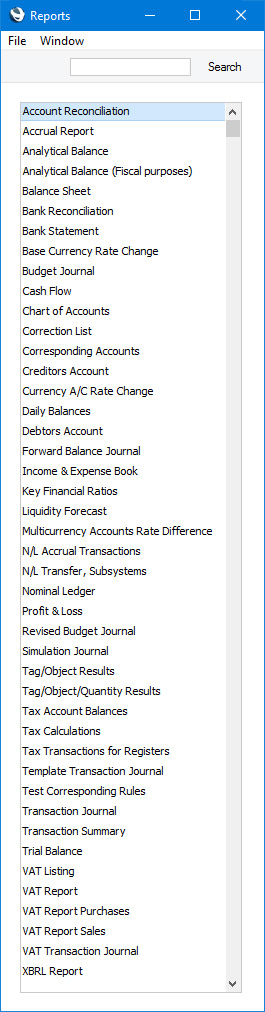
You can often report on a selection range, such as a range of Accounts, or a range of Items. To do this, enter the lowest and highest values of the range, separated by a colon. For example, to report on Accounts 001 to 010, enter "001:010" in the Account field. Depending on the field, the sort used might be alpha or numeric. In the case of an alpha sort, a range of 1:2 would also include 100, 10109, etc.
Use the Media options at the bottom of the specification window to determine the print destination of the report. The default is to print to screen. You can initially print to screen and subsequently send the report to a printer by clicking the Printer icon at the top of the window (Windows/macOS) or by selecting 'Recalculate and Print' from the Operations menu. If you are using iOS or Android, you will find this function on the Tools menu (with 'wrench' icon). You can also print the report to disk as a text file. This will be useful if you want to format the report in your house style before printing.
Once you have entered the reporting criteria and have chosen a print destination, click or tap [Run].
If you print a report to screen, you can use the 'Recalculate' command on the Operations menu of the report window to update the report after making alterations to background data. The 'Reopen Report Specification' command on the same menu allows you to produce a new report using different reporting criteria. If you are using iOS or Android, the 'Recalculate' function will be on the Tools menu. There will be no 'Reopen Report Specification' command: tap < to go back to the specification window instead.
Please follow the links below for details about each report:
- Introduction
- Definition of Nominal Ledger Reports
- Drill-down
- The Operations Menu
- Account Reconciliation
- Accrual Report
- Analytical Balance
- Analytical Balance (Fiscal purposes)
- Balance Sheet
- Bank Reconciliation
- Bank Statement
- Bank Transactions
- Base Currency Rate Change
- Budget Journal
- Chart of Accounts
- Correction List
- Corresponding Accounts
- Creditors Account
- Currency A/C Rate Change
- Daily Balances
- Debtors Account
- Forward Balance Journal
- Income & Expense Book
- Key Financial Ratios
- Liquidity Forecast
- Multicurrency Accounts Rate Difference
- N/L Accrual Transactions
- N/L Transfer, Subsystems
- Nominal Ledger
- Profit & Loss
- Revised Budget Journal
- Simulation Journal
- Tag/Object Results
- Tag/Object/Quantity Results
- Tax Account Balances
- Tax Calculations
- Tax Transactions for Registers
- Template Transaction Journal
- Test Corresponding Rules
- Transaction Journal
- Transaction Summary
- Trial Balance
- VAT Listing
- VAT Report
- VAT Report Purchases
- VAT Report Sales
- VAT Transaction Journal
- XBRL Report
Go back to:
- Home page for Nominal Ledger manual
- Home page for Standard ERP manual
Reports - Definition of Nominal Ledger Reports
You can change the design, appearance and format of some Nominal Ledger reports to suit your specific requirements. This is known as changing the report's definition. The reports for which this facility is available are the Balance Sheet, Cash Flow report, Key Financial Ratios, Profit & Loss Report and VAT Report.To change a report definition, first ensure you are in the Nominal Ledger. Then, if you are using Windows or macOS, click the [Settings] button in the Navigation Centre. If you are using iOS or Android, select 'Settings' from the 'Tools' menu (with 'wrench' icon). Double-click or tap 'Report Settings' in the subsequent list. Then, highlight a report name in the list on the left-hand side of the 'Report Settings' window and click or tap the [Definition] button. The subsequent definitions windows are described on the pages describing the individual reports (linked in the list of five reports above).
! | If you have modified the standard Chart of Accounts or imported your own, you must change the Nominal Ledger report definitions accordingly. |
---
Reports in the Nominal Ledger:
- Introduction
- Definition of Nominal Ledger Reports
- Drill-down
- The Operations Menu
- Account Reconciliation
- Accrual Report
- Analytical Balance
- Analytical Balance (Fiscal purposes)
- Balance Sheet
- Bank Reconciliation
- Bank Statement
- Bank Transactions
- Base Currency Rate Change
- Budget Journal
- Chart of Accounts
- Correction List
- Corresponding Accounts
- Creditors Account
- Currency A/C Rate Change
- Daily Balances
- Debtors Account
- Forward Balance Journal
- Income & Expense Book
- Key Financial Ratios
- Liquidity Forecast
- Multicurrency Accounts Rate Difference
- N/L Accrual Transactions
- N/L Transfer, Subsystems
- Nominal Ledger
- Profit & Loss
- Revised Budget Journal
- Simulation Journal
- Tag/Object Results
- Tag/Object/Quantity Results
- Tax Account Balances
- Tax Calculations
- Tax Transactions for Registers
- Template Transaction Journal
- Test Corresponding Rules
- Transaction Journal
- Transaction Summary
- Trial Balance
- VAT Listing
- VAT Report
- VAT Report Purchases
- VAT Report Sales
- VAT Transaction Journal
- XBRL Report
Go back to:
- Home page for Nominal Ledger manual
- Home page for Standard ERP manual
Reports - Drill-down
Many reports include a drill-down feature when you print them to screen. For example, when you have a Profit & Loss statement on screen, you can click (Windows/macOS) or tap (iOS/Android) on any of the Account numbers in the report. Subject to you having the necessary access rights, the Nominal Ledger report for the same Account and period will be opened in a separate window, listing the Transactions that contribute to the account balance in the Profit & Loss statement. If you then click or tap on one of the Transaction Numbers in the Nominal Ledger report, the Transaction record will open, showing all the details recorded for the event. This example is illustrated below: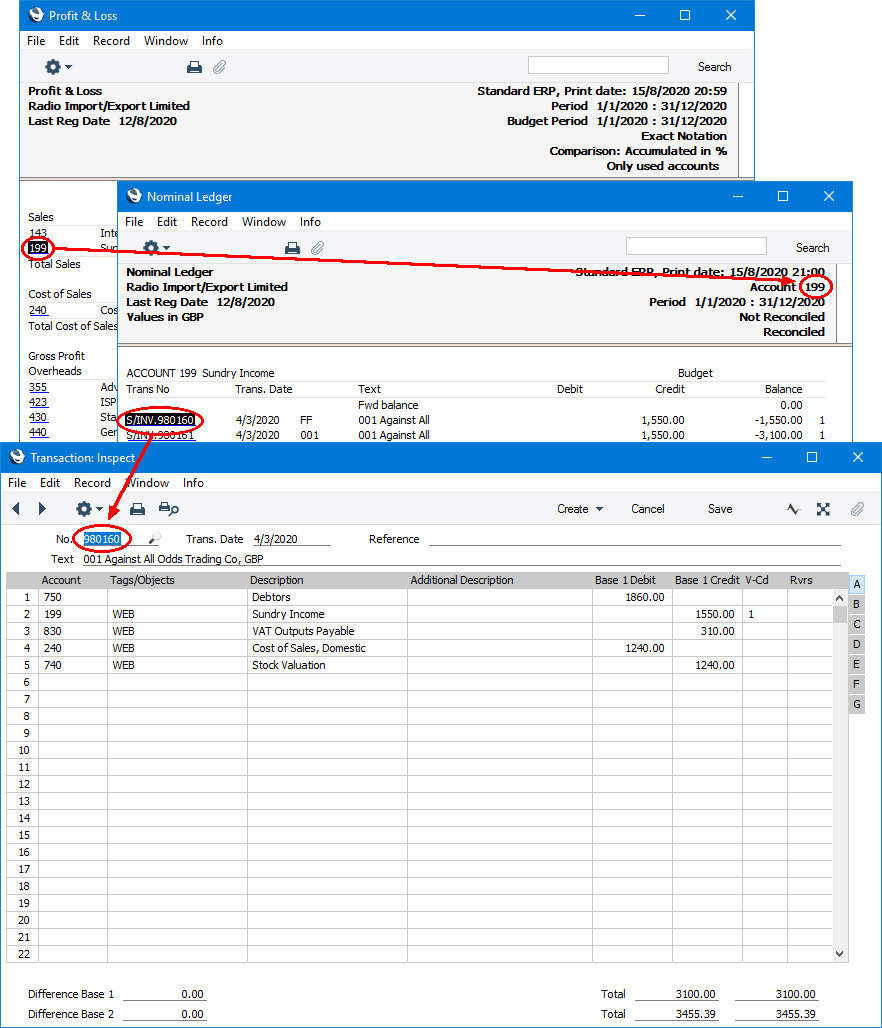
---
Reports in the Nominal Ledger:
- Introduction
- Definition of Nominal Ledger Reports
- Drill-down
- The Operations Menu
- Account Reconciliation
- Accrual Report
- Analytical Balance
- Analytical Balance (Fiscal purposes)
- Balance Sheet
- Bank Reconciliation
- Bank Statement
- Bank Transactions
- Base Currency Rate Change
- Budget Journal
- Chart of Accounts
- Correction List
- Corresponding Accounts
- Creditors Account
- Currency A/C Rate Change
- Daily Balances
- Debtors Account
- Forward Balance Journal
- Income & Expense Book
- Key Financial Ratios
- Liquidity Forecast
- Multicurrency Accounts Rate Difference
- N/L Accrual Transactions
- N/L Transfer, Subsystems
- Nominal Ledger
- Profit & Loss
- Revised Budget Journal
- Simulation Journal
- Tag/Object Results
- Tag/Object/Quantity Results
- Tax Account Balances
- Tax Calculations
- Tax Transactions for Registers
- Template Transaction Journal
- Test Corresponding Rules
- Transaction Journal
- Transaction Summary
- Trial Balance
- VAT Listing
- VAT Report
- VAT Report Purchases
- VAT Report Sales
- VAT Transaction Journal
- XBRL Report
Go back to:
- Home page for Nominal Ledger manual
- Home page for Standard ERP manual
Reports - Operations Menu
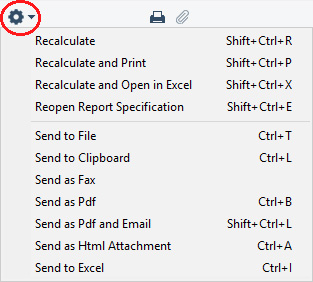
If you are using Windows or macOS, you can open the Operations menu by clicking the button with the 'cog' icon (shown highlighted in the illustration above). If you are using iOS or Android, you can access the Operations menu functions through the Tools menu (with 'wrench' icon).
The 'Recalculate' command will immediately recalculate the report to include any changes you have made to records shown in the report and to add to the report any records created. since the report was last calculated. The 'Reopen Report Specification' command on the same menu allows you to produce a new report using different reporting criteria. 'Reopen Report Specification' will not be available if you are using iOS or Android: tap < to go back to the specification window instead.
The other commands on the Operations/Tools menu allow you to send the report to various print destinations.
---
Reports in the Nominal Ledger:
- Introduction
- Definition of Nominal Ledger Reports
- Drill-down
- The Operations Menu
- Account Reconciliation
- Accrual Report
- Analytical Balance
- Analytical Balance (Fiscal purposes)
- Balance Sheet
- Bank Reconciliation
- Bank Statement
- Bank Transactions
- Base Currency Rate Change
- Budget Journal
- Chart of Accounts
- Correction List
- Corresponding Accounts
- Creditors Account
- Currency A/C Rate Change
- Daily Balances
- Debtors Account
- Forward Balance Journal
- Income & Expense Book
- Key Financial Ratios
- Liquidity Forecast
- Multicurrency Accounts Rate Difference
- N/L Accrual Transactions
- N/L Transfer, Subsystems
- Nominal Ledger
- Profit & Loss
- Revised Budget Journal
- Simulation Journal
- Tag/Object Results
- Tag/Object/Quantity Results
- Tax Account Balances
- Tax Calculations
- Tax Transactions for Registers
- Template Transaction Journal
- Test Corresponding Rules
- Transaction Journal
- Transaction Summary
- Trial Balance
- VAT Listing
- VAT Report
- VAT Report Purchases
- VAT Report Sales
- VAT Transaction Journal
- XBRL Report
Go back to:
- Home page for Nominal Ledger manual
- Home page for Standard ERP manual
Account Reconciliation
This page describes the Account Reconciliation report in the Nominal Ledger.---
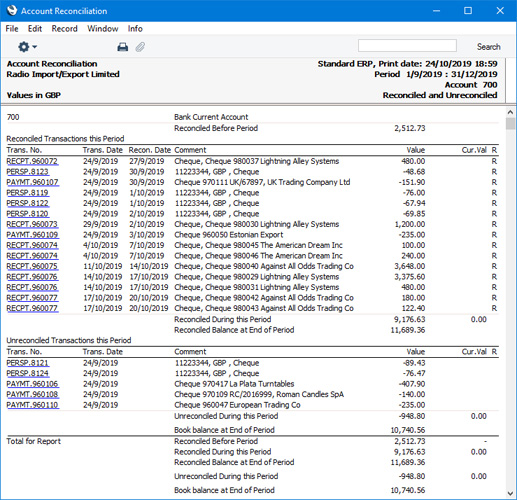
The Account Reconciliation report is one of two reports in the Nominal Ledger that you can use to help with the task of reconciling bank statements, the other being the Bank Reconciliation report. Use the Account Reconciliation register to reconcile bank statements.
The Account Reconciliation report is a list of Transaction rows (i.e. individual account postings) for the report period in date order, showing for each the Account, Transaction Number and Date, Amount in either Base Currency (as selected) and Amount in foreign Currency (where appropriate). You can choose whether the report will list reconciled or unreconciled postings or both. If you choose both, reconciled or unreconciled postings will be shown in separate sections.
You can also produce this report from the 'Account Reconciliation' window, by selecting 'Account Reconciliation Report' from the Operations menu (with 'cog' icon, Windows/macOS) or Tools menu (with 'wrench' icon, iOS/Android). When you produce the report in this way, the specification window will not appear. Instead, the report will be produced for the Account, Tags/Objects and Reconciliation Code that you have entered in the 'Account Reconciliation' window, and the selection of the Reconciled and Unreconciled options will also be taken from the 'Account Reconciliation' window. You should therefore supply this information in the 'Account Reconciliation' window before producing the report.
When printed to screen, the Account Reconciliation report has the Standard ERP Drill-down feature. Click (Windows/macOS) or tap (iOS/Android) on a Transaction Number in the report to open a Nominal Ledger Transaction. If the Nominal Ledger Transaction was created from a Sub System record (e.g. from a Receipt or Payment), you can (subject to access rights) then open the Sub System record by selecting 'Open Subsystem Record' from the Operations or Tools menu.
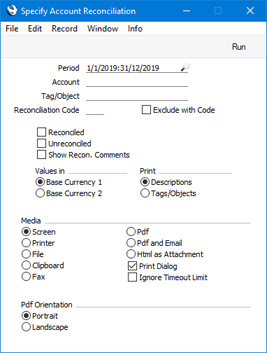
- Period
- Paste Special
Reporting Periods setting, System module
- The report will list the postings (i.e. the Transaction rows) entered during the period that you specify here. The default value is the first period in the Reporting Periods setting.
- Using the Reconciled and Unreconciled options below, you can choose whether reconciled or unreconciled postings or both will be included in the report. For a reconciled posting to appear in the report, you must have entered it and reconciled it during this period. The listing of unreconciled postings will depend on whether you are using the Ignore Period Start Date for Unreconciled Transactions option in the Reconciliation Settings setting. If you are not using this option, an unreconciled posting will appear in the report if you entered it during this period and reconciled it after this period or not reconciled it at all. If you are using this option, the start of the period will be ignored when listing unreconciled postings. All unreconciled postings up to the end of the specified period will be listed.
- Using the Reconciled and Unreconciled options below, you can choose whether reconciled or unreconciled postings or both will be included in the report. For a reconciled posting to appear in the report, you must have entered it and reconciled it during this period. The listing of unreconciled postings will depend on whether you are using the Ignore Period Start Date for Unreconciled Transactions option in the Reconciliation Settings setting. If you are not using this option, an unreconciled posting will appear in the report if you entered it during this period and reconciled it after this period or not reconciled it at all. If you are using this option, the start of the period will be ignored when listing unreconciled postings. All unreconciled postings up to the end of the specified period will be listed.
- Accounts
- Paste Special
Account register, Nominal Ledger/System module
- Range Reporting Alpha
- Use this field to limit the report to Transaction rows posting to a certain Account, or range of Accounts. Usually you will only need to specify your Bank Account(s) or other reconcilable Account here, otherwise the report will be much longer than necessary.
- In multi-user systems, you can use Access Groups to prevent the postings to sensitive Accounts such as salary Accounts being listed in this report, depending on the user producing the report. To do this, list the sensitive Accounts in the Block A/Cs field in each Access Group as appropriate.
- Use this field to limit the report to Transaction rows posting to a certain Account, or range of Accounts. Usually you will only need to specify your Bank Account(s) or other reconcilable Account here, otherwise the report will be much longer than necessary.
- Tags/Objects
- Paste Special
Tag/Object register, Nominal Ledger/System module
- Specify a Tag/Object here if you need the report to list Transaction rows with a particular Tag/Object. If you enter a number of Tags/Objects separated by commas, only those Transaction rows with all the Tags/Objects that you have listed will be shown in the report.
- Recon. Code, Exclude with Code
- If you want to list reconciled Transaction postings with a particular Recon. Code, enter that Recon. Code here. To list all reconciled postings except those with a particular Recon. Code, select the Exclude With Code option as well.
- Reconciliation Codes are arbitrary codes that you can use to identify postings that you have reconciled on a particular day or from a particular bank statement. Specifying a Reconciliation Code here will therefore allow you to list those postings if you need to check them at a later date.
- This field and check box will have no effect if you are only listing unreconciled postings.
- Reconciliation Codes are arbitrary codes that you can use to identify postings that you have reconciled on a particular day or from a particular bank statement. Specifying a Reconciliation Code here will therefore allow you to list those postings if you need to check them at a later date.
- Reconciled
- Select this option if you need reconciled postings to be included in the report.
- Unreconciled
- Select this option if you need unreconciled postings to be included in the report. You must select at least one of the Reconciled and Unreconciled options or the report will be blank.
- Show Recon. Comments
- When you reconcile each posting, you can mark it with a Reconciliation Code. The Reconciliation Code that you use might be connected to a longer description in the Reconciliation Codes setting. Select this option if you want these longer descriptions to be included in the report.
- Values in
- If you are using the Dual-Base system, use these options to specify whether the values in the report are to be shown in Base Currency 1 or 2.
- If you are not using the Dual-Base system, use the Base Currency 1 option to produce a report in your home Currency.
- If you are not using the Dual-Base system, use the Base Currency 1 option to produce a report in your home Currency.
- Print
- You can choose to have Descriptions or Tag/Object Codes included in the report. If you choose the
Descriptions option, the Description from each Transaction row will be shown together with the Text from its Transaction header.
Reports in the Nominal Ledger:
- Introduction
- Definition of Nominal Ledger Reports
- Drill-down
- The Operations Menu
- Account Reconciliation
- Accrual Report
- Analytical Balance
- Analytical Balance (Fiscal purposes)
- Balance Sheet
- Bank Reconciliation
- Bank Statement
- Bank Transactions
- Base Currency Rate Change
- Budget Journal
- Cash Flow
- Chart of Accounts
- Correction List
- Corresponding Accounts
- Creditors Account
- Currency A/C Rate Change
- Daily Balances
- Debtors Account
- Forward Balance Journal
- Income & Expense Book
- Key Financial Ratios
- Liquidity Forecast
- Multicurrency Accounts Rate Difference
- N/L Accrual Transactions
- N/L Transfer, Subsystems
- Nominal Ledger
- Profit & Loss
- Revised Budget Journal
- Simulation Journal
- Tag/Object Results
- Tag/Object/Quantity Results
- Tax Account Balances
- Tax Calculations
- Tax Transactions for Registers
- Template Transaction Journal
- Test Corresponding Rules
- Transaction Journal
- Transaction Summary
- Trial Balance
- VAT Listing
- VAT Report
- VAT Report Purchases
- VAT Report Sales
- VAT Transaction Journal
- XBRL Report
Go back to:
- Home page for Nominal Ledger manual
- Home page for Standard ERP manual
Accrual Report
This page describes the Accrual Report in the Nominal Ledger.---
The Accrual Report is a list of Invoices in which there is at least one row with an N/L Accrual specified on flip C (in the case of Purchase Invoices) or flip B (in the case of Sales Invoices). The report lists the accrued postings for each Invoice, showing whether each individual posting has already been debited to a Purchase Account or credited to a Sales Account. It therefore provides an indication of the value of accrued postings that have not yet been transferred from Accrual Accounts to Sales or Purchase Accounts, and also provides a timetable for when they will be transferred. Please refer here or more details about N/L Accruals.
When printed to screen, the Accrual Report has the Standard ERP Drill-down feature. Click (Windows/macOS) or tap (iOS/Android) on an Invoice Number in the report to open the Nominal Ledger Transaction for that Invoice. You can then open the Invoice itself by selecting 'Open Subsystem Record' from the Operations menu (Windows/macOS) or Tools menu (iOS/Android). You can also click or tap on a Simulation Number in the report to open an individual Accrual Simulation record.
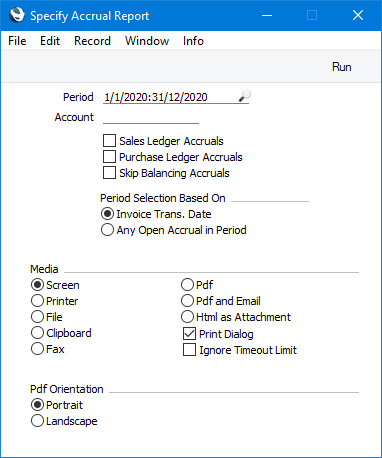
- Period
- Paste Special
Reporting Periods setting, System module
- The effect of the report period will depend on which of the Period Selection Based On options below you have selected, as follows:
- Invoice Trans. Date
- The report will list Purchase and Sales Invoices whose Transaction Dates fall in the period specified here and in which there is at least one row with an N/L Accrual specified on flip C (in the case of Purchase Invoices) or flip B (in the case of Sales Invoices). For each Invoice, all accrual postings (i.e. those that are scheduled to be transferred from Accrual Accounts to Sales or Purchase Accounts within this period and those that have been transferred within this period) will be listed.
- Any Open Accrual in Period
- The report will list accrual postings that are scheduled to be transferred from Accrual Accounts to Sales or Purchase Accounts within the period specified here.
- Invoice Trans. Date
- Account
- Paste Special
Account register, Nominal Ledger/System module
- Range Reporting Alpha
- If you specify an Account (or range of Accounts) here, the report will list Invoices that use that Account as an Accrual Account. This is the Account that is used as the Prel. Account in the N/L Accrual record specified on flip C of an accrued Purchase Invoice row or on flip B of an accrued Sales Invoice row.
- If you specify an Account (or range of Accounts) here, the report will list Invoices that use that Account as an Accrual Account. This is the Account that is used as the Prel. Account in the N/L Accrual record specified on flip C of an accrued Purchase Invoice row or on flip B of an accrued Sales Invoice row.
- Sales Ledger Accruals
- Select this option if you would like accrued Sales Invoices to be listed in the report.
- Purchase Ledger Accruals
- Select this option if you would like accrued Purchase Invoices to be listed in the report.
- Skip Balancing Accruals
- By default, every accrued Invoice in the selected Ledger and from the specified period will be listed in the report. If you select this option, the report will only list Invoices where the accrued value will not have been transferred fully from the Accrual Account to the Sales or Purchase Account by the end of the report period.
- In the example illustrations below, there are postings that are scheduled to be transferred after the end of the report period, so the example Purchase Invoice will be included in the report if it is produced using this option.
- In the example illustrations below, there are postings that are scheduled to be transferred after the end of the report period, so the example Purchase Invoice will be included in the report if it is produced using this option.
- Period Selection Based On
- These options determine how the period specified above will be used when producing the report. Please refer to the description of the Period field above for details.
- These options also affect the appearance of the report, as follows:
- Invoice Trans. Date
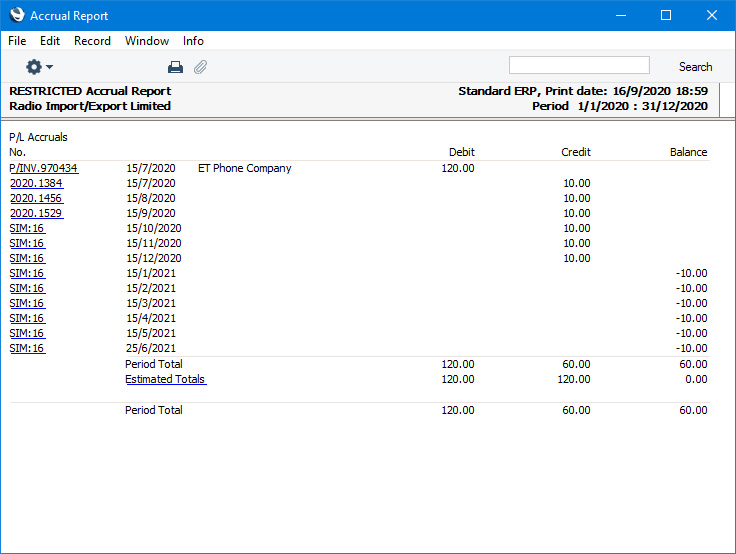
- In this example, a Purchase Invoice was created on July 15. The full value to be accrued was 120.00 as shown in the Debit column in the first line.
- The first three accrual postings have been transferred from the Accrual Account to the Purchase Account. These are shown on the next three lines, together with Transaction Numbers and with values in the Credit column.
- The next three accrual postings have not yet been transferred. These are shown on the next three lines, together with the Simulation Number and with values in the Credit column.
- The final six postings have also not yet been transferred, but these are scheduled to be transferred after the end of the report period. Their values are therefore shown in the Balance column.
- The first three accrual postings have been transferred from the Accrual Account to the Purchase Account. These are shown on the next three lines, together with Transaction Numbers and with values in the Credit column.
- Any Open Accrual in Period
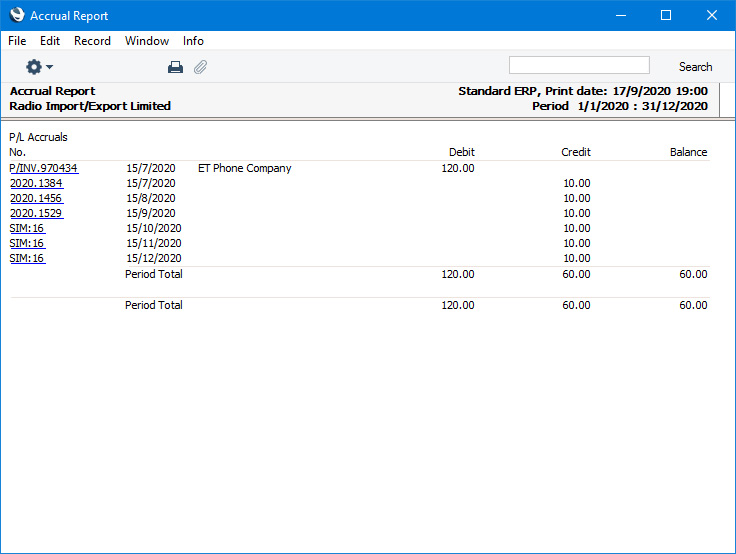
- Using this option, only the accrual postings that were transferred or are scheduled to be transferred from the Accrual Account to the Purchase Account during the report period will be included in the report.
- These options also affect the appearance of the report, as follows:
Reports in the Nominal Ledger:
- Introduction
- Definition of Nominal Ledger Reports
- Drill-down
- The Operations Menu
- Account Reconciliation
- Accrual Report
- Analytical Balance
- Analytical Balance (Fiscal purposes)
- Balance Sheet
- Bank Reconciliation
- Bank Statement
- Bank Transactions
- Base Currency Rate Change
- Budget Journal
- Chart of Accounts
- Correction List
- Corresponding Accounts
- Creditors Account
- Currency A/C Rate Change
- Daily Balances
- Debtors Account
- Forward Balance Journal
- Income & Expense Book
- Key Financial Ratios
- Liquidity Forecast
- Multicurrency Accounts Rate Difference
- N/L Accrual Transactions
- N/L Transfer, Subsystems
- Nominal Ledger
- Profit & Loss
- Revised Budget Journal
- Simulation Journal
- Tag/Object Results
- Tag/Object/Quantity Results
- Tax Account Balances
- Tax Calculations
- Tax Transactions for Registers
- Template Transaction Journal
- Test Corresponding Rules
- Transaction Journal
- Transaction Summary
- Trial Balance
- VAT Listing
- VAT Report
- VAT Report Purchases
- VAT Report Sales
- VAT Transaction Journal
- XBRL Report
Go back to:
- Home page for Nominal Ledger manual
- Home page for Standard ERP manual
Analytical Balance
This page describes the Analytical Balance report in the Nominal Ledger.---
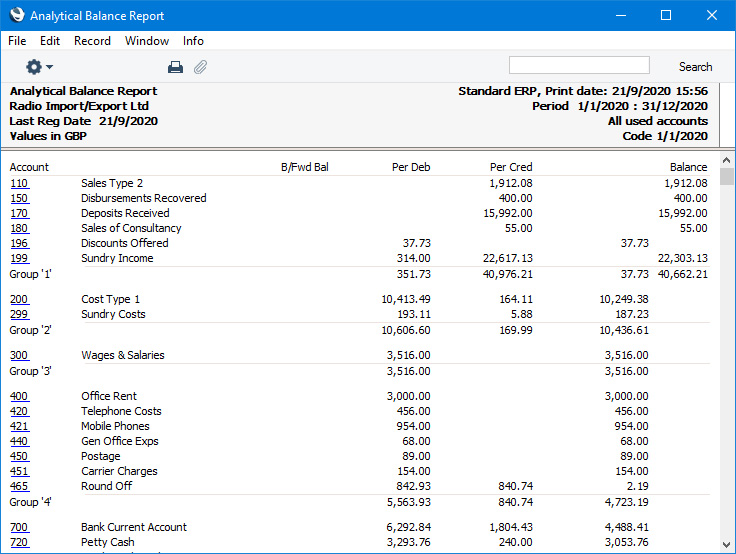
This report is similar to the Trial Balance, but with the addition of debit and credit balances for each Account. The paper printout in addition shows the accumulated balances for the financial year.
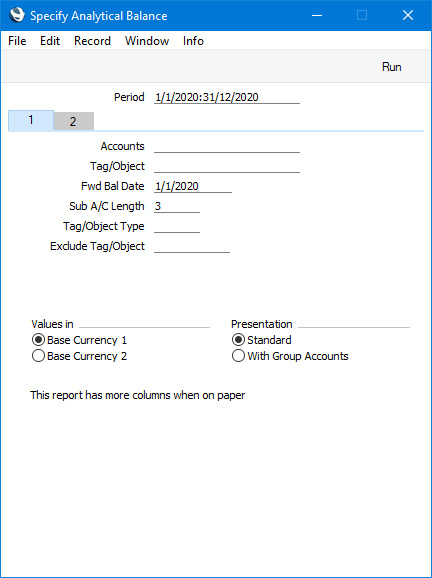
Header
- Period
- Paste Special
Reporting Periods setting, System module
- Enter the period to be covered by the report. The Account balances in the report will be calculated from postings (i.e. from Transaction rows) recorded during the period specified here. The default value is the first period in the Reporting Periods setting.
Card 1
- Accounts
- Paste Special
Account register, Nominal Ledger/System module
- Range Reporting Alpha
- Enter an Account Number or a range of Numbers separated by a colon (:) here if you would like specific Accounts to be listed in the report.
- Enter an Account Number or a range of Numbers separated by a colon (:) here if you would like specific Accounts to be listed in the report.
- Tag/Object
- Paste Special
Tag/Object register, Nominal Ledger/System module
- Enter a Tag/Object here if you want the balances in the report to be calculated from postings with a particular Tag/Object only. Unlike most Nominal Ledger reports, you can only enter a single Tag/Object here: if you enter a number of Tags/Objects separated by commas, the report will be empty.
- Fwd Bal Date
- Specify here the date for which the Brought Forward Balances (opening balances) in the report are to be calculated. The default is the first date of the default report period above.
- Sub A/C Length
- You should use this field together with the Sub A/C Totals option on card 2. Please refer to the description of this option below for details.
- Tag/Object Type
- Paste Special
Tag/Object Types setting, Nominal Ledger
- Enter a Tag/Object Type here if you want the balances in the report to be calculated from postings with Tags/Objects belonging to a particular Tag/Object Type only.
- Exclude Tag/Object
- Paste Special
Tag/Object register, Nominal Ledger/System module
- Enter a Tag/Object Code here if you need postings with that Tag/Object to be excluded from the Account balance calculations.
- Values in
- If you are using the Dual-Base system, use these options to specify whether values in the report are to be shown in Base Currency 1 or 2.
- If you are not using the Dual-Base system, use the Base Currency 1 option to produce a report in your home Currency.
- If you are not using the Dual-Base system, use the Base Currency 1 option to produce a report in your home Currency.
- Presentation
- You can produce two versions of this report:
- Standard
- This version of the report lists standard Accounts only.
- With Group Accounts
- This version of the report is designed for use in Portugal. It includes the hierarchical report headings (together with subtotals) defined using the Group Account option in Account records. Please refer here for full details.
- If you use this option together with the Opening Statement option on card 2, the report will show Balance Sheet Accounts only.
- Standard
Card 2
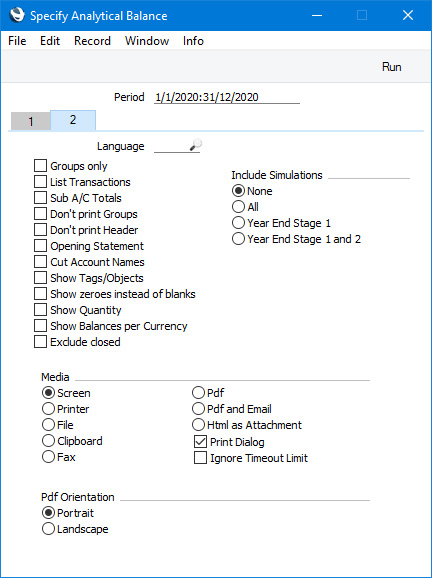
- Language
- Paste Special
Languages setting, System module
- You can produce the Analytical Balance report in different Languages: enter the required Language Code here. The appropriate translations of the Account Names will be taken from the 'Texts' card of each Account record.
- If you do not enter a Language here, but you have entered a Language in the Company Info setting in the System module, the report will be produced in that Language if you are using the Account Description in Company Language option in the Transaction Settings setting in the Nominal Ledger.
- If you do not enter a Language here, but you have entered a Language in the Company Info setting in the System module, the report will be produced in that Language if you are using the Account Description in Company Language option in the Transaction Settings setting in the Nominal Ledger.
- Groups only
- Using this option, the report will only show subtotals for groups of Accounts, grouped using the first digit of the Account Code. If you do not use this option, balances for each Account will be shown together with the group subtotals.
- List Transactions
- If you select this option, the Transaction Numbers of all Transactions that fall within the reporting period, together with debit and credit totals, will be listed at the end of the report.
- Sub A/C Totals
- This option takes the group totalling offered by the Groups only option above a stage further. It displays subtotals for groups of Accounts with the same initial digits. Specify the number of initial digits that should be the same in the Sub A/C Length field on card 1. For example, if the Sub A/C Length is 3, the balances for Accounts 4011, 4012 and 4014 will be shown as a subtotal. The single-digit group total (for Accounts starting with 4 in the example) will be shown as well.
- Don't print Groups
- By default, the report lists balances for each Account together with the group subtotals (subtotals of balances of Accounts with the same initial digit). Select this option if you don't want to print the group subtotals.
- Don't print Header
- Select this option if you want the report to be printed without a header.
- Opening Statement
- You can only use this option together with the With Group Accounts option card 1. This combination produces a report only showing opening balances (i.e. balances on the Fwd Bal Date specified on card 1) for Balance Sheet Accounts.
- Cut Account Names
- This option prints abbreviated versions of each Account Name (the first fifteen characters are printed).
- Show Tags/Objects
- Usually the report shows overall debit and credit balances for each Account. Select this option if you would like subtotal balances for each Tag/Object to be shown as well.
- Show zeros instead of blanks
- For each Account, the report will display debit and credit opening balances, debit and credit balances for the report period and debit and credit closing balances. If an Account only has balances on one side (e.g. only on the debit side), the other side will display blank values. Select this option if you would prefer "0.00" to be printed instead of the blanks.
- Show Quantity
- Select this option if you would like quantities (from flip G of each Transaction row) to be included in the report. Separate quantity figures will be shown for each Account, on a separate line. You can only use this option with the Standard option (it will have no effect if you use the With Group Accounts option).
- Show Balances per Currency
- Select this option if you would like balances in Currency to be shown for each Account (in addition to the overall balances). You can only use this option with the Standard option (it will have no effect if you use the With Group Accounts option).
- Exclude closed
- Select this option if you would like Closed Accounts to be excluded from the report. You can only use this option with the With Group Accounts option (Closed Accounts will always be excluded when using the Standard option).
- Include Simulations
- Choose one of these options if you need simulated transactions from the Simulation register to be included in the report. If you choose the All option, Simulation rows in which the Status is "Invalid" or "Transferred" Status will not be included.
Reports in the Nominal Ledger:
- Introduction
- Definition of Nominal Ledger Reports
- Drill-down
- The Operations Menu
- Account Reconciliation
- Accrual Report
- Analytical Balance
- Analytical Balance (Fiscal purposes)
- Balance Sheet
- Bank Reconciliation
- Bank Statement
- Bank Transactions
- Base Currency Rate Change
- Budget Journal
- Chart of Accounts
- Correction List
- Corresponding Accounts
- Creditors Account
- Currency A/C Rate Change
- Daily Balances
- Debtors Account
- Forward Balance Journal
- Income & Expense Book
- Key Financial Ratios
- Liquidity Forecast
- Multicurrency Accounts Rate Difference
- N/L Accrual Transactions
- N/L Transfer, Subsystems
- Nominal Ledger
- Profit & Loss
- Revised Budget Journal
- Simulation Journal
- Tag/Object Results
- Tag/Object/Quantity Results
- Tax Account Balances
- Tax Calculations
- Tax Transactions for Registers
- Template Transaction Journal
- Test Corresponding Rules
- Transaction Journal
- Transaction Summary
- Trial Balance
- VAT Listing
- VAT Report
- VAT Report Purchases
- VAT Report Sales
- VAT Transaction Journal
- XBRL Report
Go back to:
- Home page for Nominal Ledger manual
- Home page for Standard ERP manual
Analytical Balance (Fiscal purposes)
The Analytical Balance (Fiscal purposes) report is similar to the Analytical Balance, with the difference that the Groups only and With Group Accounts options will produce reports in which figures are printed without the thousands separator (e.g. 1,000.00 is printed as 1000.00). This format is required by the fiscal authorities in Portugal.Please refer to the description of the Analytical Balance report for full details.
---
Reports in the Nominal Ledger:
- Introduction
- Definition of Nominal Ledger Reports
- Drill-down
- The Operations Menu
- Account Reconciliation
- Accrual Report
- Analytical Balance
- Analytical Balance (Fiscal purposes)
- Balance Sheet
- Bank Reconciliation
- Bank Statement
- Bank Transactions
- Base Currency Rate Change
- Budget Journal
- Chart of Accounts
- Correction List
- Corresponding Accounts
- Creditors Account
- Currency A/C Rate Change
- Daily Balances
- Debtors Account
- Forward Balance Journal
- Income & Expense Book
- Key Financial Ratios
- Liquidity Forecast
- Multicurrency Accounts Rate Difference
- N/L Accrual Transactions
- N/L Transfer, Subsystems
- Nominal Ledger
- Profit & Loss
- Revised Budget Journal
- Simulation Journal
- Tag/Object Results
- Tag/Object/Quantity Results
- Tax Account Balances
- Tax Calculations
- Tax Transactions for Registers
- Template Transaction Journal
- Test Corresponding Rules
- Transaction Journal
- Transaction Summary
- Trial Balance
- VAT Listing
- VAT Report
- VAT Report Purchases
- VAT Report Sales
- VAT Transaction Journal
- XBRL Report
Go back to:
- Home page for Nominal Ledger manual
- Home page for Standard ERP manual
Balance Sheet
This page introduces the Balance Sheet report in the Nominal Ledger.---
The Balance Sheet shows the assets, liabilities and capital of the company at a given point in time.
The Balance Sheet is fully user-definable. An example Balance Sheet definition is supplied with Standard ERP. You can edit this example to suit your needs, or you can create your own definition.
Please follow the links below for more details about the Balance Sheet report:
- The Definition of the Balance Sheet
- Multiple Balance Sheet Definitions
- Printing the Balance Sheet
- Special features of the Balance Sheet
Reports in the Nominal Ledger:
- Introduction
- Definition of Nominal Ledger Reports
- Drill-down
- The Operations Menu
- Account Reconciliation
- Accrual Report
- Analytical Balance
- Analytical Balance (Fiscal purposes)
- Balance Sheet
- Bank Reconciliation
- Bank Statement
- Bank Transactions
- Base Currency Rate Change
- Budget Journal
- Chart of Accounts
- Correction List
- Corresponding Accounts
- Creditors Account
- Currency A/C Rate Change
- Daily Balances
- Debtors Account
- Forward Balance Journal
- Income & Expense Book
- Key Financial Ratios
- Liquidity Forecast
- Multicurrency Accounts Rate Difference
- N/L Accrual Transactions
- N/L Transfer, Subsystems
- Nominal Ledger
- Profit & Loss
- Revised Budget Journal
- Simulation Journal
- Tag/Object Results
- Tag/Object/Quantity Results
- Tax Account Balances
- Tax Calculations
- Tax Transactions for Registers
- Template Transaction Journal
- Test Corresponding Rules
- Transaction Journal
- Transaction Summary
- Trial Balance
- VAT Listing
- VAT Report
- VAT Report Purchases
- VAT Report Sales
- VAT Transaction Journal
- XBRL Report
Go back to:
- Home page for Nominal Ledger manual
- Home page for Standard ERP manual
Balance Sheet - Defining
This page describes the configuration of the Balance Sheet report.---
Before producing a Balance Sheet for the first time, you should define the structure of the Balance Sheet to suit your requirements. The following example illustrates the set-up process.
A file containing an example Balance Sheet definition is supplied with Standard ERP. If you want to use this example as a template for your own definitions, import the relevant file (named "UKACCS1.TXT" in the UK) as described on the Importing Sample Data page.
To configure or change the report definition of the Balance Sheet, first ensure you are in the Nominal Ledger. Then, if you are using Windows or macOS, click the [Settings] button in the Navigation Centre. If you are using iOS or Android, select 'Settings' from the 'Tools' menu (with 'wrench' icon). Double-click or tap 'Report Settings' in the subsequent list. Then, double-click (Windows/macOS) 'Balance Sheet' in the list on the left-hand side of the 'Report Settings' window, or highlight it and press the [Definition] button (all platforms). The 'Balance Sheet Report Definition: Inspect' window will be opened.
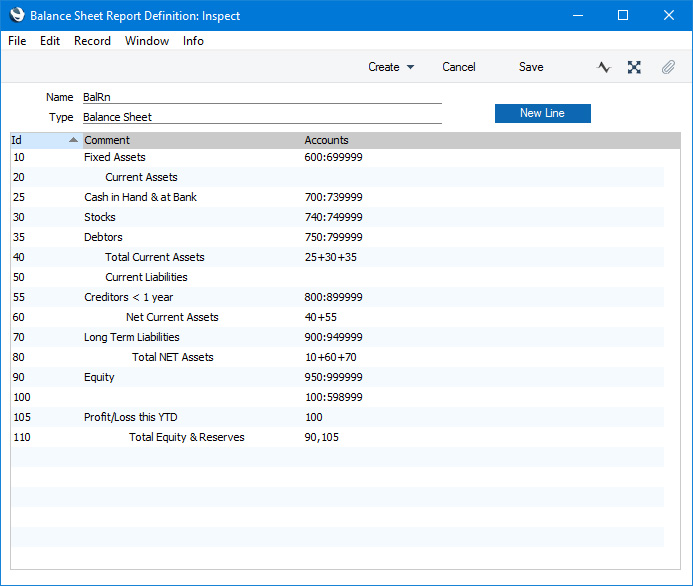
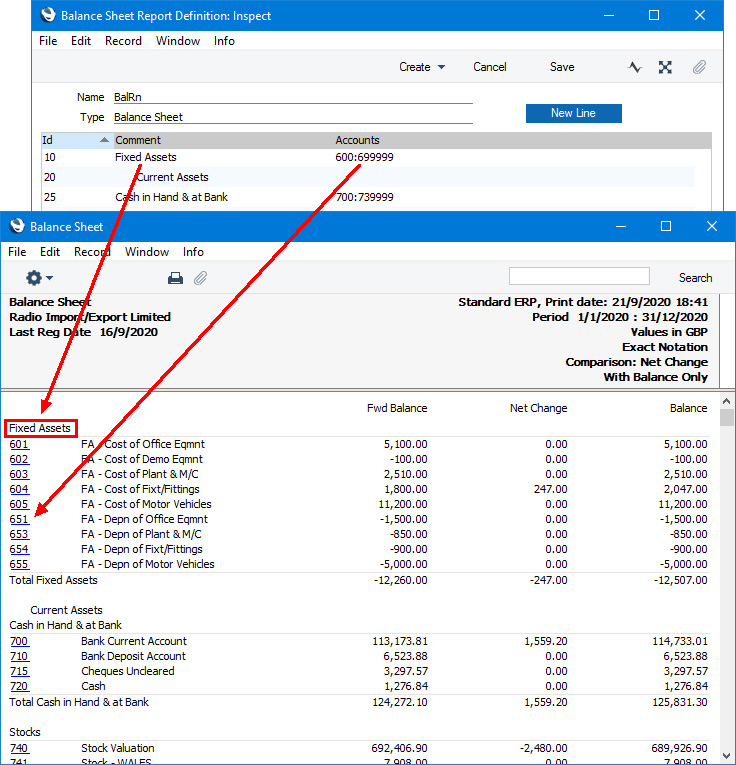
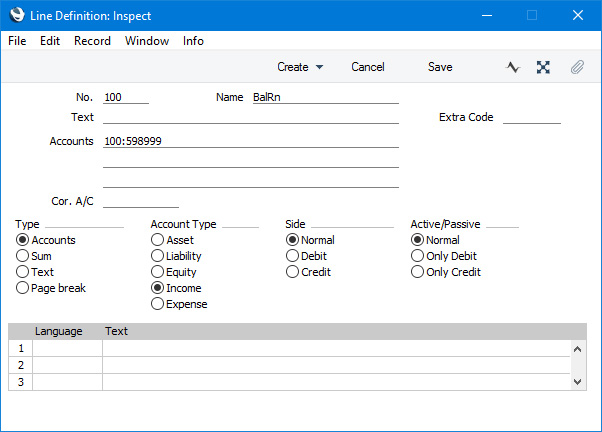
Each row in the definitions list will cause a section to be printed in the Balance Sheet, as shown in the illustration below:
- No.
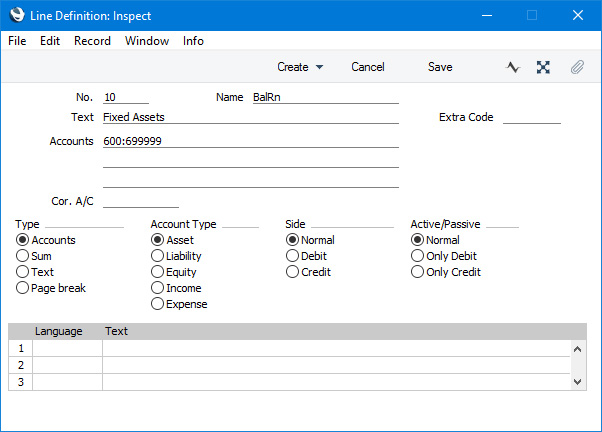
- As well as acting as the unique identifying code for each row in the Balance Sheet, the No. determines the order in which the rows will be printed in the report. When entering rows, it is recommended that you leave gaps in the numbering sequence, so there is room to insert new rows later.
- Text
- This Text will be printed in the report as a heading.
- You can use the grid in the lower part of the window to enter various translations of this Text. Specify a Language in the first column using 'Paste Special' if necessary, and the appropriate translation in the second column. There is no need to enter a row for your home Language. When you print the report, you will be able to specify which Language is to be used.
- You can use the grid in the lower part of the window to enter various translations of this Text. Specify a Language in the first column using 'Paste Special' if necessary, and the appropriate translation in the second column. There is no need to enter a row for your home Language. When you print the report, you will be able to specify which Language is to be used.
- Accounts
- Paste Special
Account register, Nominal Ledger/System module
Enter an Account or a range of Account numbers separated by a colon (:). The Account Number, Name and balance of every Account in this range will be printed in the Balance Sheet, under the heading specified in the Text field. An alpha sort is used so, in the example illustration above, "600:69999" effectively means that all Accounts whose first digit is "6" will be printed in the report.
The Accounts field consists of three rows, with room for a definition 300 characters long. As well as specifying a single Account or a range of Accounts, you can also specify a number of individual Accounts, or ranges of Accounts, separated by commas. If you enter a range of Accounts with the highest number first, the Accounts in that range will be presented in reverse order. For example, the sequence "605:601,626,651:655" will appear as follows in the printed report:
In this example, the "Reverse order example" heading was taken from the Text field in the Line Definition.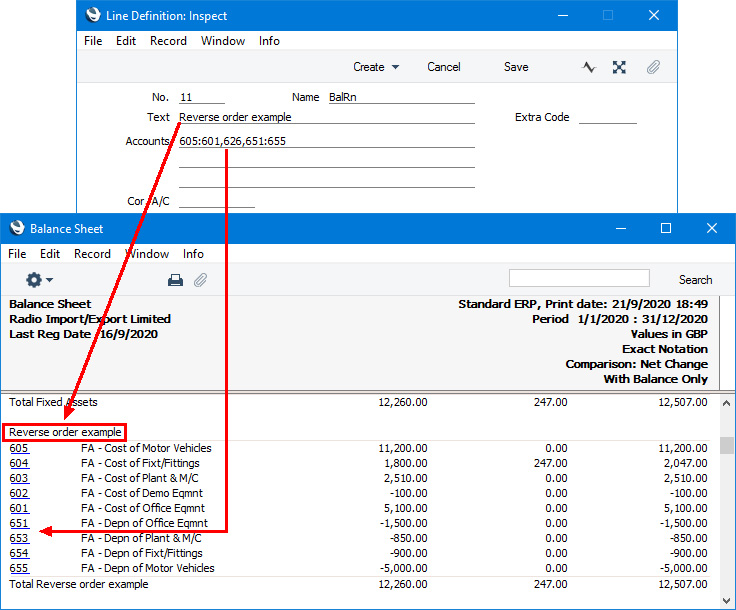
- Type
- Choose the "Accounts" option to signify that each of the Accounts in the range specified above will be printed individually in the report. After the last Account in the range, a total for the range will be printed.
- Account Type
- Choose the Account Type. This will connect the Line Definition with the Presentation of Balances setting, which controls whether figures and balances will be treated in reports as positive or negative depending on the Account Type. For example, if you select "Asset" as the Account Type, the Line Definition will obey the Assets check box in column 1 in the Presentation of Balances setting.
- Side and Active/Passive
- These options are described on the Special Features of the Balance Sheet page.
- Extra Code
- This field is used in Russia where the Balance Sheet is printed using a standard report design that includes line numbers: use this field to specify the correct line number for this row of the report. The Extra Code will only appear in the report when you produce it using the No Comparison option.
- Cor. A/C
- Paste Special
Account register, Nominal Ledger/System module
- You only need use this field when working with the definition of the Profit & Loss report, not with that of the Balance Sheet (you will use the same 'Line Definition' window when defining both reports).
- If you specify an Account as the Cor. A/C in this field, the report will show the balance posted to the Accounts specified above where the Cor. A/C is the balancing Account. For example, if you have entered "100:199" in the Accounts field above and "720" as the Cor. A/C, the report will print the total amount posted to the Accounts 100:199 where Account 720 is the balancing Account.
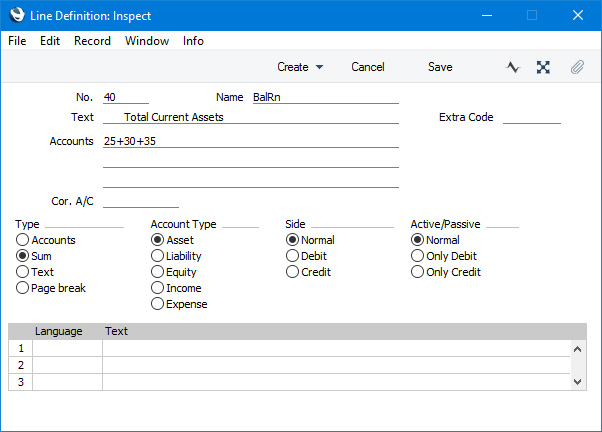
- Type
- Choose the "Sum" option to signify that the line in the report will add the total values from previous lines in the report together and print the result on a separate line. In this case, the result will be printed under the heading " Total Current Assets" (from the Text field).
- Accounts
- Since the Type is "Sum", use the Accounts field to specify the line numbers (25+30+35) whose total values are to be added together. Do not enter Account Numbers in the three Accounts fields if the Type is "Sum".
- Account Type
- Again these options control the presentation of the total figure when printed in the report (positive or negative).
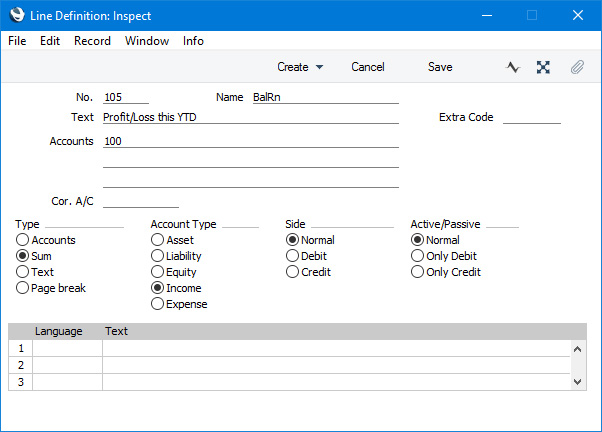
If the Type in a Line is "Text", leaving the Text field empty will cause a blank line to be printed in the report. This can be useful if you want to insert spaces between sections in the report.
When you have finished with the last row, click [Save] (Windows/macOS) or tap √ (iOS/Android) if you want to save your changes, click [Save], or else close the window using the close box or by tapping <. Then, close the list of definitions using the close box or by tapping < once again.
The new Balance Sheet report is now ready to print.
! | A standard Chart of Accounts and a set of Report Definitions are supplied with Standard ERP. This is a well-structured Chart, with systematic groupings of Accounts. It is suitable without any changes for most small or medium companies, but it is also easily modified by you or your financial adviser. |
If you stay within the structure of the Chart (e.g. avoid putting Liability Accounts among the Assets!), there is no need to alter the report definitions. But remember, it is a good idea to print a test Balance Sheet to see if your definition produces a report that is as expected.
Deleting a Line Definition from the Balance Sheet
- Open the 'Balance Sheet Report Definition: Inspect' window as described at the beginning of this page.
- Find the Line Definition you want to remove and open it by double-clicking (Windows/macOS) or tapping (iOS/Android). This opens the 'Line Definition' window.
- Select 'Delete' from the Record menu (which has a 'cog' icon if you are using iOS or Android). The line will be deleted from the Balance Sheet and you will be returned to the 'Balance Sheet Report Definition: Inspect' window.
! | You cannot undo the deletion of a row in the Balance Sheet. |
Please follow the links below for more details about the Balance Sheet report:
- The Definition of the Balance Sheet
- Multiple Balance Sheet Definitions
- Printing the Balance Sheet
- Special features of the Balance Sheet
Reports in the Nominal Ledger:
- Introduction
- Definition of Nominal Ledger Reports
- Drill-down
- The Operations Menu
- Account Reconciliation
- Accrual Report
- Analytical Balance
- Analytical Balance (Fiscal purposes)
- Balance Sheet
- Bank Reconciliation
- Bank Statement
- Bank Transactions
- Base Currency Rate Change
- Budget Journal
- Chart of Accounts
- Correction List
- Corresponding Accounts
- Creditors Account
- Currency A/C Rate Change
- Daily Balances
- Debtors Account
- Forward Balance Journal
- Income & Expense Book
- Key Financial Ratios
- Liquidity Forecast
- Multicurrency Accounts Rate Difference
- N/L Accrual Transactions
- N/L Transfer, Subsystems
- Nominal Ledger
- Profit & Loss
- Revised Budget Journal
- Simulation Journal
- Tag/Object Results
- Tag/Object/Quantity Results
- Tax Account Balances
- Tax Calculations
- Tax Transactions for Registers
- Template Transaction Journal
- Test Corresponding Rules
- Transaction Journal
- Transaction Summary
- Trial Balance
- VAT Listing
- VAT Report
- VAT Report Purchases
- VAT Report Sales
- VAT Transaction Journal
- XBRL Report
Go back to:
- Home page for Nominal Ledger manual
- Home page for Standard ERP manual
Balance Sheet - Multiple Balance Sheet Definitions
In some companies there is a requirement for multiple Balance Sheet, Cash Flow, Profit & Loss and Key Financial Ratio report definitions. To cater for this requirement, you can add as many separate reports of these types as you need to the Nominal Ledger. Each of these reports should have its own definition. This page describes adding a new report definition using the Balance Sheet as an example.To add a new Balance Sheet, follow these steps:
- Click the [Settings] button in the Navigation Centre (Windows/macOS) or select 'Settings' from the 'Tools' menu (with 'wrench' icon, iOS/Android) and double-click or tap 'Report Settings' in the subsequent list.
- When the 'Report Settings' window opens, click or tap the [New] button to create a new report. Alternatively, to copy an existing report and its entire definition (either one you have added yourself or the standard Balance Sheet), highlight it in the list and click or tap the [Duplicate] button. The 'New Report' window opens, empty if you pressed [New] or containing the details of the duplicated report:
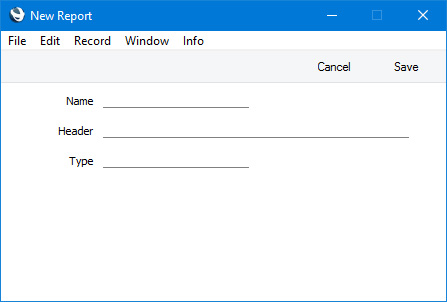
- Name
- Enter a name for the report. This name will appear in the 'Reports' list. You cannot use the same name for more than one report.
- Header
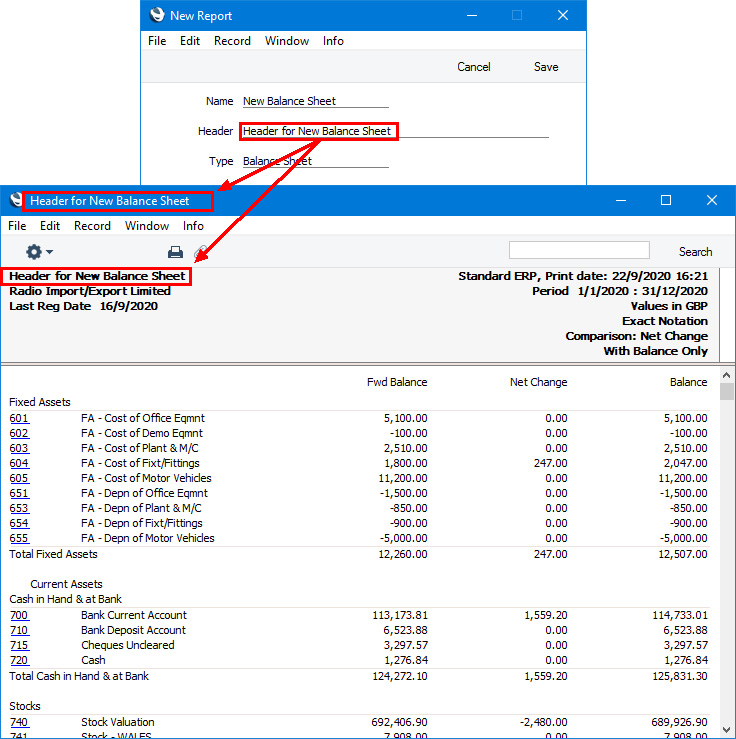
- Enter a second name for the report. This name will be printed in the report header, and will also appear in the title bar of the report window if you print the report to screen.
- Type
- Paste Special
Choices of possible entries
- Use this field to specify the report type (i.e. Balance Sheet, Profit & Loss, Key Financial Ratios, VAT Report or Cash Flow).
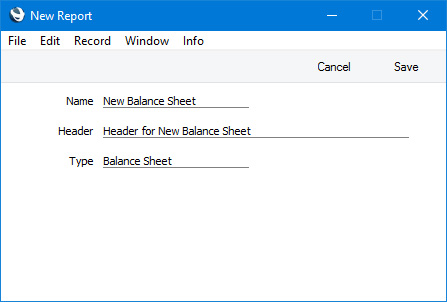
- Name
- Click or tap the [Save] button to save the new report. The 'New Report' window will close, and the new report will be added to the bottom of the list in the Report Settings window, using the Name that you specified in the 'New Report' window:
If you need to modify the report (perhaps you made a spelling mistake or you chose a temporary name), highlight it in the list in the 'Report Settings' window and click or tap the [Open] button. The report will be opened in the 'New Report' window illustrated in step 2.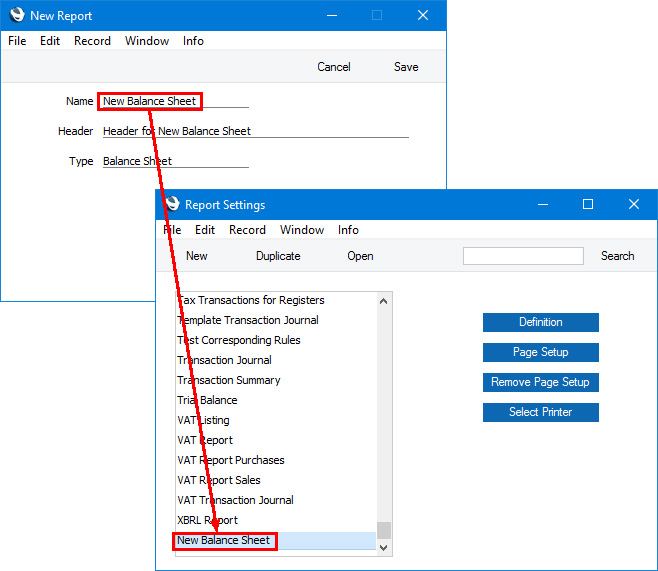
- Having created the new report, you should now enter a definition for the new report. Double-click it in the list in the 'Report Settings' window (Windows/macOS) or highlight it and press the [Definition] button (all platforms). This process is the same as for the 'standard' Balance Sheet, and is as described on the Defining a Balance Sheet page. If you created the new report by duplicating an existing one, the definition will have been duplicated as well.
You can also drag rows from an existing report definition to the new one. If you open both report definitions from the list in the 'Report Settings' window, you will be able to drag rows individually from one window to the other. You can also highlight several rows at a time by shift-clicking and drag them all at once.
- To print the new report, open the 'Reports' list as normal. The new report will appear at the bottom of the list, using the Name that you specified in the 'New Report' window:
Double-click or tap the report name and print the report in the usual way. The specification window for the report is the same as that for the 'standard' Balance Sheet, and is described on the Printing a Balance Sheet page. The text in the title bar of the report window, and the report title on the first line of the report header ("Header for New Balance Sheet") will be taken from the Header field in the 'New Report' window illustrated in step 2 above.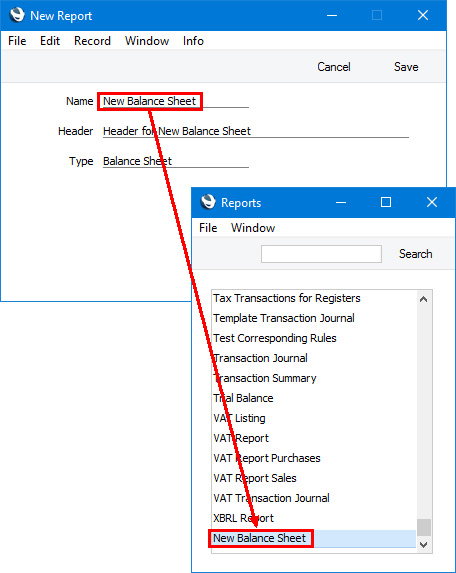
- If you need to remove the new report, open the 'Report Settings' window or the 'Reports' list and highlight the report name. Then, select 'Clear' from the Edit menu.
- You can control access to the new report using Access Groups in the usual way. In a new row in an Access Group record, enter "Report" in the Type column and the Name (as specified in the 'New Report' window illustrated in step 2) in the Item column, and then specify the appropriate level of access in the Level column::
As shown in the illustration, if you need to grant Full or Read access to the new report, you must grant the same access to the standard Balance Sheet as well. In other words, access to the new report cannot be higher than the access to the standard report.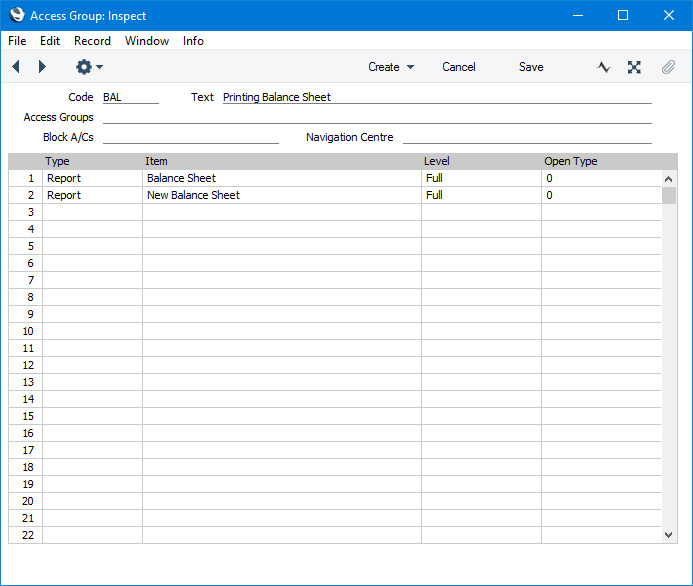
Please follow the links below for more details about the Balance Sheet report:
- The Definition of the Balance Sheet
- Multiple Balance Sheet Definitions
- Printing the Balance Sheet
- Special features of the Balance Sheet
Reports in the Nominal Ledger:
- Introduction
- Definition of Nominal Ledger Reports
- Drill-down
- The Operations Menu
- Account Reconciliation
- Accrual Report
- Analytical Balance
- Analytical Balance (Fiscal purposes)
- Balance Sheet
- Bank Reconciliation
- Bank Statement
- Bank Transactions
- Base Currency Rate Change
- Budget Journal
- Chart of Accounts
- Correction List
- Corresponding Accounts
- Creditors Account
- Currency A/C Rate Change
- Daily Balances
- Debtors Account
- Forward Balance Journal
- Income & Expense Book
- Key Financial Ratios
- Liquidity Forecast
- Multicurrency Accounts Rate Difference
- N/L Accrual Transactions
- N/L Transfer, Subsystems
- Nominal Ledger
- Profit & Loss
- Revised Budget Journal
- Simulation Journal
- Tag/Object Results
- Tag/Object/Quantity Results
- Tax Account Balances
- Tax Calculations
- Tax Transactions for Registers
- Template Transaction Journal
- Test Corresponding Rules
- Transaction Journal
- Transaction Summary
- Trial Balance
- VAT Listing
- VAT Report
- VAT Report Purchases
- VAT Report Sales
- VAT Transaction Journal
- XBRL Report
Go back to:
- Home page for Nominal Ledger manual
- Home page for Standard ERP manual
Balance Sheet - Printing
This page describes printing the Balance Sheet report.---
Having entered a definition for the Balance Sheet as described here, you will be ready to print the report. After ensuring you are in the Nominal Ledger, click (Windows/macOS) or tap (iOS/Android) the [Reports] button in the Navigation Centre and then double-click or tap 'Balance Sheet' in the 'Reports' list. The 'Specify Balance Sheet' window will be opened.
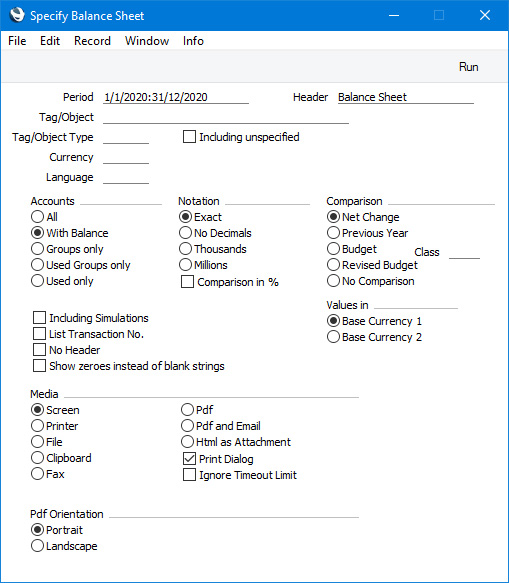
- Period
- Paste Special
Reporting Periods setting, System module
- Enter the period for the Balance Sheet you want to print. The Account balances in the report will be calculated from postings (i.e. from Transaction rows) recorded during the period specified here. The first period in the Reporting Periods setting will be offered as a default.
- Header
- Specify a title for the report here. This title will be printed in the report header, and will also appear in the title bar of the report window if you print the report to screen.
- Tag/Object
- Paste Special
Tag/Object register, Nominal Ledger/System module
- Enter a Tag/Object Code here if you need the Account balances in the report to be calculated from postings with a particular Tag/Object. You can also enter a number of Tags/Objects separated by commas, in which case Account balances will be calculated from postings with all the Tags/Objects listed. If you leave this field empty, the Account balances in the report will be calculated from all Transaction rows, with and without Tags/Objects.
- Tag/Object Type
- Paste Special
Tag/Object Types setting, Nominal Ledger
- Enter a Tag/Object Type Code in this field if you want the report to show Account balances calculated from postings with Tags/Objects belonging to a particular Tag/Object Type.
- Including Unspecified
- Select this option if, for each Account, you want to show a balance figure calculated from postings (i.e. Transaction rows) with Tags/Objects belonging to the Tag/Object Type specified above and a second balance calculated from all other Transaction rows.
- Currency
- Paste Special
Currency register, System module
- If you specify a Currency here, the Account balances in the report will be calculated only from those Transaction rows with the specified Currency shown on flip C. The balances will be calculated using the figures on flip C of those Transaction rows (i.e. they will be in the chosen Currency). If you leave this field blank, all Transaction rows will be included in the calculations. In this case the calculation will use the figures in the Base 1 or Base 2 Debit or Credit fields on flip A (choose which Base Currency is to be used using the Values in options described below).
- Language
- Paste Special
Languages setting, System module
- You can produce the Balance Sheet in different Languages: enter the required Language Code here. The appropriate translations of the Account Names will be taken from the 'Texts' card of each Account record, while the translations for each report heading and sub-heading will be taken from the report definition.
- If you do not enter a Language here, but you have entered a Language in the Company Info setting in the System module, the report will be produced in that Language if you are using the Account Description in Company Language option in the Transaction Settings setting in the Nominal Ledger.
- If you do not enter a Language here, but you have entered a Language in the Company Info setting in the System module, the report will be produced in that Language if you are using the Account Description in Company Language option in the Transaction Settings setting in the Nominal Ledger.
- Accounts
- Select one of these options to specify which Accounts are to be included in the report and how their balances will be displayed.
- All
- This option will list all the Accounts that have been included in the Balance Sheet definition.
- With Balance
- This option will only list Accounts that have an opening balance and/or a closing balance.
- An Account with no opening balance that has been used during the period in such a way that it also has no closing balance will not be shown in the report. If you want such an Account to be included in the report, use the Used only option below.
- An Account with no opening balance that has been used during the period in such a way that it also has no closing balance will not be shown in the report. If you want such an Account to be included in the report, use the Used only option below.
- Groups only
- This option does not print balances for individual Accounts. Instead, it simply prints an overall balance for each line in the Balance Sheet definition.
- Used Groups only
- This option only prints balances for lines in the Balance Sheet definition that have been used.
- Used only
- This option will only list Accounts that have been used. This includes Accounts that have balances brought forward from a previous period that have not been used during the report period.
- This option is similar to With Balance above, with the exception that it also includes Accounts with no opening balances that have been used during the period in such a way that they also have no closing balances.
- All
- Notation
- Select the printing format for the values in the Balance Sheet.
- Exact
- Shows the balances as stored in the Transactions.
- No Decimals
- Rounds the balances up or down to the nearest whole number.
- Thousands, Millions
- Divide the balances by 1,000 or 1,000,000.
- Comparison in %
- If you choose "Budget" or "Revised Budget" as the Comparison option (below), an extra column will be added to the report. If you do not select this Comparison in % option, the extra column will display the Budget or Revised Budget figures for each Account. If you do select this option, the column will display the difference between the Budget or Revised Budget and actual figures, expressed as a percentage.
- Exact
- Comparison
- Choose to compare with Net Change, Budget, Revised Budget or the same period the previous year.
- Net Change
- This option will display an opening balance for each Account, the net change over the report period and the closing balance.
- Previous Year
- This option will display the balances for each Account at the end of the report period, and the balances at the end of the same period the previous year.
- Budget, Revised Budget
- Budget or Revised Budget figures will be calculated from the Budget or Revised Budget matrix rows with dates that fall within the report period. If the matrix in a Budget or Revised Budget record is empty or only contains rows whose dates are outside the report period, figures from that record will not be included in the report. You do not need to mark a Budget or Revised Budget record as OK for its figures to appear in the report.
- If you use Tags/Objects, you should create Budget (and, if you are using them, Revised Budget) records for each Tag/Object - Account combination and overall Budgets/Revised Budgets for each Account without Tags/Objects. This will allow you to use the Budget or Revised Budget options with a particular Tag/Object, and with no Tag/Object.
- If you select either of these options, you can also choose a Budget Class using 'Paste Special' from the Class field. The Budget or Revised Budget figures will be taken from the Budget or Revised Budget records with the specified Class. If you do not specify a Class, figures will be taken from the Budget or Revised Budget records in which the Class is blank.
- If you use Tags/Objects, you should create Budget (and, if you are using them, Revised Budget) records for each Tag/Object - Account combination and overall Budgets/Revised Budgets for each Account without Tags/Objects. This will allow you to use the Budget or Revised Budget options with a particular Tag/Object, and with no Tag/Object.
- No Comparison
- This option will simply display balances brought forward and for the report period. It is appropriate for users in Russia where the Balance Sheet is printed using a standard report design including line numbers. You should define the line numbers using the Extra Code field in the Balance Sheet Line Definitions.
- Net Change
- Including Simulations
- Select this option if you need simulated transactions from the Simulation register to be included in the report. Simulation rows in which the Status is "Invalid" and "Transferred" will not be included.
- List Transaction No.
- If you select this option, the Transaction Numbers of all Transactions that fall within the reporting period, together with debit and credit totals, will be listed at the end of the report.
- No Header
- Check this box if you want the report to be printed without a header.
- Show zeroes instead of blank strings
- If you choose "All" as the Accounts option, unused Accounts will be shown in the report with blank values. Blank values may also be included in the report if you choose "Budget" or "Revised Budget" as the Comparison option, which will add an extra column to the report. Depending on the Comparison in % option, this column will display the Budget or Revised Budget figures for each Account or the difference between the Budget or Revised Budget and actual figures, expressed as a percentage. If there is no Budget or Revised Budget figure for a particular Account, nothing will be printed (i.e. the space will be blank).
- If you would prefer "0.00" to be printed instead of the blanks, select this Show zeroes instead of blank strings option.
- If you would prefer "0.00" to be printed instead of the blanks, select this Show zeroes instead of blank strings option.
- Values in
- If you are using the Dual-Base system, use these options to specify whether the values in the report are to be shown in Base Currency 1 or 2.
- If you are not using the Dual-Base system, use the Base Currency 1 option to produce a report in your home Currency.
- If you have entered a Currency in the Currency field above, the figures in the report will be in that Currency.
- If you are not using the Dual-Base system, use the Base Currency 1 option to produce a report in your home Currency.
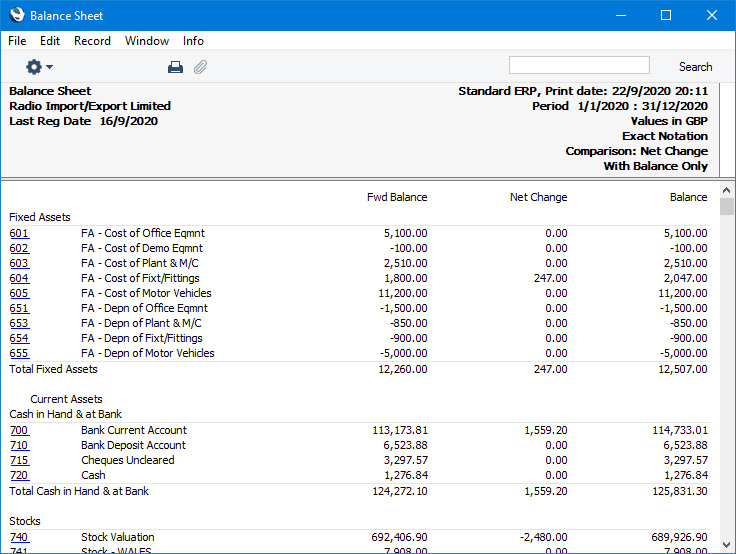
Please follow the links below for more details about the Balance Sheet report:
- The Definition of the Balance Sheet
- Multiple Balance Sheet Definitions
- Printing the Balance Sheet
- Special features of the Balance Sheet
Reports in the Nominal Ledger:
- Introduction
- Definition of Nominal Ledger Reports
- Drill-down
- The Operations Menu
- Account Reconciliation
- Accrual Report
- Analytical Balance
- Analytical Balance (Fiscal purposes)
- Balance Sheet
- Bank Reconciliation
- Bank Statement
- Bank Transactions
- Base Currency Rate Change
- Budget Journal
- Chart of Accounts
- Correction List
- Corresponding Accounts
- Creditors Account
- Currency A/C Rate Change
- Daily Balances
- Debtors Account
- Forward Balance Journal
- Income & Expense Book
- Key Financial Ratios
- Liquidity Forecast
- Multicurrency Accounts Rate Difference
- N/L Accrual Transactions
- N/L Transfer, Subsystems
- Nominal Ledger
- Profit & Loss
- Revised Budget Journal
- Simulation Journal
- Tag/Object Results
- Tag/Object/Quantity Results
- Tax Account Balances
- Tax Calculations
- Tax Transactions for Registers
- Template Transaction Journal
- Test Corresponding Rules
- Transaction Journal
- Transaction Summary
- Trial Balance
- VAT Listing
- VAT Report
- VAT Report Purchases
- VAT Report Sales
- VAT Transaction Journal
- XBRL Report
Go back to:
- Home page for Nominal Ledger manual
- Home page for Standard ERP manual
Balance Sheet - Special Features
This page describes the Side and Active/Passive options in the Balance Sheet Line Definitions.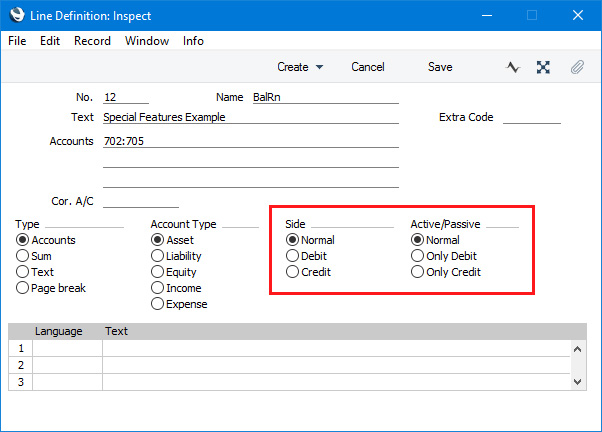
To complicate things even further, in some countries it is customary to distinguish between four different "states" of a book entry: Debit+, Debit-, Credit+ and Credit-. In modern western accounting systems, a book entry is either debit or credit, regardless of the class of the account, i.e. there is a simple arithmetic definition of balances.
In those environments where all these special rules are used, the preparation of balance reports tends to become complicated and labour consuming. These special functions in Standard ERP allow the far-reaching automation of many of these routine tasks. This is how it works.
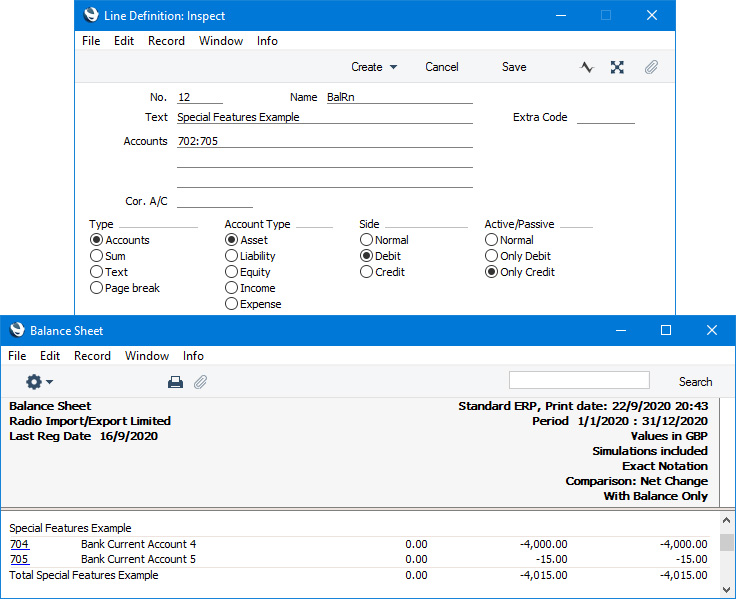
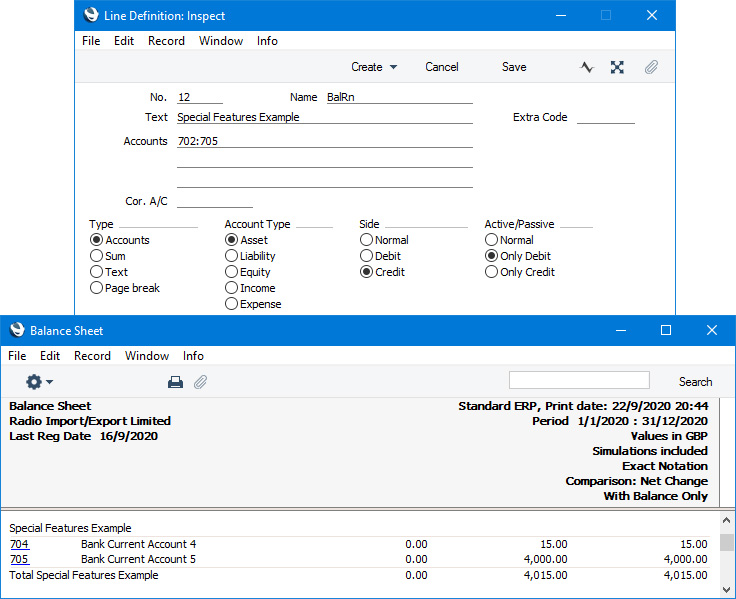
Let us start with the following Nominal Ledger reports, showing the postings made to four Asset Accounts.
- Account 702 has a normal debit balance. Two negative values have been posted, one as a debit and one as a credit:
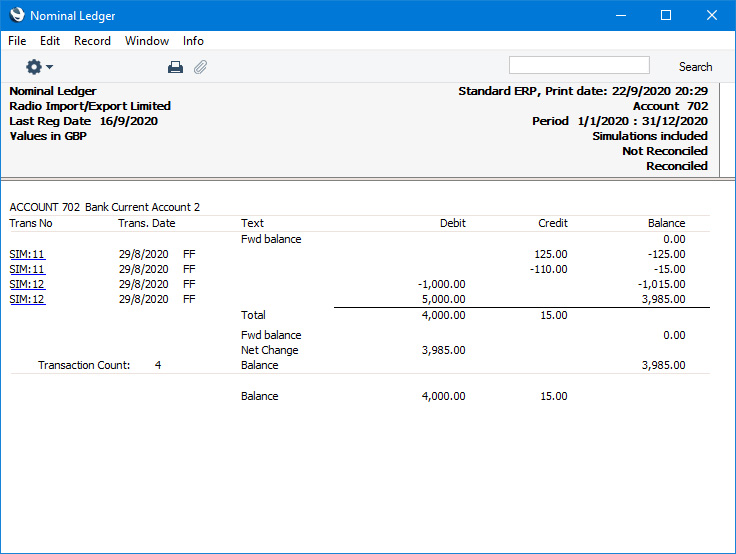
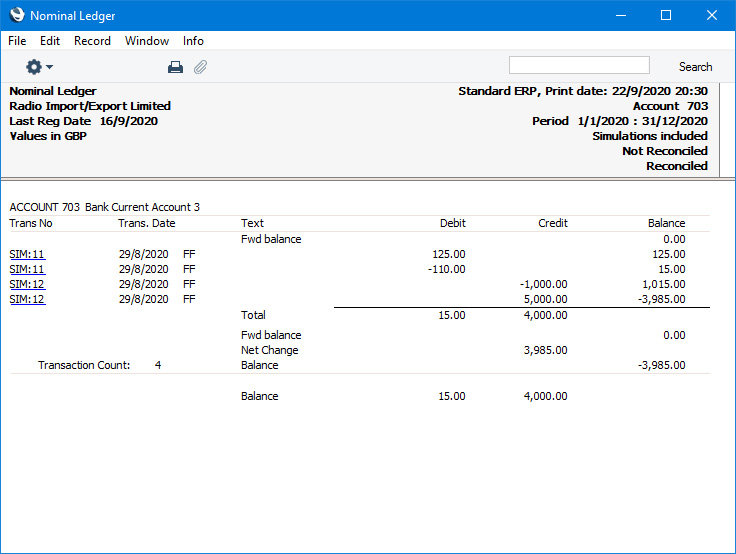
- Account 703 currently has a balance in credit. The debit total for this Account for the period is 15.00, and the credit total 4000.00:
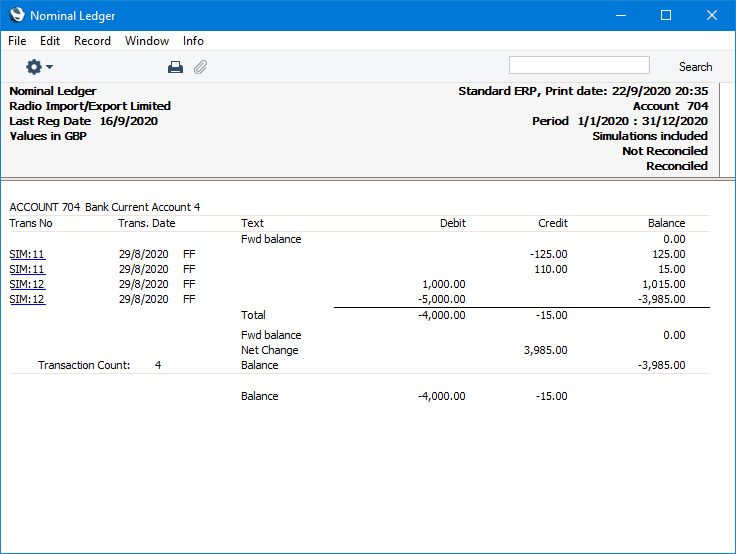
- Account 704 has an overall credit balance because of a large negative debit posting:
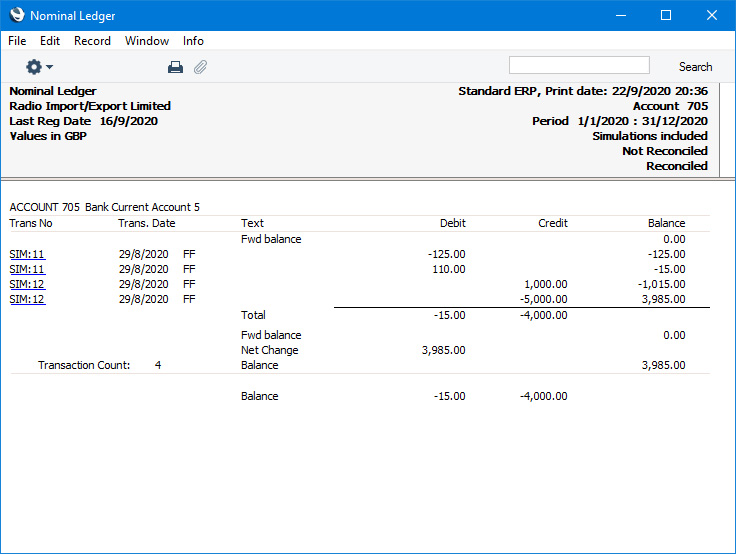
- Account 705 has an overall debit balance because of a large negative credit posting:
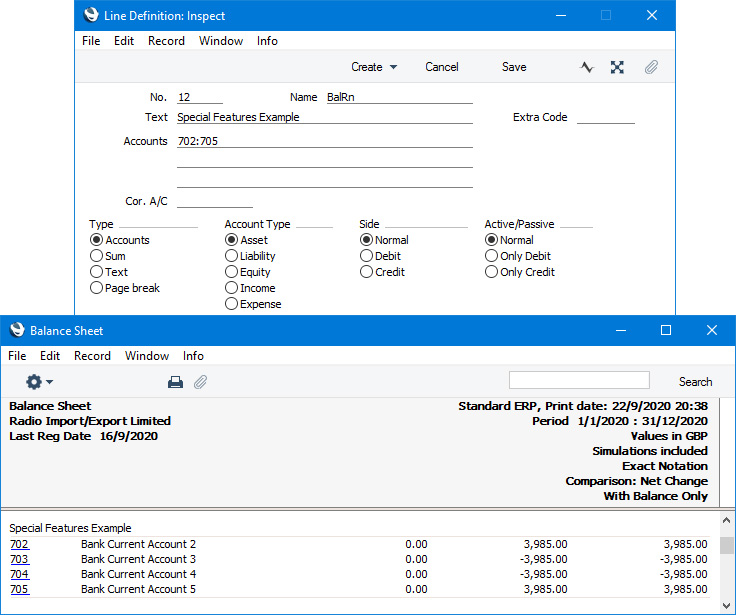
- Normal
- The overall balance will be shown (debits - credits).
- Debit
- The debit balance will be shown.
- Credit
- The credit balance will be shown.
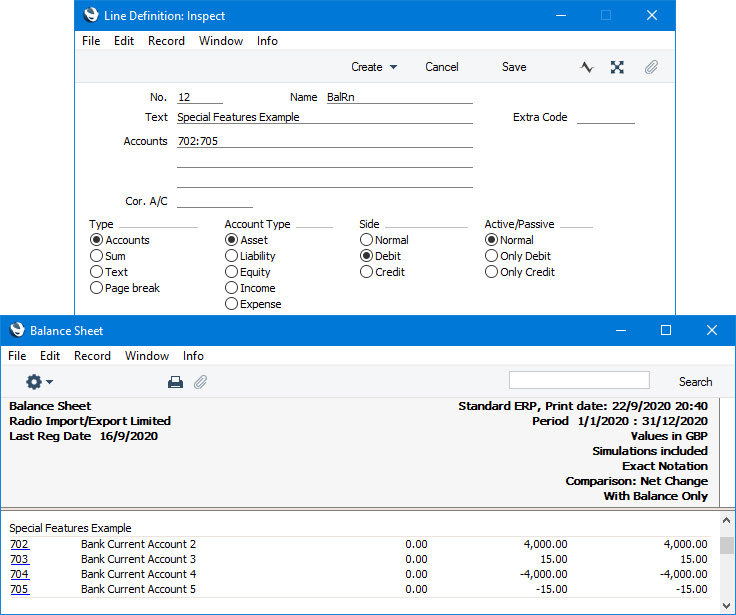
- Normal
- All Accounts will be included in the report.
- Only Debit
- Only Accounts that are in debit will be included in the report. For each Account, the overall balance will be shown (debits - credits).
- Only Credit
- Only Accounts that are in credit will be included in the report. For each Account, the overall balance will be shown (debits - credits).
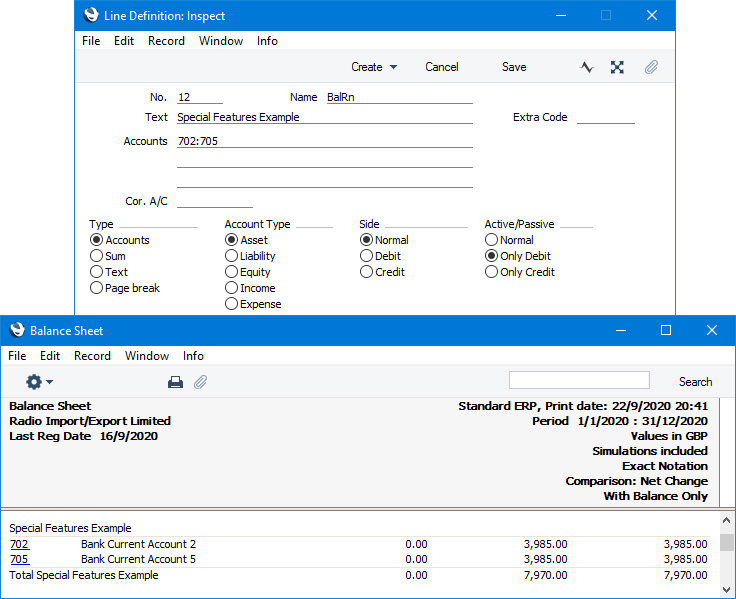
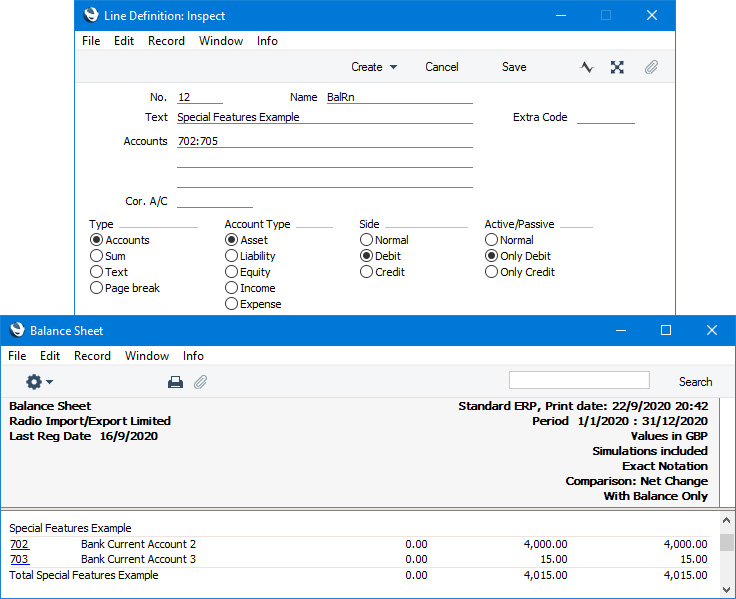
- Debit, Only Debit
- Side:Debit signifies that the debit balance of each Account will be shown in the report, and Acitve/Passive:Only Debit signifies that an Account will only be included in the report if its debit balance is positive (debit+).
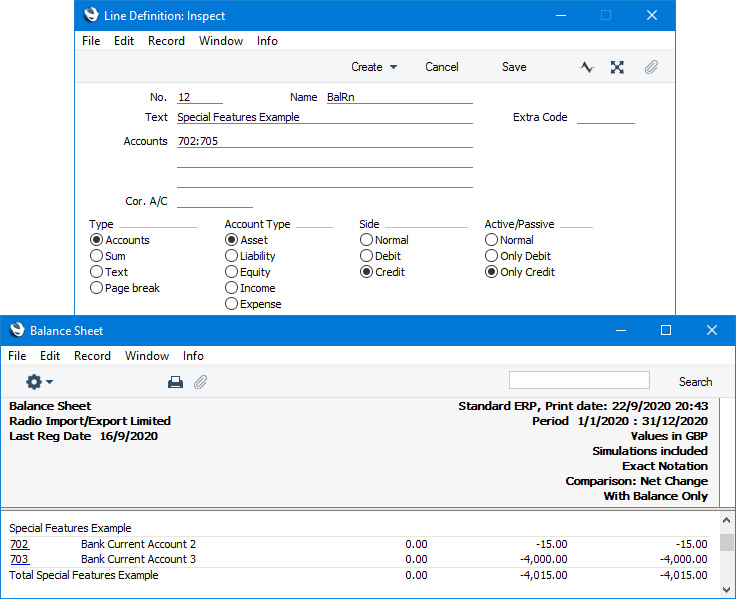
- Credit, Only Credit
- Side:Credit signifies that the credit balance of each Account will be shown in the report, and Acitve/Passive:Only Credit signifies that an Account will only be included in the report if its credit balance is positive (credit+).
- Debit, Only Credit
- Side:Debit signifies that the debit balance of each Account will be shown in the report, and Acitve/Passive:Only Credit signifies that an Account will only be included in the report if its debit balance is negative (debit-).
- Credit, Only Debit
- Side:Credit signifies that the credit balance of each Account will be shown in the report, and Acitve/Passive:Only Debit signifies that an Account will only be included in the report if its credit balance is negative (credit-).
Please follow the links below for more details about the Balance Sheet report:
- The Definition of the Balance Sheet
- Multiple Balance Sheet Definitions
- Printing the Balance Sheet
- Special features of the Balance Sheet
Reports in the Nominal Ledger:
- Introduction
- Definition of Nominal Ledger Reports
- Drill-down
- The Operations Menu
- Account Reconciliation
- Accrual Report
- Analytical Balance
- Analytical Balance (Fiscal purposes)
- Balance Sheet
- Bank Reconciliation
- Bank Statement
- Bank Transactions
- Base Currency Rate Change
- Budget Journal
- Chart of Accounts
- Correction List
- Corresponding Accounts
- Creditors Account
- Currency A/C Rate Change
- Daily Balances
- Debtors Account
- Forward Balance Journal
- Income & Expense Book
- Key Financial Ratios
- Liquidity Forecast
- Multicurrency Accounts Rate Difference
- N/L Accrual Transactions
- N/L Transfer, Subsystems
- Nominal Ledger
- Profit & Loss
- Revised Budget Journal
- Simulation Journal
- Tag/Object Results
- Tag/Object/Quantity Results
- Tax Account Balances
- Tax Calculations
- Tax Transactions for Registers
- Template Transaction Journal
- Test Corresponding Rules
- Transaction Journal
- Transaction Summary
- Trial Balance
- VAT Listing
- VAT Report
- VAT Report Purchases
- VAT Report Sales
- VAT Transaction Journal
- XBRL Report
Go back to:
- Home page for Nominal Ledger manual
- Home page for Standard ERP manual
Bank Reconciliation
This page describes the Bank Reconciliation report in the Nominal Ledger.---
The Bank Reconciliation report is one of two reports in the Nominal Ledger that you can use to help with the task of reconciling bank statements, the other being the Account Reconciliation report. Use the Account Reconciliation register to reconcile bank statements.
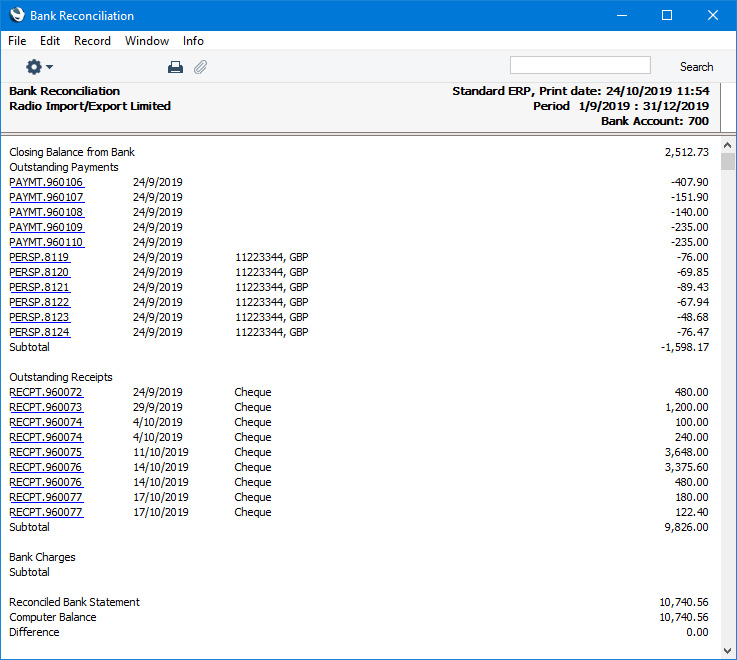
The Bank Reconciliation report is a list of unreconciled postings to a specified Bank Account from a specified period. An unreconciled posting is one that you have not reconciled to a transaction on your bank statement using the Account Reconciliation register. The report divides the unreconciled postings into three groups: Outstanding Payments; Outstanding Receipts; and Bank Charges. The third group includes all postings that do not fall into the other two groups (e.g. bank interest, transfers between bank accounts, salary payments).
When producing the report, you will enter the closing balance from your last bank statement. The report will display a new balance, calculated from that figure and including the unreconciled postings. This new balance will be compared to the balance for the Bank Account in your database on the last day of the report period. If the two balances are different, the probable reason is that there is still at least one unreconciled posting that you can reconcile with the bank statement.
When printed to screen, the Bank Reconciliation report has the Standard ERP Drill-down feature. Click (Windows/macOS) or tap (iOS/Android) on a Sub System Number (e.g. Invoice Number) in the report to open the Nominal Ledger Transaction for that Sub System record. You can then open the Sub System record itself (e.g. the Invoice) by selecting 'Open Subsystem Record' from the Operations menu (Windows/macOS) or Tools menu (iOS/Android).
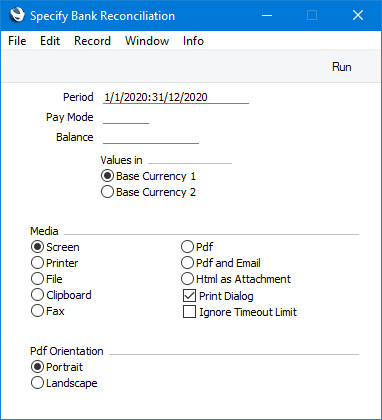
- Period
- Paste Special
Reporting Periods setting, System module
- Specify the report period. This should be sufficient to include all unreconciled postings to the Bank Account.
- Note that a posting to the Bank Account that you made during the report period and that you reconciled after the report period will be treated as unreconciled. The report period may therefore need to have an earlier start date than that of the bank statement you are working from.
- Note that a posting to the Bank Account that you made during the report period and that you reconciled after the report period will be treated as unreconciled. The report period may therefore need to have an earlier start date than that of the bank statement you are working from.
- Pay Mode
- Paste Special
Payment Modes setting, Sales/Purchase Ledger
- Enter a Payment Mode: the report will list all unreconciled postings to the Account shown on flip A of this Payment Mode.
- The report will be empty if you do not specify a Payment Mode.
- The report will be empty if you do not specify a Payment Mode.
- Balance
- Enter the closing balance from your last bank statement. The report will calculate a new balance that takes the unreconciled postings into account. This new balance is then compared with the current balance for the Account in the Payment Mode specified above.
- Values in
- If you are using the Dual-Base system, values in this report can be shown in either Base Currency. Use these options to choose which Currency is to be used on this occasion.
- If you are not using the Dual-Base system, use the Base Currency 1 option to produce a report in your home Currency.
- If you are not using the Dual-Base system, use the Base Currency 1 option to produce a report in your home Currency.
Reports in the Nominal Ledger:
- Introduction
- Definition of Nominal Ledger Reports
- Drill-down
- The Operations Menu
- Account Reconciliation
- Accrual Report
- Analytical Balance
- Analytical Balance (Fiscal purposes)
- Balance Sheet
- Bank Reconciliation
- Bank Statement
- Bank Transactions
- Base Currency Rate Change
- Budget Journal
- Cash Flow
- Chart of Accounts
- Correction List
- Corresponding Accounts
- Creditors Account
- Currency A/C Rate Change
- Daily Balances
- Debtors Account
- Forward Balance Journal
- Key Financial Ratios
- Liquidity Forecast
- Multicurrency Accounts Rate Difference
- N/L Accrual Transactions
- N/L Transfer, Subsystems
- Nominal Ledger
- Profit & Loss
- Revised Budget Journal
- Simulation Journal
- Tag/Object Results
- Tag/Object/Quantity Results
- Tax Account Balances
- Tax Calculations
- Tax Transactions for Registers
- Template Transaction Journal
- Test Corresponding Rules
- Transaction Journal
- Transaction Summary
- Trial Balance
- VAT Listing
- VAT Report
- VAT Report Purchases
- VAT Report Sales
- VAT Transaction Journal
- XBRL Report
Go back to:
- Home page for Nominal Ledger manual
- Home page for Standard ERP manual
Bank Statement
This page describes the Bank Statement report in the Nominal Ledger.---
The Bank Statement report is a list of the Payments, Receipts, Nominal Ledger Transactions and Personnel Payments that were paid into or out from a specified Bank Account during the specified period, together with opening and closing balances.
Compared to other Nominal Ledger reports listing Account postings and balances, the Bank Statement lists each transaction individually and also shows Customer and Supplier information. In addition, using the Standard ERP Drill-down feature to click (Windows/macOS) or tap (iOS/Android) on a Receipt, Payment or Personnel Payment Number will open the corresponding sub system record, not the related Nominal Ledger Transaction that will be opened from other Nominal Ledger reports.
You can also produce a Bank Statement report from individual Receipt, Payment and Personnel Payment records. To do this, open a Receipt, Payment or Personnel Payment record and select 'Bank Statement' from the Operations menu (Windows/macOS) or Tools menu (iOS/Android). A report will be printed to screen listing the transactions posting to the Bank or Cash Account (i.e. to the Account in the Payment Mode specified in the Receipt, Payment or Personnel Payment) and the balance of that Account on the day of the Receipt, Payment or Personnel Payment.
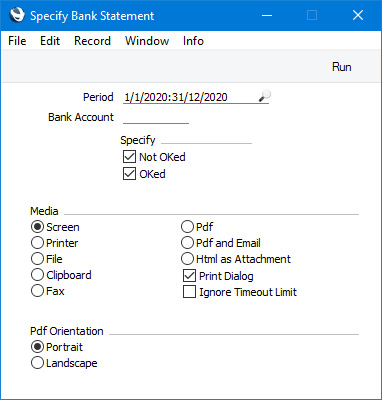
- Period
- Paste Special
Reporting Periods setting, System module
- The report will list the transactions posting to the Bank Account that you entered during the period specified here.
- Bank Account
- Paste Special
Account register, Nominal Ledger/System module
- Specify the Account whose transactions and balance you wish to see. You must specify an Account, otherwise the report will be empty.
- Specify
- Use these options to specify whether Receipts, Payments and Personnel Payments that have been marked as OK, Receipts, Payments and Personnel Payments that have not been marked as OK or both will be shown in the report. Nominal Ledger Transactions will always be shown, irrespective of the options that you choose here.
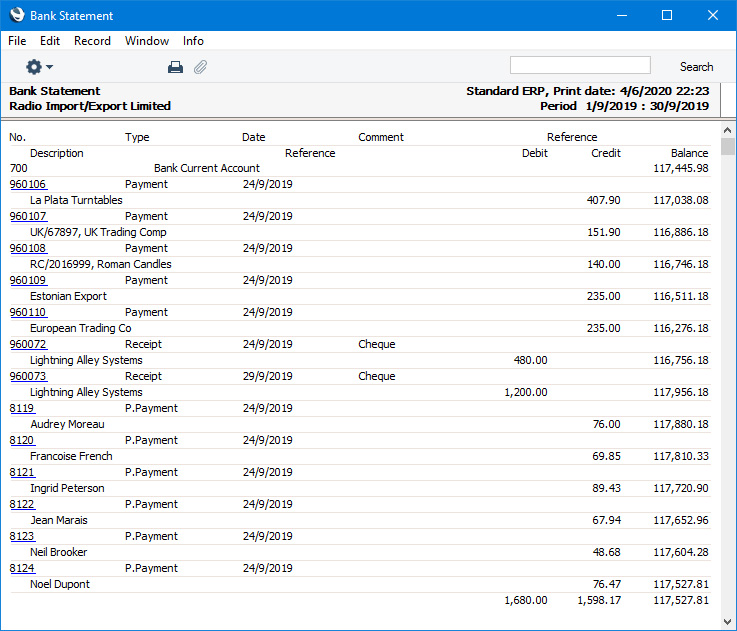
Reports in the Nominal Ledger:
- Introduction
- Definition of Nominal Ledger Reports
- Drill-down
- The Operations Menu
- Account Reconciliation
- Accrual Report
- Analytical Balance
- Analytical Balance (Fiscal purposes)
- Balance Sheet
- Bank Reconciliation
- Bank Statement
- Bank Transactions
- Base Currency Rate Change
- Budget Journal
- Cash Flow
- Chart of Accounts
- Correction List
- Corresponding Accounts
- Creditors Account
- Currency A/C Rate Change
- Daily Balances
- Debtors Account
- Forward Balance Journal
- Key Financial Ratios
- Liquidity Forecast
- Multicurrency Accounts Rate Difference
- N/L Accrual Transactions
- N/L Transfer, Subsystems
- Nominal Ledger
- Profit & Loss
- Revised Budget Journal
- Simulation Journal
- Tag/Object Results
- Tag/Object/Quantity Results
- Tax Account Balances
- Tax Calculations
- Tax Transactions for Registers
- Template Transaction Journal
- Test Corresponding Rules
- Transaction Journal
- Transaction Summary
- Trial Balance
- VAT Listing
- VAT Report
- VAT Report Purchases
- VAT Report Sales
- VAT Transaction Journal
- XBRL Report
Go back to:
- Home page for Nominal Ledger manual
- Home page for Standard ERP manual
Bank Transactions
This page describes the Bank Transactions report in the Nominal Ledger. This report is only available in Estonia and Lithuania (i.e. when the VAT Law in the Company Info setting is set to "Estonian" or "Lithuanian").---
The Bank Transactions report is a list of the records in the Bank Transactions setting. This setting contains transactions from electronic bank statements that you will have imported using the 'Bank Transactions' Import function in the Nominal Ledger or (Estonia only) that were received electronically from SEB Bank through the SEB Bank Statements Cloud Service. Each record in this setting represents a single transaction on a bank statement. If you need to check that a statement is correct, you can print this report before using the Bank Reconciliation register to reconcile the transactions on the statement with those in your Standard ERP database.
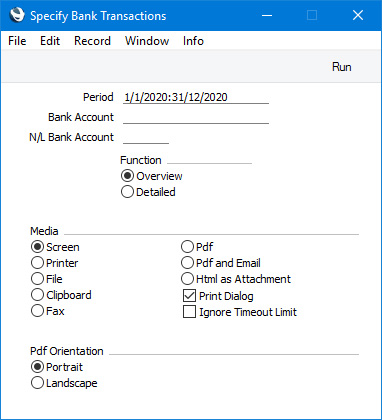
- Period
- Paste Special
Reporting Periods setting, System module
- Enter the start and end date of the report period. A Bank Transaction record will be included in the report if its R. Trans. Date (on the 'Recipient' card) falls in the period specified here.
- Bank Account
- If you have several bank accounts, you can enter a bank account number in this field if you need to restrict the report to the Bank Transactions affecting one particular bank account. The report will list Bank Transactions in which the Type is "C" and with this bank account number in the P. Bank Acc. field on the 'Payer' card, and Bank Transactions in which the Type is "D" and with this bank account number in the R. Bank Acc. field on the 'Recipient' card.
- N/L Bank Account
- Paste Special
Account register, Nominal Ledger/System module
- If you specify the Account that represents your bank account in your Chart of Accounts here, the report will include the opening balance for that Account, and a theoretical closing balance that includes the Bank Transactions.
- Function
- Use these options to choose the level of detail that you want to be printed in the report.
- Overview
- The report will contain a single line for each Bank Transaction, showing the R. Trans. Date, the Tr. Number, the Currency, the amount (shown as a debit if the Type is "D" or as a credit if the Type is "C") and the Comment.
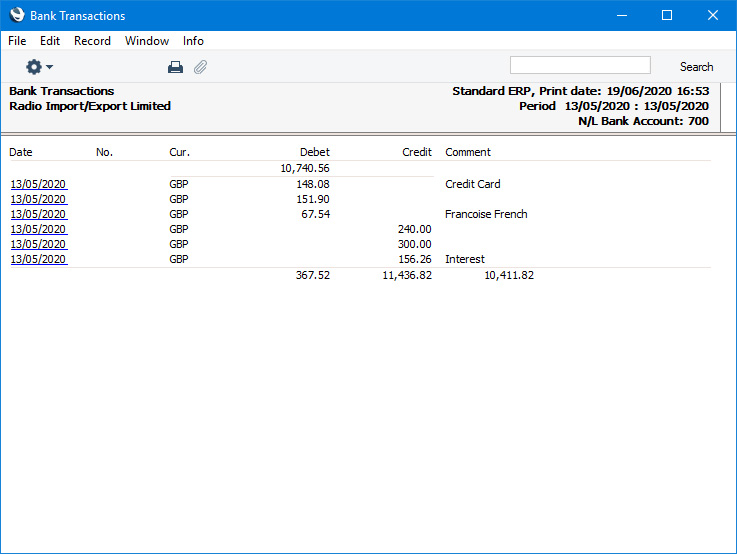
- Detailed
- In addition to the information printed in the Overview, the report will print the Payer and Recipient names, the P. and R. References and the P. Reg. No. 1.
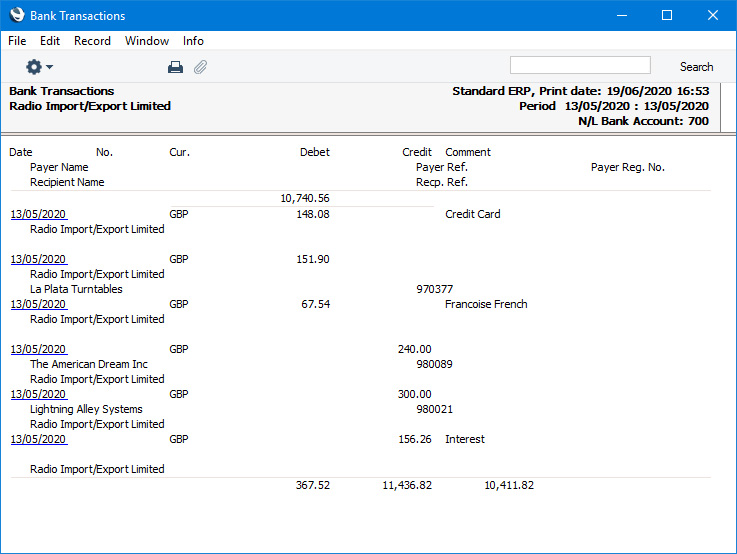
- Overview
Reports in the Nominal Ledger:
- Introduction
- Definition of Nominal Ledger Reports
- Drill-down
- The Operations Menu
- Account Reconciliation
- Accrual Report
- Analytical Balance
- Analytical Balance (Fiscal purposes)
- Balance Sheet
- Bank Reconciliation
- Bank Statement
- Bank Transactions
- Base Currency Rate Change
- Budget Journal
- Cash Flow
- Chart of Accounts
- Correction List
- Corresponding Accounts
- Creditors Account
- Currency A/C Rate Change
- Daily Balances
- Debtors Account
- Forward Balance Journal
- Key Financial Ratios
- Liquidity Forecast
- Multicurrency Accounts Rate Difference
- N/L Accrual Transactions
- N/L Transfer, Subsystems
- Nominal Ledger
- Profit & Loss
- Revised Budget Journal
- Simulation Journal
- Tag/Object Results
- Tag/Object/Quantity Results
- Tax Account Balances
- Tax Calculations
- Tax Transactions for Registers
- Template Transaction Journal
- Test Corresponding Rules
- Transaction Journal
- Transaction Summary
- Trial Balance
- VAT Listing
- VAT Report
- VAT Report Purchases
- VAT Report Sales
- VAT Transaction Journal
- XBRL Report
Go back to:
- Home page for Nominal Ledger manual
- Home page for Standard ERP manual
Base Currency Rate Change
Please refer here for full details about this report.---
Reports in the Nominal Ledger:
- Introduction
- Definition of Nominal Ledger Reports
- Drill-down
- The Operations Menu
- Account Reconciliation
- Accrual Report
- Analytical Balance
- Analytical Balance (Fiscal purposes)
- Balance Sheet
- Bank Reconciliation
- Bank Statement
- Bank Transactions
- Base Currency Rate Change
- Budget Journal
- Chart of Accounts
- Correction List
- Corresponding Accounts
- Creditors Account
- Currency A/C Rate Change
- Daily Balances
- Debtors Account
- Forward Balance Journal
- Income & Expense Book
- Key Financial Ratios
- Liquidity Forecast
- Multicurrency Accounts Rate Difference
- N/L Accrual Transactions
- N/L Transfer, Subsystems
- Nominal Ledger
- Profit & Loss
- Revised Budget Journal
- Simulation Journal
- Tag/Object Results
- Tag/Object/Quantity Results
- Tax Account Balances
- Tax Calculations
- Tax Transactions for Registers
- Template Transaction Journal
- Test Corresponding Rules
- Transaction Journal
- Transaction Summary
- Trial Balance
- VAT Listing
- VAT Report
- VAT Report Purchases
- VAT Report Sales
- VAT Transaction Journal
- XBRL Report
Go back to:
- Home page for Nominal Ledger manual
- Home page for Standard ERP manual
Budget Journal
This page describes the Budget Journal report in the Nominal Ledger.---
The Budget Journal is a list of the records in the Budget register.
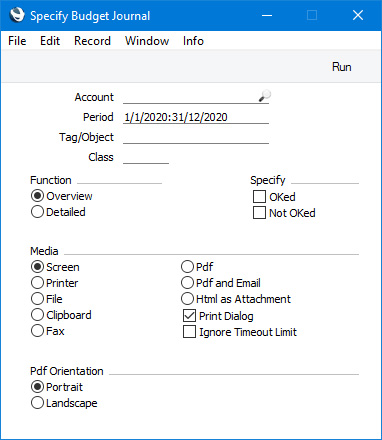
- Account
- Paste Special
Account register, Nominal Ledger/System module
- Range Reporting Alpha
- If you need the report to list Budgets for a particular Account, specify that Account here. You can also enter a range of Accounts separated by a colon (:).
- If you need the report to list Budgets for a particular Account, specify that Account here. You can also enter a range of Accounts separated by a colon (:).
- Period
- Paste Special
Reporting Periods setting, System module
- Enter the start and end date of the period whose Budgets are to be shown in the report. The first record in the Reporting Periods setting will be used as a default.
- All Budgets that are relevant to the report period will be listed in the report. For example, if the report period is June 1st to June 30th, Budgets starting or ending in June will be included, and Budgets starting before June and ending after June will also be shown.
- All Budgets that are relevant to the report period will be listed in the report. For example, if the report period is June 1st to June 30th, Budgets starting or ending in June will be included, and Budgets starting before June and ending after June will also be shown.
- Tag/Object
- Paste Special
Tag/Object register, Nominal Ledger/System module
- To list Budgets with a particular Tag/Object, enter that Tag/Object here. For a Budget to be included in the report, its Tags/Objects and those in this field must match exactly. So, a Budget with the Tags/Objects "AB,10101" will not be included in the report if you enter "AB" in this field.
- Class
- Paste Special
Budget Classes setting, Nominal Ledger
- If you need the report to list Budgets with a particular Class, specify that Class here.
- Function
- Use these options to specify the level of detail that you need to be included in the report.
- Overview
- This option will produce a report that contains a single summary line for each Budget, showing Account Number and Name, Tag/Object, Class, Start and End Date and Sum.
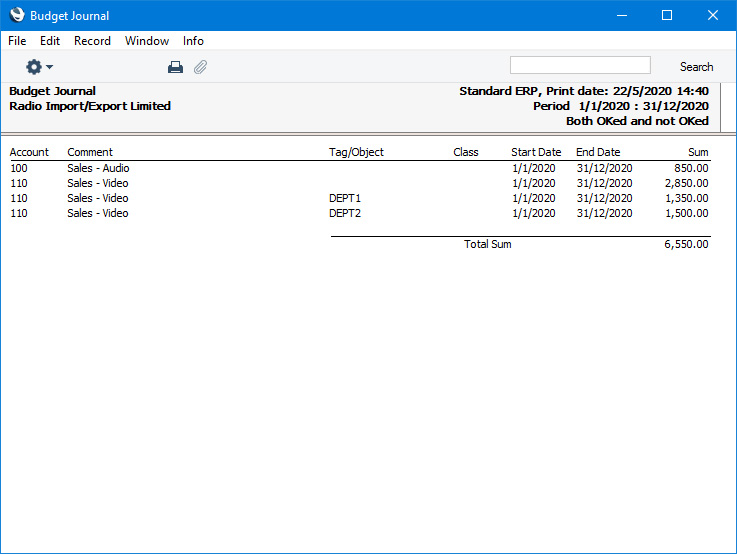
- Detailed
- In addition to the information shown in the Overview, this option also lists the monthly, quarterly or other periodic totals in each Budget.
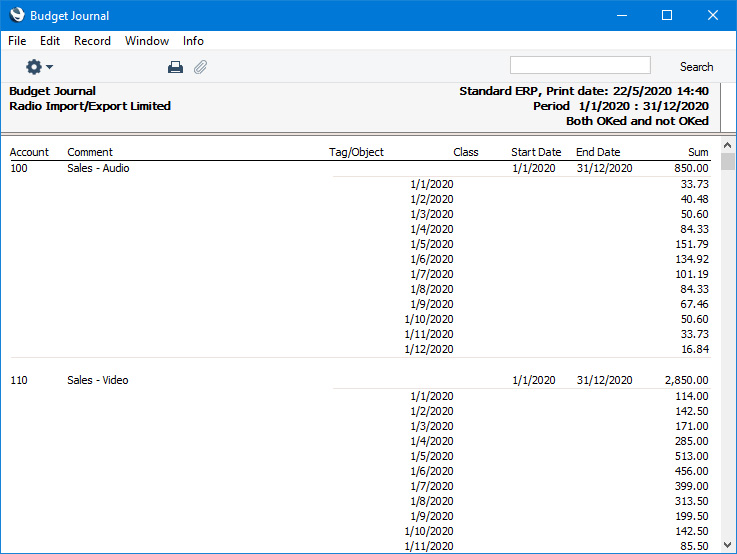
- Overview
- Specify
- Use these options to specify whether Budgets that have been marked as OK, Budgets that have not been marked as OK or both are to be included in the report. You must choose at least one option, otherwise the report will be empty.
Reports in the Nominal Ledger:
- Introduction
- Definition of Nominal Ledger Reports
- Drill-down
- The Operations Menu
- Account Reconciliation
- Accrual Report
- Analytical Balance
- Analytical Balance (Fiscal purposes)
- Balance Sheet
- Bank Reconciliation
- Bank Statement
- Bank Transactions
- Base Currency Rate Change
- Budget Journal
- Cash Flow
- Chart of Accounts
- Correction List
- Corresponding Accounts
- Creditors Account
- Currency A/C Rate Change
- Daily Balances
- Debtors Account
- Forward Balance Journal
- Key Financial Ratios
- Liquidity Forecast
- Multicurrency Accounts Rate Difference
- N/L Accrual Transactions
- N/L Transfer, Subsystems
- Nominal Ledger
- Profit & Loss
- Revised Budget Journal
- Simulation Journal
- Tag/Object Results
- Tag/Object/Quantity Results
- Tax Account Balances
- Tax Calculations
- Tax Transactions for Registers
- Template Transaction Journal
- Test Corresponding Rules
- Transaction Journal
- Transaction Summary
- Trial Balance
- VAT Listing
- VAT Report
- VAT Report Purchases
- VAT Report Sales
- VAT Transaction Journal
- XBRL Report
Go back to:
- Home page for Nominal Ledger manual
- Home page for Standard ERP manual
Chart of Accounts
This page describes the Chart of Accounts report in the Nominal Ledger.---
Use the Chart of Accounts report when you need to print a list of the Accounts in the Account register. You can also produce this report by running the System Documentation report in the System module using the Chart of Accounts or Chart of Accounts with Report definitions options.
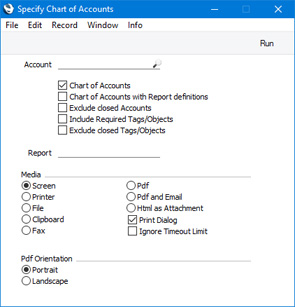
- Account
- Paste Special
Account register, Nominal Ledger/System module
- Range Reporting Alpha
- Enter an Account Number or a range of Numbers separated by a colon (:) here if you would like specific Accounts to be shown in the report.
- Enter an Account Number or a range of Numbers separated by a colon (:) here if you would like specific Accounts to be shown in the report.
- Chart of Accounts
- This option prints a list of the Accounts in the Account register, in Account Number order. It shows the Account Number and Name, VAT Code, Autotransaction and Account Type.
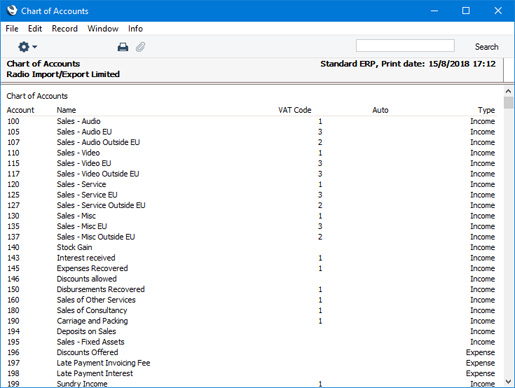
- Chart of Accounts with Report definitions
- This option adds an extra column to the report showing the report definitions in which each Account has been used.
- For example, if Account 11110 appears in row 1020 in the Balance Sheet, the extra column in this report will show "B1020", with "B" signifying the Balance Sheet and "1020" signifying the row number. If you have more than one Balance Sheet definition, the same code "B" will be used for each one, so it will not be possible to distinguish between different definitions. If you would like the report to show the Account usage in a single report definition, specify that report in the Report field below.
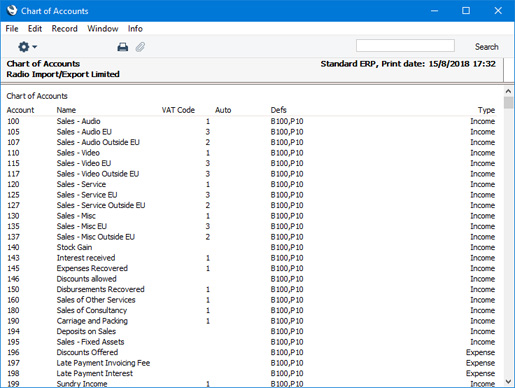
- For example, if Account 11110 appears in row 1020 in the Balance Sheet, the extra column in this report will show "B1020", with "B" signifying the Balance Sheet and "1020" signifying the row number. If you have more than one Balance Sheet definition, the same code "B" will be used for each one, so it will not be possible to distinguish between different definitions. If you would like the report to show the Account usage in a single report definition, specify that report in the Report field below.
- Exclude closed Accounts
- Select this option if you would like to omit Accounts that have been marked as Closed from the report.
- Include Required Tags/Objects
- Select this option if you would like the report to display the Tags/Objects that must be used with each Account, as specified in the Tag/Object Type Control setting.
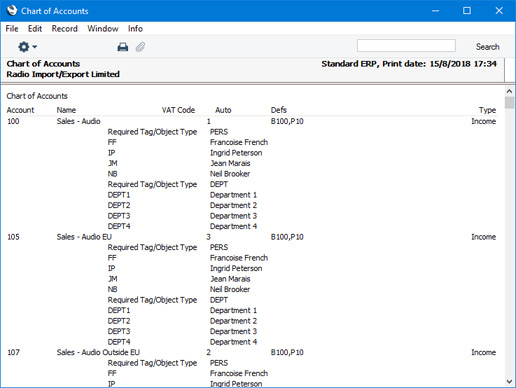
- Exclude closed Tags/Objects
- If you have selected the Include Required Tags/Objects option above, select this option as well if you need Objects that have been marked as Closed to be excluded from the report.
- Report
- Paste Special
Report Definitions in the Report Settings setting, Nominal Ledger
- If you have selected the Chart of Accounts with Report definitions option above and you need the report to show the Accounts that are used in a single report definition, specify that report here.
Reports in the Nominal Ledger:
- Introduction
- Definition of Nominal Ledger Reports
- Drill-down
- The Operations Menu
- Account Reconciliation
- Accrual Report
- Analytical Balance
- Analytical Balance (Fiscal purposes)
- Balance Sheet
- Bank Reconciliation
- Bank Statement
- Bank Transactions
- Base Currency Rate Change
- Budget Journal
- Cash Flow
- Chart of Accounts
- Correction List
- Corresponding Accounts
- Creditors Account
- Currency A/C Rate Change
- Daily Balances
- Debtors Account
- Forward Balance Journal
- Income & Expense Book
- Key Financial Ratios
- Liquidity Forecast
- Multicurrency Accounts Rate Difference
- N/L Accrual Transactions
- N/L Transfer, Subsystems
- Nominal Ledger
- Profit & Loss
- Revised Budget Journal
- Simulation Journal
- Tag/Object Results
- Tag/Object/Quantity Results
- Tax Account Balances
- Tax Calculations
- Tax Transactions for Registers
- Template Transaction Journal
- Test Corresponding Rules
- Transaction Journal
- Transaction Summary
- Trial Balance
- VAT Listing
- VAT Report
- VAT Report Purchases
- VAT Report Sales
- VAT Transaction Journal
- XBRL Report
Go back to:
- Home page for Nominal Ledger manual
- Home page for Standard ERP manual
Correction List
This page describes the Correction List report in the Nominal Ledger.---
The Correction List is a list of corrections and updates that you have made to Transactions from a specified period. You can make a correction to a Transaction by opening it in a record window and selecting 'Correction Mark' from the Operations menu (Windows/macOS) or Tools menu (iOS/Android), while you can make an update using the 'Update Mark' function on the same menu. The report will also include Transactions created from Sub System records that you have invalidated. You cannot change the definition of this report.
You can also produce this report from the Consolidation module. In this case, the report will list corrections and updates made to Transactions in every Company in the database.
When printed to screen, the Correction List has the Standard ERP Drill-down feature. Click (Windows/macOS) or tap (iOS/Android) on any Transaction Number in the report to open an individual Transaction record.
Selecting 'Correction List' from the 'Reports' list in the Nominal Ledger or the Consolidation module will open the following window:
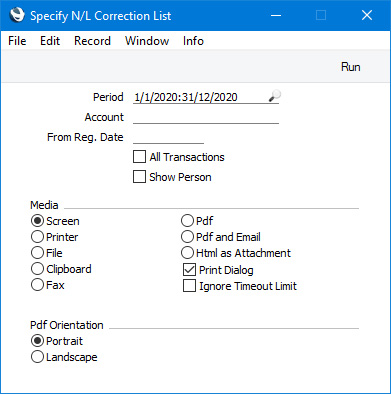
- Period
- Paste Special
Reporting Periods setting, System module
- Enter the report period. The report will list corrected and updated Transactions that were originally entered during the period that you specify here. The corrections and updates themselves may have been made after this period.
- If you need the period to be a single day, just enter the date once and this will be converted to the period format automatically.
- The first row of the Reporting Periods setting will be used as the default value.
- If you need the period to be a single day, just enter the date once and this will be converted to the period format automatically.
- Account
- Paste Special
Account register, Nominal Ledger/System module
- Range Reporting Alpha
- Enter an Account here if you need the report to list corrected and updated Transactions featuring a particular Account in at least one row.
- Enter an Account here if you need the report to list corrected and updated Transactions featuring a particular Account in at least one row.
- From Reg. Date
- Enter a date here if you need the report to list corrections and updates made on or after a particular date.
- All Transactions
- By default, the report will only list Transactions that have been corrected or updated. For each Transaction, it will show the Transaction Number, the Transaction Date, the action (i.e. correction or update) and date of the action. In the case of a corrected Transaction, the Number of the correcting Transaction will also be shown. If you select this option, every Transaction, including those that have not been corrected or updated, will be listed in the report, together with their registration dates. You might use this option to gain an impression of the proportion of Transactions that have been changed, or to get an idea of how long it takes for updates and corrections to be made.
- If you use this option and also enter an Account in the field above, the report will list all Transactions that post to that Account, with and without corrections and updates. Other updates and corrections will not be shown.
- If you use this option and also enter an Account in the field above, the report will list all Transactions that post to that Account, with and without corrections and updates. Other updates and corrections will not be shown.
- Show Person
- If a Transaction was corrected, the Signature of the correcting Person will be included in the report if you have selected this option. If a Transaction was updated or invalidated, the Signature will always be shown.
- 2020.1379
- Transaction corrected by Transaction 2020.1381.
- 2020.1380
- Transaction updated.
- P/INV.970435
- Transaction created from a Sub System record (Purchase Invoice 970435) that was invalidated.
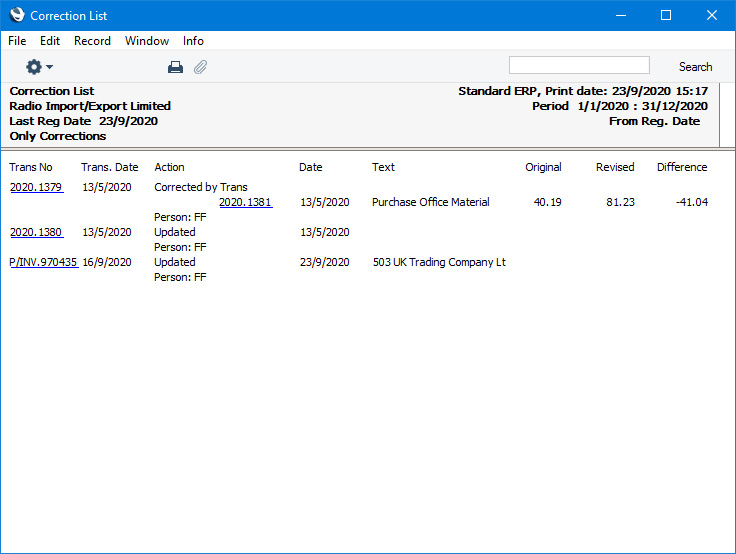
Reports in the Nominal Ledger:
- Introduction
- Definition of Nominal Ledger Reports
- Drill-down
- The Operations Menu
- Account Reconciliation
- Accrual Report
- Analytical Balance
- Analytical Balance (Fiscal purposes)
- Balance Sheet
- Bank Reconciliation
- Bank Statement
- Bank Transactions
- Base Currency Rate Change
- Budget Journal
- Cash Flow
- Chart of Accounts
- Correction List
- Corresponding Accounts
- Creditors Account
- Currency A/C Rate Change
- Daily Balances
- Debtors Account
- Forward Balance Journal
- Income & Expense Book
- Key Financial Ratios
- Liquidity Forecast
- Multicurrency Accounts Rate Difference
- N/L Accrual Transactions
- N/L Transfer, Subsystems
- Nominal Ledger
- Profit & Loss
- Revised Budget Journal
- Simulation Journal
- Tag/Object Results
- Tag/Object/Quantity Results
- Tax Account Balances
- Tax Calculations
- Tax Transactions for Registers
- Template Transaction Journal
- Test Corresponding Rules
- Transaction Journal
- Transaction Summary
- Trial Balance
- VAT Listing
- VAT Report
- VAT Report Purchases
- VAT Report Sales
- VAT Transaction Journal
- XBRL Report
Go back to:
- Home page for Nominal Ledger manual
- Home page for Standard ERP manual
Correction List
This page describes the Correction List report in the Nominal Ledger.---
The Correction List is a list of corrections and updates that you have made to Transactions from a specified period. You can make a correction to a Transaction by opening it in a record window and selecting 'Correction Mark' from the Operations menu (Windows/macOS) or Tools menu (iOS/Android), while you can make an update using the 'Update Mark' function on the same menu. The report will also include Transactions created from Sub System records that you have invalidated. You cannot change the definition of this report.
You can also produce this report from the Consolidation module. In this case, the report will list corrections and updates made to Transactions in every Company in the database.
When printed to screen, the Correction List has the Standard ERP Drill-down feature. Click (Windows/macOS) or tap (iOS/Android) on any Transaction Number in the report to open an individual Transaction record.
Selecting 'Correction List' from the 'Reports' list in the Nominal Ledger or the Consolidation module will open the following window:
- Period
- Paste Special
Reporting Periods setting, System module
- Enter the report period. The report will list corrected and updated Transactions that were originally entered during the period that you specify here. The corrections and updates themselves may have been made after this period.
- If you need the period to be a single day, just enter the date once and this will be converted to the period format automatically.
- The first row of the Reporting Periods setting will be used as the default value.
- If you need the period to be a single day, just enter the date once and this will be converted to the period format automatically.
- Account
- Paste Special
Account register, Nominal Ledger/System module
- Range Reporting Alpha
- Enter an Account here if you need the report to list corrected and updated Transactions featuring a particular Account in at least one row.
- Enter an Account here if you need the report to list corrected and updated Transactions featuring a particular Account in at least one row.
- From Reg. Date
- Enter a date here if you need the report to list corrections and updates made on or after a particular date.
- All Transactions
- By default, the report will only list Transactions that have been corrected or updated. For each Transaction, it will show the Transaction Number, the Transaction Date, the action (i.e. correction or update) and date of the action. In the case of a corrected Transaction, the Number of the correcting Transaction will also be shown. If you select this option, every Transaction, including those that have not been corrected or updated, will be listed in the report, together with their registration dates. You might use this option to gain an impression of the proportion of Transactions that have been changed, or to get an idea of how long it takes for updates and corrections to be made.
- If you use this option and also enter an Account in the field above, the report will list all Transactions that post to that Account, with and without corrections and updates. Other updates and corrections will not be shown.
- If you use this option and also enter an Account in the field above, the report will list all Transactions that post to that Account, with and without corrections and updates. Other updates and corrections will not be shown.
- Show Person
- If a Transaction was corrected, the Signature of the correcting Person will be included in the report if you have selected this option. If a Transaction was updated or invalidated, the Signature will always be shown.
- 2020.1379
- Transaction corrected by Transaction 2020.1381.
- 2020.1380
- Transaction updated.
- P/INV.970435
- Transaction created from a Sub System record (Purchase Invoice 970435) that was invalidated.
Reports in the Nominal Ledger:
- Introduction
- Definition of Nominal Ledger Reports
- Drill-down
- The Operations Menu
- Account Reconciliation
- Accrual Report
- Analytical Balance
- Analytical Balance (Fiscal purposes)
- Balance Sheet
- Bank Reconciliation
- Bank Statement
- Bank Transactions
- Base Currency Rate Change
- Budget Journal
- Cash Flow
- Chart of Accounts
- Correction List
- Corresponding Accounts
- Creditors Account
- Currency A/C Rate Change
- Daily Balances
- Debtors Account
- Forward Balance Journal
- Income & Expense Book
- Key Financial Ratios
- Liquidity Forecast
- Multicurrency Accounts Rate Difference
- N/L Accrual Transactions
- N/L Transfer, Subsystems
- Nominal Ledger
- Profit & Loss
- Revised Budget Journal
- Simulation Journal
- Tag/Object Results
- Tag/Object/Quantity Results
- Tax Account Balances
- Tax Calculations
- Tax Transactions for Registers
- Template Transaction Journal
- Test Corresponding Rules
- Transaction Journal
- Transaction Summary
- Trial Balance
- VAT Listing
- VAT Report
- VAT Report Purchases
- VAT Report Sales
- VAT Transaction Journal
- XBRL Report
Go back to:
- Home page for Nominal Ledger manual
- Home page for Standard ERP manual
Corresponding Accounts
This page describes the Corresponding Accounts report in the Nominal Ledger.---
The Corresponding Accounts report is a list of Account postings made during the selected period showing how each one has been balanced. For example, where an Account has been used on the credit side of a Transaction, the report will show the Account(s) used on the debit side, with amounts posted. The balancing Accounts are termed 'Corresponding Accounts'.
In a complex Transaction, where, for example, the first two lines are debit Accounts and there are then several credit lines, you should establish correspondence manually while entering the Transaction using the Corr field on flip F of each Transaction row.
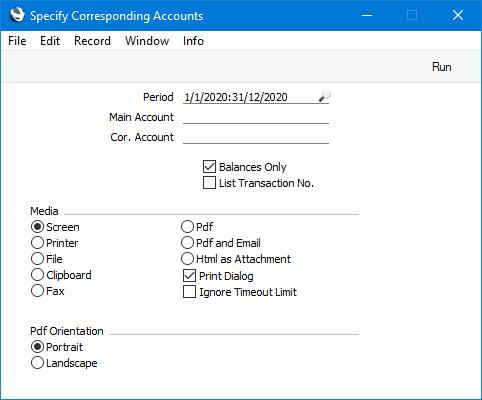
- Period
- Paste Special
Reporting Periods setting, System module
- Specify the period to be covered by the report. The report will list postings in Transactions entered during this period.
- Main Account
- Paste Special
Account register, Nominal Ledger/System module
- Specify here the Account whose correspondence you wish to analyse.
- Corr. Account
- Paste Special
Account register, Nominal Ledger/System module
- Use this field if you are only interested in viewing a specific corresponding Account.
- Balances Only
- With this option selected, for each Main Account, each Corresponding Account will be listed on a single row, with debit and/or credit totals for the report period (i.e. the total amount posted to the Main Account balanced by postings to the Corresponding Account).
- In the example illustrated below, Account 750 has an opening balance of -47,923.60. During the report period, a total of 3,500.00 was debited to this Account with Account 199 as the Corresponding (balancing) Account. 1,980.00 was credited to Account 750 with Account 700 as Corresponding Account.
If you do not select the Balances Only option, every posting will be listed individually.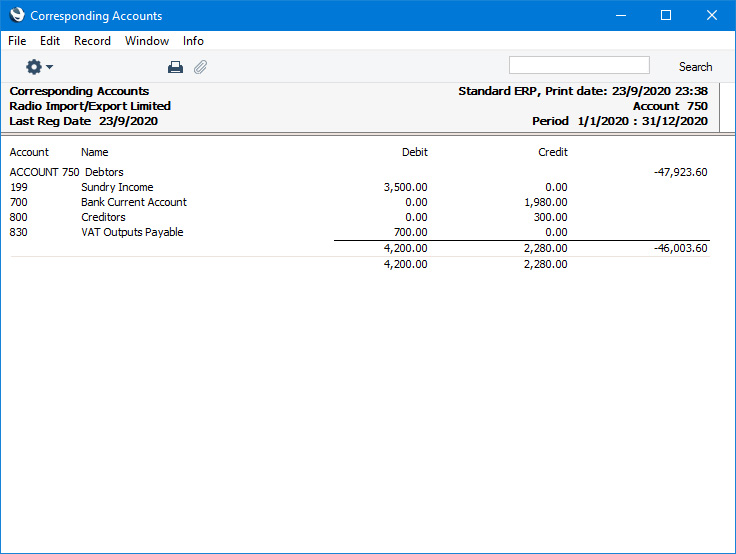
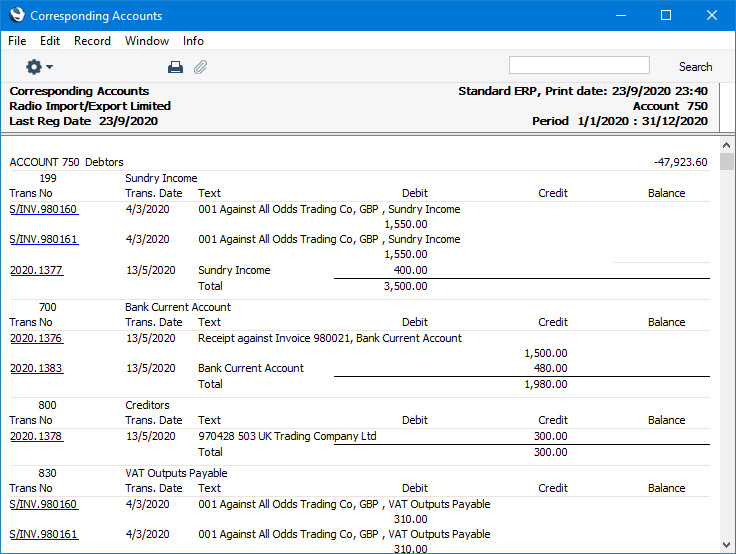
- In the example illustrated below, Account 750 has an opening balance of -47,923.60. During the report period, a total of 3,500.00 was debited to this Account with Account 199 as the Corresponding (balancing) Account. 1,980.00 was credited to Account 750 with Account 700 as Corresponding Account.
- List Transaction No.
- If you select this option, the Transaction Numbers of all Transactions that fall within the reporting period, together with debit and credit totals, will be listed at the end of the report.
Reports in the Nominal Ledger:
- Introduction
- Definition of Nominal Ledger Reports
- Drill-down
- The Operations Menu
- Account Reconciliation
- Accrual Report
- Analytical Balance
- Analytical Balance (Fiscal purposes)
- Balance Sheet
- Bank Reconciliation
- Bank Statement
- Bank Transactions
- Base Currency Rate Change
- Budget Journal
- Cash Flow
- Chart of Accounts
- Correction List
- Corresponding Accounts
- Creditors Account
- Currency A/C Rate Change
- Daily Balances
- Debtors Account
- Forward Balance Journal
- Income & Expense Book
- Key Financial Ratios
- Liquidity Forecast
- Multicurrency Accounts Rate Difference
- N/L Accrual Transactions
- N/L Transfer, Subsystems
- Nominal Ledger
- Profit & Loss
- Revised Budget Journal
- Simulation Journal
- Tag/Object Results
- Tag/Object/Quantity Results
- Tax Account Balances
- Tax Calculations
- Tax Transactions for Registers
- Template Transaction Journal
- Test Corresponding Rules
- Transaction Journal
- Transaction Summary
- Trial Balance
- VAT Listing
- VAT Report
- VAT Report Purchases
- VAT Report Sales
- VAT Transaction Journal
- XBRL Report
Go back to:
- Home page for Nominal Ledger manual
- Home page for Standard ERP manual
Creditors Account
This page describes the Creditors Account report in the Nominal Ledger.---
The Creditors Account report satisfies a specific requirement of users in Russia. It is a list of Suppliers, summarising the debit and credit postings made to a specified Creditor Account that are associated with each Supplier.
The report is compiled from Transaction rows that post to the specified Account. It uses the Supplier information on flip E of each Transaction row to connect that row to a Supplier. If the Supplier information is missing from a particular Transaction row that posts to the specified Creditor Account, that Transaction row cannot be connected to a Supplier and therefore it will not be included in the report. When a Nominal Ledger Transaction is created from a Purchase Invoice or Payment, Supplier information will only be copied to flip E of that Transaction if the Supp. Info on Trans. option on the 'Comment' card of the Purchase Invoice or in the Payment is selected. This option will be selected by default if you are using the Supp. Info on Trans. option in the Account Usage P/L setting, so it is recommended that you select this option if you want to use this report.
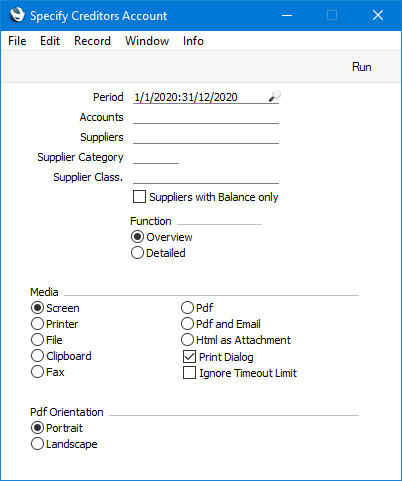
- Period
- Paste Special
Reporting Periods setting, System module
- The report will include all postings to the Creditor Account specified below made during the period that you specify here.
- Accounts
- Paste Special
Account register, Nominal Ledger/System module
- Range Reporting Alpha
- Specify the Creditor Account whose postings are to be included in the report. You can also enter a range of Accounts separated by a colon (:). You must specify an Account, otherwise the report will be empty.
- Specify the Creditor Account whose postings are to be included in the report. You can also enter a range of Accounts separated by a colon (:). You must specify an Account, otherwise the report will be empty.
- Suppliers
- Paste Special
Suppliers in Contact register
- Range Reporting Alpha
- Enter a Supplier Number (or range of Supplier Numbers separated by a colon) here if you need to report on a particular Supplier (or range of Suppliers).
- Enter a Supplier Number (or range of Supplier Numbers separated by a colon) here if you need to report on a particular Supplier (or range of Suppliers).
- Supplier Category
- Paste Special
Supplier Categories setting, Purchase Ledger
- Enter a Supplier Category here if you need the report to list postings to the Creditor Account related to Suppliers belonging to a particular Supplier Category.
- Supplier Class.
- Paste Special
Contact Classifications setting, CRM module
- Enter a Classification Code in this field if you want to list Suppliers with a certain Classification in the report. If you leave the field blank, all Suppliers, with and without Classification, will be included. If you enter a number of Classifications separated by commas, only those Suppliers featuring all the Classifications listed will be included. If you enter a number of Classifications separated by plus signs (+), all Suppliers featuring at least one of the Classifications listed will be included. If you enter a Classification preceded by an exclamation mark (!), all Suppliers featuring any Classification except the one listed will be included.
- For example:
- 1,2
- Lists Suppliers with Classifications 1 and 2 (including Suppliers with Classifications 1, 2 and 3).
- 1+2
- Lists Suppliers with Classifications 1 or 2.
- !2
- Lists all Suppliers except those with Classification 2.
- 1,!2
- Lists Suppliers with Classification 1 but excludes those with Classification 2 (i.e. Suppliers with Classifications 1 and 2 are not shown). Note the comma before the exclamation mark in this example.
- !1,!2
- Lists all Suppliers except those with Classification 1 or 2 or both. Again, note the comma.
- !(1,2)
- Lists all Suppliers except those with Classifications 1 and 2 (Suppliers with Classifications 1, 2 and 3 will not be listed).
- !1+2
- Lists Suppliers without Classification 1 and those with Classification 2 (Suppliers with Classifications 1 and 2 will be listed).
- (1,2)+(3,4)
- Lists Suppliers with Classifications 1 and 2, and those with Classifications 3 and 4.
- 1*
- Lists Suppliers with Classifications beginning with 1 (e.g. 1, 10, 100).
- 1*,!1
- Lists Suppliers with Classifications beginning with 1 but not 1 itself.
- *1
- Lists Suppliers with Classifications ending with 1 (e.g. 1, 01, 001).
- 1*,*1
- Lists Suppliers with Classifications beginning and ending with 1.
- For example:
- Suppliers with Balance only
- By default, the report will list every Supplier in the Contact register. Select this option if you want the report only to list those Suppliers that have been quoted in at least one posting to the Creditor Account (i.e. Suppliers with at least one Purchase Invoice or Payment posting to that Account).
- Function
- Use these options to control the level of detail shown in the report.
- Overview
- The Overview is a simple list with one line per Supplier, showing the following debit and credit balances for the specified Creditor Account: opening balances; period balances; and closing balances.
- Detailed
- As well as the information contained in the Overview, the Detailed option lists the individual postings to the Creditor Account, showing the Purchase Invoice Number in each case.
- Overview
Reports in the Nominal Ledger:
- Introduction
- Definition of Nominal Ledger Reports
- Drill-down
- The Operations Menu
- Account Reconciliation
- Accrual Report
- Analytical Balance
- Analytical Balance (Fiscal purposes)
- Balance Sheet
- Bank Reconciliation
- Bank Statement
- Bank Transactions
- Base Currency Rate Change
- Budget Journal
- Cash Flow
- Chart of Accounts
- Correction List
- Corresponding Accounts
- Creditors Account
- Currency A/C Rate Change
- Daily Balances
- Debtors Account
- Forward Balance Journal
- Income & Expense Book
- Key Financial Ratios
- Liquidity Forecast
- Multicurrency Accounts Rate Difference
- N/L Accrual Transactions
- N/L Transfer, Subsystems
- Nominal Ledger
- Profit & Loss
- Revised Budget Journal
- Simulation Journal
- Tag/Object Results
- Tag/Object/Quantity Results
- Tax Account Balances
- Tax Calculations
- Tax Transactions for Registers
- Template Transaction Journal
- Test Corresponding Rules
- Transaction Journal
- Transaction Summary
- Trial Balance
- VAT Listing
- VAT Report
- VAT Report Purchases
- VAT Report Sales
- VAT Transaction Journal
- XBRL Report
Go back to:
- Home page for Nominal Ledger manual
- Home page for Standard ERP manual
Currency A/C Rate Change
Please refer here for full details about this report.---
Reports in the Nominal Ledger:
- Introduction
- Definition of Nominal Ledger Reports
- Drill-down
- The Operations Menu
- Account Reconciliation
- Accrual Report
- Analytical Balance
- Analytical Balance (Fiscal purposes)
- Balance Sheet
- Bank Reconciliation
- Bank Statement
- Bank Transactions
- Base Currency Rate Change
- Budget Journal
- Cash Flow
- Chart of Accounts
- Correction List
- Corresponding Accounts
- Creditors Account
- Currency A/C Rate Change
- Daily Balances
- Debtors Account
- Forward Balance Journal
- Income & Expense Book
- Key Financial Ratios
- Liquidity Forecast
- Multicurrency Accounts Rate Difference
- N/L Accrual Transactions
- N/L Transfer, Subsystems
- Nominal Ledger
- Profit & Loss
- Revised Budget Journal
- Simulation Journal
- Tag/Object Results
- Tag/Object/Quantity Results
- Tax Account Balances
- Tax Calculations
- Tax Transactions for Registers
- Template Transaction Journal
- Test Corresponding Rules
- Transaction Journal
- Transaction Summary
- Trial Balance
- VAT Listing
- VAT Report
- VAT Report Purchases
- VAT Report Sales
- VAT Transaction Journal
- XBRL Report
Go back to:
- Home page for Nominal Ledger manual
- Home page for Standard ERP manual
Daily Balances
This page describes the Daily Balances report in the Nominal Ledger.---
The Daily Balances report provides daily debit and credit posting totals for a specified Account or Accounts. If you need to see a list of the individual postings that make up these totals, use the Nominal Ledger report.
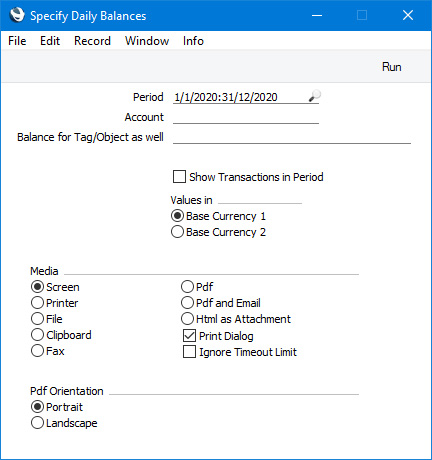
- Period
- Paste Special
Reporting Periods setting, System module
- Specify the period to be covered by the report. To obtain balances for a particular day, simply enter the date.
- For each Account, the report will provide debit and credit posting totals for each day in the specified period when the Account was used.
- For each Account, the report will provide debit and credit posting totals for each day in the specified period when the Account was used.
- Account
- Paste Special
Account register, Nominal Ledger/System module
- Range Reporting Alpha
- Specify the Account or range of Accounts whose daily debit and credit posting totals are to be shown in the report. You must specify an Account, otherwise the report will be empty.
- Specify the Account or range of Accounts whose daily debit and credit posting totals are to be shown in the report. You must specify an Account, otherwise the report will be empty.
- Balance for Tag/Object as well
- Paste Special
Tag/Object register, Nominal Ledger/System module
- If you need to show for each Account daily debit and credit posting totals for a particular Tag/Object as well, specify that Tag/Object here. If you enter a number of Tags/Objects separated by commas, the figures will be calculated from postings (i.e. Transaction rows) featuring all the Tags/Objects listed.
- Show Transactions in Period
- If you select this option, the Transaction Numbers of each Transaction that falls within the reporting period, together with debit and credit totals, will be listed at the end of the report.
- Values in
- If you are using the Dual-Base system, use these options to specify whether the values in the report are to be shown in Base Currency 1 or 2.
- If you are not using the Dual-Base system, use the Base Currency 1 option to produce a report in your home Currency.
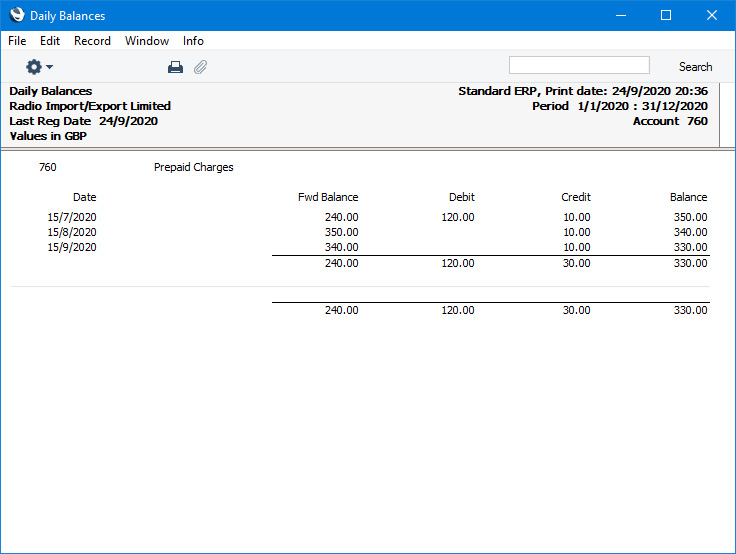
- If you are not using the Dual-Base system, use the Base Currency 1 option to produce a report in your home Currency.
Reports in the Nominal Ledger:
- Introduction
- Definition of Nominal Ledger Reports
- Drill-down
- The Operations Menu
- Account Reconciliation
- Accrual Report
- Analytical Balance
- Analytical Balance (Fiscal purposes)
- Balance Sheet
- Bank Reconciliation
- Bank Statement
- Bank Transactions
- Base Currency Rate Change
- Budget Journal
- Cash Flow
- Chart of Accounts
- Correction List
- Corresponding Accounts
- Creditors Account
- Currency A/C Rate Change
- Daily Balances
- Debtors Account
- Forward Balance Journal
- Income & Expense Book
- Key Financial Ratios
- Liquidity Forecast
- Multicurrency Accounts Rate Difference
- N/L Accrual Transactions
- N/L Transfer, Subsystems
- Nominal Ledger
- Profit & Loss
- Revised Budget Journal
- Simulation Journal
- Tag/Object Results
- Tag/Object/Quantity Results
- Tax Account Balances
- Tax Calculations
- Tax Transactions for Registers
- Template Transaction Journal
- Test Corresponding Rules
- Transaction Journal
- Transaction Summary
- Trial Balance
- VAT Listing
- VAT Report
- VAT Report Purchases
- VAT Report Sales
- VAT Transaction Journal
- XBRL Report
Go back to:
- Home page for Nominal Ledger manual
- Home page for Standard ERP manual
Debtors Account
This page describes the Debtors Account report in the Nominal Ledger.---
The Debtors Account report satisfies a specific requirement of users in Russia. It is a list of Customers, summarising the debit and credit postings made to a specified Debtor Account that are associated with each Customer.
The report is compiled from Transaction rows that post to the specified Account. It uses the Customer information on flip E of each Transaction row to connect that row to a Customer. If the Customer information is missing from a particular Transaction row that posts to the specified Debtor Account, that Transaction row cannot be connected to a Customer and therefore it will not be included in the report. When a Nominal Ledger Transaction is created from an Invoice or Receipt, Customer information will only be copied to flip E of that Transaction if the Cust. Info on Trans. option on the 'Identifiers' card of the Invoice or in the Receipt is selected. This option will be selected by default if you are using the Invoice Info on N/L Transaction option in the Account Usage S/L setting, so it is therefore recommended that you select this option if you want to use this report.
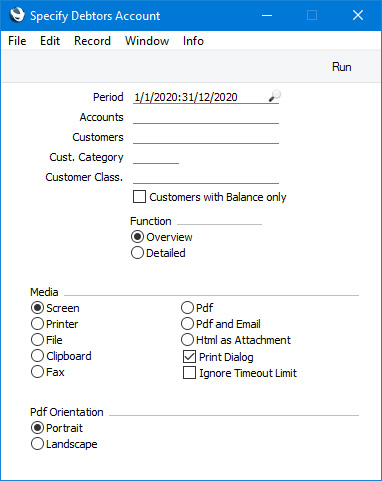
- Period
- Paste Special
Reporting Periods setting, System module
- The report will include all postings to the Debtor Account specified below made during the period that you specify here.
- Accounts
- Paste Special
Account register, Nominal Ledger/System module
- Specify the Debtor Account whose postings are to be included in the report. You must specify an Account, otherwise the report will be empty.
- Customers
- Paste Special
Customers in Contact register
- Range Reporting Alpha
- Enter a Customer Number (or range of Customer Numbers separated by a colon) here if you need to report on a particular Customer (or range of Customers).
- Enter a Customer Number (or range of Customer Numbers separated by a colon) here if you need to report on a particular Customer (or range of Customers).
- Cust. Category
- Paste Special
Customer Categories setting, Sales Ledger
- Enter a Customer Category here if you need the report to list postings to the Debtor Account related to Customers belonging to a particular Customer Category.
- Customer Class.
- Paste Special
Contact Classifications setting, CRM module
- Enter a Classification Code in this field if you want to list Customers with a certain Classification in the report. If you leave the field blank, all Customers, with and without Classification, will be included. If you enter a number of Classifications separated by commas, only those Customers featuring all the Classifications listed will be included. If you enter a number of Classifications separated by plus signs (+), all Customers featuring at least one of the Classifications listed will be included. If you enter a Classification preceded by an exclamation mark (!), all Customers featuring any Classification except the one listed will be included.
- For example:
- 1,2
- Lists Customers with Classifications 1 and 2 (including Customers with Classifications 1, 2 and 3).
- 1+2
- Lists Customers with Classifications 1 or 2.
- !2
- Lists all Customers except those with Classification 2.
- 1,!2
- Lists Customers with Classification 1 but excludes those with Classification 2 (i.e. Customers with Classifications 1 and 2 are not shown). Note the comma before the exclamation mark in this example.
- !1,!2
- Lists all Customers except those with Classification 1 or 2 or both. Again, note the comma.
- !(1,2)
- Lists all Customers except those with Classifications 1 and 2 (Customers with Classifications 1, 2 and 3 will not be listed).
- !1+2
- Lists Customers without Classification 1 and those with Classification 2 (Customers with Classifications 1 and 2 will be listed).
- (1,2)+(3,4)
- Lists Customers with Classifications 1 and 2, and those with Classifications 3 and 4.
- 1*
- Lists Customers with Classifications beginning with 1 (e.g. 1, 10, 100).
- 1*,!1
- Lists Customers with Classifications beginning with 1 but not 1 itself.
- *1
- Lists Customers with Classifications ending with 1 (e.g. 1, 01, 001).
- 1*,*1
- Lists Customers with Classifications beginning and ending with 1.
- For example:
- Customers with Balance only
- By default, the report will list every Customer in the Contact register. Select this option if you want the report only to list those Customers that have been quoted in at least one posting to the Debtor Account (i.e. Customers with at least one Invoice or Receipt posting to that Account).
- Function
- Use these options to control the level of detail shown in the report.
- Overview
- The Overview is a simple list with one line per Customer, showing the following debit and credit balances for the specified Debtor Account: opening balances; period balances; and closing balances.
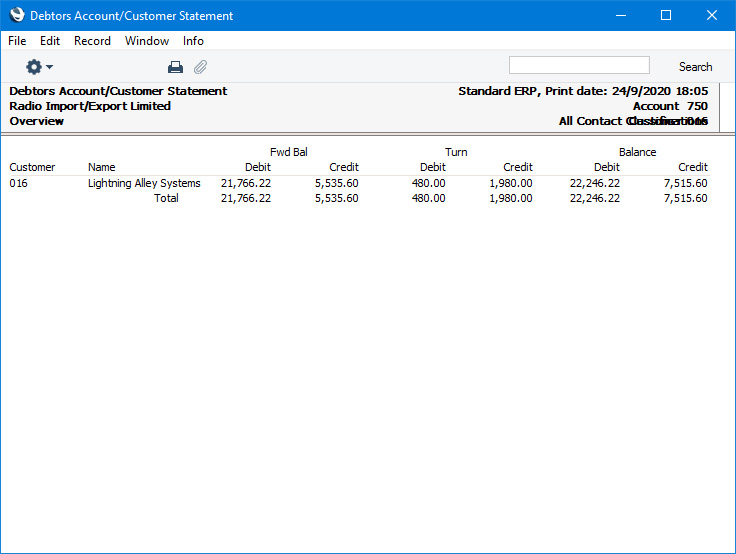
- Detailed
- As well as the information contained in the Overview, the Detailed option lists the individual postings to the Debtor Account, showing the Invoice Number in each case.
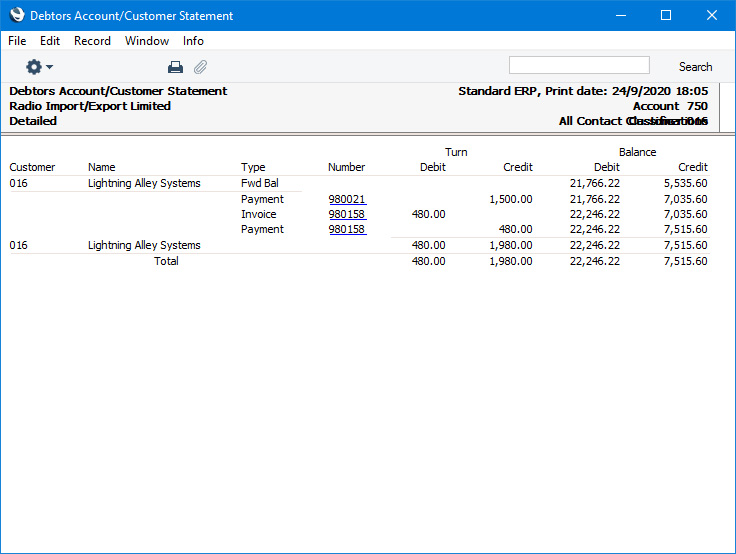
- Overview
Reports in the Nominal Ledger:
- Introduction
- Definition of Nominal Ledger Reports
- Drill-down
- The Operations Menu
- Account Reconciliation
- Accrual Report
- Analytical Balance
- Analytical Balance (Fiscal purposes)
- Balance Sheet
- Bank Reconciliation
- Bank Statement
- Bank Transactions
- Base Currency Rate Change
- Budget Journal
- Cash Flow
- Chart of Accounts
- Correction List
- Corresponding Accounts
- Creditors Account
- Currency A/C Rate Change
- Daily Balances
- Debtors Account
- Forward Balance Journal
- Income & Expense Book
- Key Financial Ratios
- Liquidity Forecast
- Multicurrency Accounts Rate Difference
- N/L Accrual Transactions
- N/L Transfer, Subsystems
- Nominal Ledger
- Profit & Loss
- Revised Budget Journal
- Simulation Journal
- Tag/Object Results
- Tag/Object/Quantity Results
- Tax Account Balances
- Tax Calculations
- Tax Transactions for Registers
- Template Transaction Journal
- Test Corresponding Rules
- Transaction Journal
- Transaction Summary
- Trial Balance
- VAT Listing
- VAT Report
- VAT Report Purchases
- VAT Report Sales
- VAT Transaction Journal
- XBRL Report
Go back to:
- Home page for Nominal Ledger manual
- Home page for Standard ERP manual
Forward Balance Journal
This page describes the Forward Balance Journal report in the Nominal Ledger.---
The Forward Balance Journal report is a lists of the records in the Brought Forward Balance setting.
For each record, the report shows the No., Date, Tag/Object and Description. The individual debit and credit postings to each Account are then listed, followed by any values in Currency if appropriate.
When printed to screen, the Forward Balance Journal has the Standard ERP Drill-down feature. Click (Windows/macOS) or tap (iOS/Android) on any serial number in the report to open an individual Brought Forward Balance record.
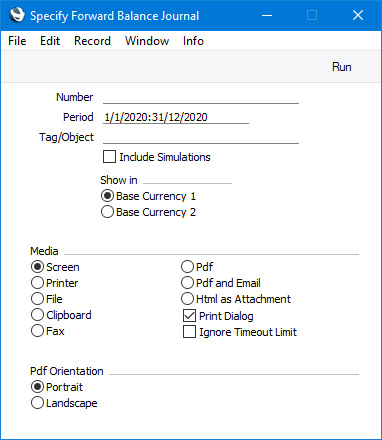
- Number
- Range Reporting
Numeric
- Enter the Number of a Brought Forward Balances record or a range of Numbers separated by a colon (:) if you need a particular Brought Forward Balance record or records to be included in the report. Leave the field blank to include all Brought Forward Balance records from the specified period in the report.
- Period
- Paste Special
Reporting Periods setting, System module
- Enter the report period. Brought Forward Balance records dated within this period will be listed in the report. The first record in the Reporting Periods setting will be used as a default.
- Object
- Paste Special
Object register, Nominal Ledger/System module
- To list Budgets with a particular Object, enter that Object here.
- Include Simulations
- Select this option if you would like to include in the report Brought Forward Balance records that you have marked to be Simulations (using the Simulation check box above the matrix in the Brought Forward Balance record window). These records will be marked as Simulations in the right-hand column in the report (this is the case for the second record in the illustration below).
- Show in
- If you are using the Dual-Base system, use these options to specify whether the values in the report are to be shown in Base Currency 1 or 2.
- If you are not using the Dual-Base system, use the Base Currency 1 option to produce a report in your home Currency.
Reports in the Nominal Ledger:
- Introduction
- Definition of Nominal Ledger Reports
- Drill-down
- The Operations Menu
- Account Reconciliation
- Accrual Report
- Analytical Balance
- Analytical Balance (Fiscal purposes)
- Balance Sheet
- Bank Reconciliation
- Bank Statement
- Bank Transactions
- Base Currency Rate Change
- Budget Journal
- Cash Flow
- Chart of Accounts
- Correction List
- Corresponding Accounts
- Creditors Account
- Currency A/C Rate Change
- Daily Balances
- Debtors Account
- Forward Balance Journal
- Income & Expense Book
- Key Financial Ratios
- Liquidity Forecast
- Multicurrency Accounts Rate Difference
- N/L Accrual Transactions
- N/L Transfer, Subsystems
- Nominal Ledger
- Profit & Loss
- Revised Budget Journal
- Simulation Journal
- Tag/Object Results
- Tag/Object/Quantity Results
- Tax Account Balances
- Tax Calculations
- Tax Transactions for Registers
- Template Transaction Journal
- Test Corresponding Rules
- Transaction Journal
- Transaction Summary
- Trial Balance
- VAT Listing
- VAT Report
- VAT Report Purchases
- VAT Report Sales
- VAT Transaction Journal
- XBRL Report
Go back to:
- Home page for Nominal Ledger manual
- Home page for Standard ERP manual
Income & Expense Book
This page describes the Income & Expense Book report in the Nominal Ledger.---
The Income and Expense Book report is a list of postings made during a specified period, sorted by date and classified by the type of Account. The report uses six Account classifications: Income Sales; Income Other; Purchases; Expense; Expense Cash and Expense Other.
Before running the report, you should use the Income & Expense Book setting in the Nominal Ledger to classify each Account. Usually you will need to enter a separate record to this setting for each classification, but you can enter more than one record for a particular classification if necessary.
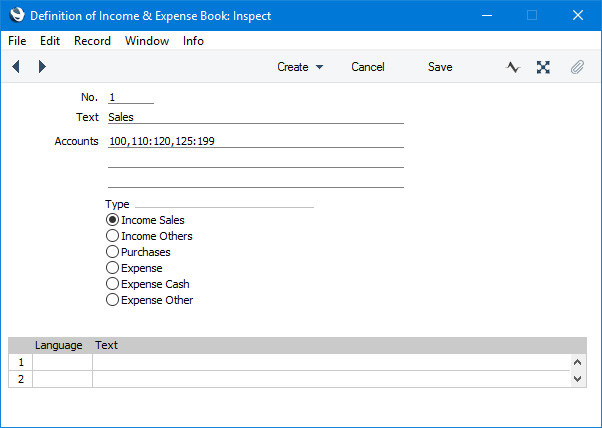
- No.
- Enter a unique code to identify each record in the Income & Expense Book setting. The code must be numeric.
- Text
- Use this field to assign a descriptive name to each record in the Income & Expense Book setting. This will be shown in the browse window.
- Accounts
- Paste Special
Account register, Nominal Ledger/System module
- Enter an Account or a range of Account numbers separated by a colon (:). You can also enter a number of individual Accounts, or ranges of Accounts, separated by commas, as shown in the illustration above.
- These Accounts should all have the same classification for the purposes of the Income & Expense Book report (e.g. they should all be income Accounts, or they should all be expense Accounts)
- The Accounts field consists of three rows, each allowing 100 characters, thus allowing for a definition 300 characters long.
- These Accounts should all have the same classification for the purposes of the Income & Expense Book report (e.g. they should all be income Accounts, or they should all be expense Accounts)
- Type
- Choose an option to specify the type or classification of the Accounts listed above for the purposes of the Income & Expense Book report.
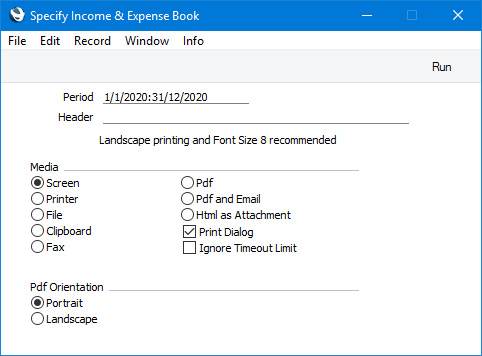
- Period
- Paste Special
Reporting Periods setting, System module
- The report will list postings from the period that you specify here. The first period in the Reporting Periods setting will be offered as a default.
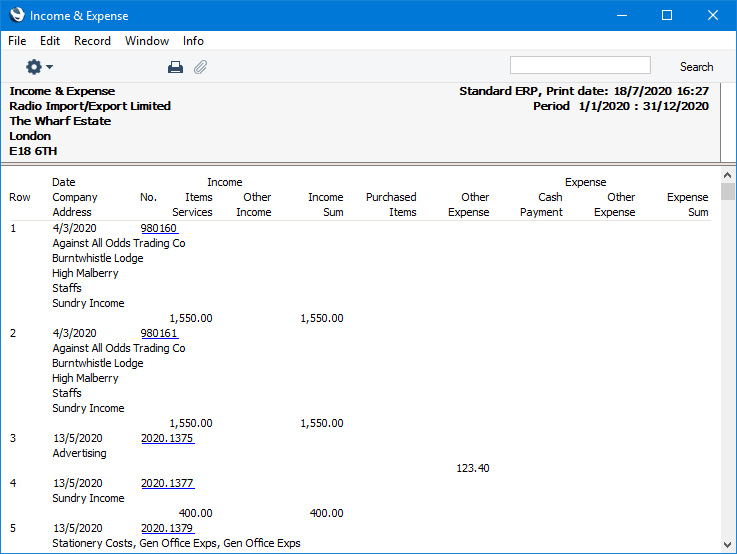
For each posting, the report will display the following information depending on the origin of the posting:
- Invoice
- The Customer Name, the Invoice Address (from the Invoice) and the Description from the Transaction row (or, if blank, the Text from the Transaction header). If the Invoice has been invalidated, the date and value will be shown struck through with red lines, the date of the invalidation and the Signature of the invalidator will be displayed, and the value will not be included in the report totals.
- Purchase Invoice
- The Supplier Name, the Invoice Address (from the Contact record for the Supplier) and the Description from the Transaction row (or, if blank, the Text from the Transaction header). Both the Supp. Inv. No. and the Purchase Invoice Number will be displayed, with the Purchase Invoice Number in brackets. If the Purchase Invoice has been invalidated, the date and value will be shown struck through with red lines, the date of the invalidation and the Signature of the invalidator will be displayed, and the value will not be included in the report totals.
- If the Purchase Invoice and Transaction Dates in a Purchase Invoice are different, the Purchase Invoice Date will be displayed in the report, but the inclusion of the Purchase Invoice in the report period will depend on the Transaction Date.
- If the Purchase Invoice and Transaction Dates in a Purchase Invoice are different, the Purchase Invoice Date will be displayed in the report, but the inclusion of the Purchase Invoice in the report period will depend on the Transaction Date.
- Other
- The Description from the Transaction row (or, if blank, the Text from the Transaction header).
Reports in the Nominal Ledger:
- Introduction
- Definition of Nominal Ledger Reports
- Drill-down
- The Operations Menu
- Account Reconciliation
- Accrual Report
- Analytical Balance
- Analytical Balance (Fiscal purposes)
- Balance Sheet
- Bank Reconciliation
- Bank Statement
- Bank Transactions
- Base Currency Rate Change
- Budget Journal
- Cash Flow
- Chart of Accounts
- Correction List
- Corresponding Accounts
- Creditors Account
- Currency A/C Rate Change
- Daily Balances
- Debtors Account
- Forward Balance Journal
- Income & Expense Book
- Key Financial Ratios
- Liquidity Forecast
- Multicurrency Accounts Rate Difference
- N/L Accrual Transactions
- N/L Transfer, Subsystems
- Nominal Ledger
- Profit & Loss
- Revised Budget Journal
- Simulation Journal
- Tag/Object Results
- Tag/Object/Quantity Results
- Tax Account Balances
- Tax Calculations
- Tax Transactions for Registers
- Template Transaction Journal
- Test Corresponding Rules
- Transaction Journal
- Transaction Summary
- Trial Balance
- VAT Listing
- VAT Report
- VAT Report Purchases
- VAT Report Sales
- VAT Transaction Journal
- XBRL Report
Go back to:
- Home page for Nominal Ledger manual
- Home page for Standard ERP manual
Key Financial Ratios
This page introduces the Key Financial Ratios report in the Nominal Ledger. The description also applies to the Cash Flow report, which is identical to the Key Financial Ratios report.---
The Key Financial Ratios report is a useful tool that can help you evaluate the performance and prospects of your company.
A Key Ratio is a figure representing a particular aspect of your company's performance. Key Ratios are fully user-definable: you must create your own Key Ratios before you can produce the report. Examples might be sales for the current period or for a previous one, sales per sq. ft. for retail outlets, and the relation between salaries and debited time for consultants. The Key Financial Ratios report is essentially a list of Key Ratios that you have defined yourself.
As well as creating your own Key Ratios to appear in the Key Financial Ratios report, you can also create several Key Ratio reports. This will allow you to create and produce several discrete reports that focus on different aspects of your business.
One particular Key Ratio is used in another report. The % Turnover option in the Profit & Loss report requires you to have defined a Key Ratio for 'turnover', named "TURNO".
Please follow the links below for more details about the Key Financial Ratios report:
- The Definition of the Key Financial Ratios report
- Example - Key Ratios for Different Periods
- Example - Adding Columns to the report
- Example - Objects
- Additional Column Options
- Assisted Formula Entry
- Multiple Key Ratio Report Definitions
- Printing the Key Financial Ratios Report
Reports in the Nominal Ledger:
- Introduction
- Definition of Nominal Ledger Reports
- Drill-down
- The Operations Menu
- Account Reconciliation
- Accrual Report
- Analytical Balance
- Analytical Balance (Fiscal purposes)
- Balance Sheet
- Bank Reconciliation
- Bank Statement
- Bank Transactions
- Base Currency Rate Change
- Budget Journal
- Cash Flow
- Chart of Accounts
- Correction List
- Corresponding Accounts
- Creditors Account
- Currency A/C Rate Change
- Daily Balances
- Debtors Account
- Forward Balance Journal
- Income & Expense Book
- Key Financial Ratios
- Liquidity Forecast
- Multicurrency Accounts Rate Difference
- N/L Accrual Transactions
- N/L Transfer, Subsystems
- Nominal Ledger
- Profit & Loss
- Revised Budget Journal
- Simulation Journal
- Tag/Object Results
- Tag/Object/Quantity Results
- Tax Account Balances
- Tax Calculations
- Tax Transactions for Registers
- Template Transaction Journal
- Test Corresponding Rules
- Transaction Journal
- Transaction Summary
- Trial Balance
- VAT Listing
- VAT Report
- VAT Report Purchases
- VAT Report Sales
- VAT Transaction Journal
- XBRL Report
Go back to:
- Home page for Nominal Ledger manual
- Home page for Standard ERP manual
Key Financial Ratios - Defining
This page describes the configuration of the Key Financial Ratios report.---
Before producing the Key Financial Ratios report for the first time, you should define how the figures in the report will be calculated and ensure the format of the report suits your specific requirements. This is known as "Defining" the Key Financial Ratios report.
To set or change the report definition of the Key Financial Ratios report, first ensure you are in the Nominal Ledger. Then, if you are using Windows or macOS, click the [Settings] button in the Navigation Centre. If you are using iOS or Android, select 'Settings' from the 'Tools' menu (with 'wrench' icon). Double-click or tap 'Report Settings' in the subsequent list. Then double-click 'Key Financial Ratios' in the list on the left-hand side of the 'Report Settings' window (Windows/macOS) or highlight it and press the [Definition] button (all platforms). The 'Key Financial Ratios Report Definition: Inspect' window will be opened.
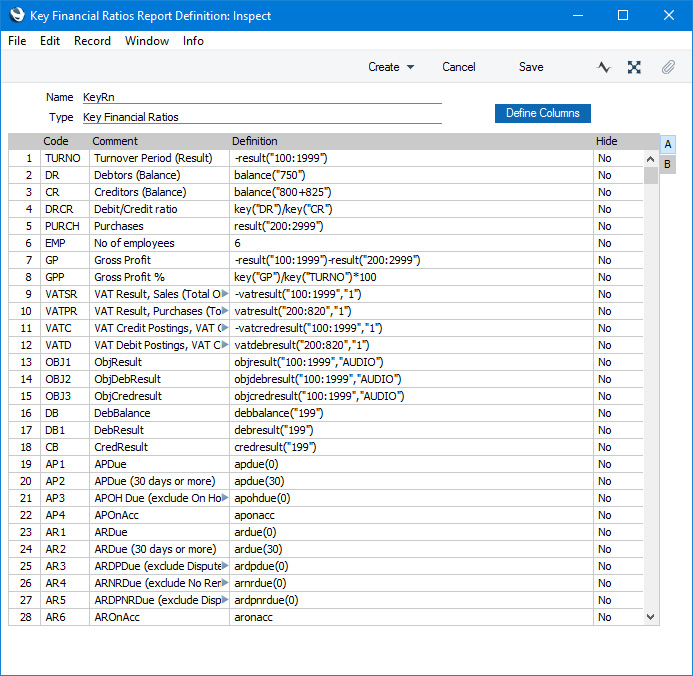
Most of the 'Key Financial Ratios Report Definition: Inspect' window is taken up by a matrix. Use this matrix to define your Key Ratios: each Key Ratio will occupy a separate row in the matrix, and each Key Ratio will cause a separate line to be printed in the Key Financial Ratios report. This is shown in the illustration below:
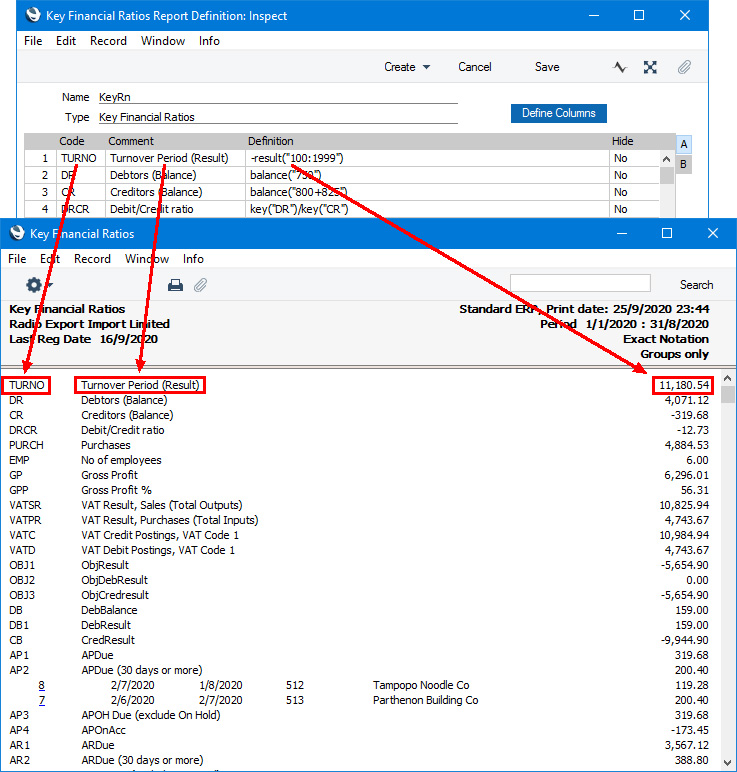
Click the [Save] button (Windows/macOS) or tap √ (iOS/Android) to save your Key Ratio definitions.
Each row in the Key Financial Ratios report definition should contain a separate Key Ratio. For each Key Ratio, enter the following information:
Flip A
- Code
- Enter a unique code to identify each Key Ratio. You can use this Code to refer to the Key Ratio in other formulae, as shown on line 8 in the illustration above.
- Comment
- Enter a name of the Key Ratio, to be printed in the report.
- Definition
- Paste Special
Assisted Formula Entry
- The formula that will be used to calculate the value of the Key Ratio. The commands that you can use in the formulae are listed immediately below, while the 'Assisted Formula Entry' window is described here.
- Hide
- Paste Special
Choice of possible entries
- Enter "Yes" in this field if you do not want a particular Key Ratio to be printed in the report. This option allows you to use rows for hidden calculations that you can then include in the definitions in later rows (using the KEY command).
- RESULT("Account Code")
- RESULT prints the net change during the period for the Account specified in the brackets. Some examples of the use of this command are as follows:
- RESULT("100")
- Prints the net change in Account 100 for the specified period. For example, if Account 100 is a Sales Account, this will print the net sales posted to that Account during the specified period.
- RESULT("100:1999")
- Prints the sum of the net changes in Accounts 100 to 1999 for the specified period. The Accounts in the range will be determined using an alpha sort, rather than a numeric one. So, Account 1000001 will be included in the example range, while Account 200 will not.
- -RESULT("100:1999")
- As the previous example, but the sign of the final figure will be changed. This will be useful when displaying figures for sales, which are stored as negative figures in Standard ERP. Prefixing the RESULT command with a minus sign will cause sales to be displayed as positive figures in the report.
- RESULT("100,199")
- Prints the sum of the net changes in the individual Accounts 100 and 199 for the specified period.
- RESULT("100+120:1999")
- Takes the net change in Account 100 and adds it to the sum of the net changes in Accounts 120 to 1999.
- RESULT("100")
- AVGRESULT("Account Code")
- AVGRESULT prints the average monthly posting during the report period to the specified Account or Accounts. For example, if the report period is one year, the command will print the RESULT divided by 12.
- CREDRESULT("Account Code")
- Prints the total credit posting during the report period to the specified Account or Accounts.
- AVGCREDRESULT("Account Code")
- Prints the average monthly credit posting during the report period to the specified Account or Accounts.
- DEBRESULT("Account Code")
- Prints the total debit posting during the report period to the specified Account or Accounts.
- AVGDEBRESULT("Account Code")
- Prints the average monthly debit posting during the report period to the specified Account or Accounts.
- BALANCE("Account Code")
- BALANCE prints the closing balance for the specified Account. It differs from RESULT in that balances brought forward from previous periods are taken into account.
- BALANCE can print the sum of the balances of a range of Accounts or of a number of Accounts in the same manner as RESULT: please refer to the description of RESULT above for examples.
- BALANCE can print the sum of the balances of a range of Accounts or of a number of Accounts in the same manner as RESULT: please refer to the description of RESULT above for examples.
- CREDBALANCE("Account Code")
- Prints the closing credit balance for the Account specified. It differs from CREDRESULT in that balances brought forward from previous periods are taken into account.
- DEBBALANCE("Account Code")
- Prints the closing debit balance for the Account specified. It differs from DEBRESULT in that balances brought forward from previous periods are taken into account.
- KEY("Code")
- KEY allows you to include the value of another Key Ratio in a calculation. You must already have defined the Key Ratio that you are referring to, otherwise the result will be a zero value. Therefore, in the example illustration, the GPP line (row 8) must appear below the GP and TURNO lines (rows 7 and 1 respectively). As this line illustrates, you can include KEYs in mathematical formulae with other KEYs and with hard-coded numbers.
- Although the KEY command itself is not case sensitive, the reference to the other Key Ratio is. Thus, in the example illustration, you can use key("TURNO") and KEY("TURNO"), but not key("turno").
- Although the KEY command itself is not case sensitive, the reference to the other Key Ratio is. Thus, in the example illustration, you can use key("TURNO") and KEY("TURNO"), but not key("turno").
- IFKEY("Comparison","print if true","print if false")
- IFKEY allows you to compare the values of two Key Ratios and to print the value of one of them, depending on the result of the comparison. You must already have defined the Key Ratios that you are referring to.
- The following examples illustrate the possible comparisons:
- IFKEY("KEY_A>KEY_B","KEY_A","KEY_B")
- If the value of KEY_A is greater than the value of KEY_B, the value of KEY_A will be printed. Otherwise, the value of KEY_B will be printed.
- IFKEY("KEY_A<KEY_B","KEY_A","KEY_B")
- If the value of KEY_A is less than the value of KEY_B, the value of KEY_A will be printed. Otherwise, the value of KEY_B will be printed.
- IFKEY("KEY_A=KEY_B","KEY_A","KEY_C")
- If the value of KEY_A is the same as the value of KEY_B, the value of KEY_A will be printed. Otherwise, the value of KEY_C will be printed.
- IFKEY("KEY_A>=KEY_B","KEY_A","KEY_B")
- If the value of KEY_A is greater than or equal to the value of KEY_B, the value of KEY_A will be printed. Otherwise, the value of KEY_B will be printed.
- IFKEY("KEY_A<=KEY_B","KEY_A","KEY_B")
- If the value of KEY_A is less than the value of KEY_B, the value of KEY_A will be printed. Otherwise, the value of KEY_B will be printed.
- The following examples illustrate the possible comparisons:
- OBJRESULT("Account Code","Tag/Object Code")
- OBJRESULT is similar to RESULT, but in calculating the net change in the specified Account or Accounts over the specified period, only postings with the specified Tag/Object Code will be taken into account.
- The reference to the Tag/Object Code is not case sensitive.
- OBJRESULT can print the sum of the net changes in a range of Accounts or in a number of Accounts in the same manner as RESULT: please refer to the description of RESULT above for examples.
- The reference to the Tag/Object Code is not case sensitive.
- AVGOBJRESULT("Account Code","Tag/Object Code")
- Prints the average monthly posting to the specified Account or Accounts during the period, calculated from postings with the specified Tag/Object Code. For example, if the report period is one year, the command will print the OBJRESULT divided by 12.
- OBJCREDRESULT("Account Code","Tag/Object Code")
- Prints the total credit posting to the specified Account or Accounts during the period, calculated from postings with the specified Tag/Object Code.
- AVGOBJCREDRESULT("Account Code","Tag/Object Code")
- Prints the average monthly credit posting during the report period to the specified Account or Accounts, calculated from postings with the specified Tag/Object Code.
- OBJDEBRESULT("Account Code","Tag/Object Code")
- Prints the total debit posting to the specified Account or Accounts during the period, calculated from postings with the specified Tag/Object Code.
- AVGOBJDEBRESULT("Account Code","Tag/Object Code")
- Prints the average monthly debit posting during the report period to the specified Account or Accounts, calculated from postings with the specified Tag/Object Code.
- VATRESULT("Account Code","VAT Code")
- VATRESULT is similar to RESULT, but in calculating the net change in the specified Account or Accounts over the specified period, only postings with the specified VAT Code will be taken into account.
- The reference to the VAT Code is not case sensitive.
- VATRESULT can print the sum of the net changes in a range of Accounts or in a number of Accounts in the same manner as RESULT: please refer to the description of RESULT above for examples.
- In Transactions created from Sub Systems (e.g. Invoices and Purchase Invoices), the appropriate VAT Code will be copied to the V-Cd field in each Transaction row posting to a Sales or Cost Account. The V-Cd field is the mechanism that allows you to use the VATRESULT command with these Accounts. However, if you are using the Add VAT Code to VAT A/C rows option in the Transaction Settings setting, the appropriate VAT Code will also be copied to the V-Cd field in each Transaction row posting to a VAT Account. This will allow you to apply the VATRESULT command to the VAT Accounts (e.g. VATRESULT("830","1"), where Account 830 is the Output VAT Account).
- The reference to the VAT Code is not case sensitive.
- AVGVATRESULT("Account Code","VAT Code")
- Prints the average monthly posting to the specified Account or Accounts during the period, calculated from postings with the specified VAT Code. For example, if the report period is one year, the command will print the VATRESULT divided by 12.
- VATCREDRESULT("Account Code","VAT Code")
- Prints the total credit posting to the specified Account or Accounts during the period, calculated from postings with the specified VAT Code.
- AVGVATCREDRESULT ("Account Code","VAT Code")
- Prints the average monthly credit posting during the report period to the specified Account or Accounts, calculated from postings with the specified VAT Code.
- VATDEBRESULT("Account Code","VAT Code")
- Prints the total debit posting to the specified Account or Accounts during the period, calculated from postings with the specified VAT Code.
- AVGVATDEBRESULT("Account Code","VAT Code")
- Prints the average monthly debit posting during the report period to the specified Account or Accounts, calculated from postings with the specified VAT Code.
- VATBALANCE("Account Code","VAT Code")
- VATBALANCE prints the closing balance for the specified Account or Accounts, calculated from postings with the specified VAT Code. It differs from VATRESULT in that balances brought forward from previous periods are taken into account.
- APDUE(Number of days)
- APDUE prints the total in the Purchase Ledger that is overdue for payment by more than the specified number of days. The last day of the report period will be used as the due date. For example, APDUE(30) will print the total that became due more than 30 days before the end of the report period (i.e. the total that is overdue by at least 30 days on the last day of the period). You must specify a number of days: use APDUE(0) if the total is to include all overdue Purchase Invoices.
- This figure does not include open On Account Payments and Prepayments: use APONACC described below if you need this figure to be shown in the report.
- There is no need place the number of days parameter in inverted commas, but doing so will not affect the calculation. In other words, you can use both APDUE(30) and APDUE("30").
- This figure does not include open On Account Payments and Prepayments: use APONACC described below if you need this figure to be shown in the report.
- APOHDUE(Number of days)
- Similar to APDUE, but Purchase Invoices marked as On Hold will not be included.
- APONACC
- Prints the On Account balance in the Purchase Ledger on the last day of the report period. This includes open On Account Payments and Prepayments.
- APRESULT("Account","Supplier")
- APRESULT checks any Purchase Invoices that were issued by the specified Supplier during the report period for any rows with the specified Account and prints the total amount posted to that Account. Some examples of the use of this command are as follows:
- APRESULT("240","")
- Prints the total amount posted to Account 240 in Purchase Invoices received from the following Suppliers:
- The Supplier or range of Suppliers specified in the Contact field in the report specification window.
- Suppliers with the Contact Classification specified in the Contact Class. field in the report specification window.
- All Suppliers, if the Contact and Contact Class. fields in the report specification window are both empty.
- The Supplier or range of Suppliers specified in the Contact field in the report specification window.
- APRESULT("200:299","503")
- Prints the total amount posted to all Accounts in the range 200:299 in Purchase Invoices received from Supplier 503.
- APRESULT("200:299","500:599")
- Prints the total amount posted to all Accounts in the range 200:299 in Purchase Invoices received from Suppliers 500:599.
- APRESULT("","503")
- Prints the total amount posted to all Accounts in Purchase Invoices received from Supplier 503.
- APRESULT("240","")
- APDUEINPERIOD("periodtype","periodoffset")
- APDUEINPERIOD prints the total in the Purchase Ledger that will become due in a specified period. The first parameter, periodtype, can be "week", "month" or "year". The second parameter, "periodoffset", should be a number that specifies which week or month or part of the report period will be used as the specified period. For example:
- APDUEINPERIOD("week","0")
- Prints the total in the Purchase Ledger that will become due in the week containing the beginning of the report period. The week is a calendar week, so if the report period begins on a Wednesday, APDUEINPERIOD("week","0") will print the total that will become due between that Wednesday and the following Sunday.
- APDUEINPERIOD("week","1")
- Prints the total in the Purchase Ledger that will become due in the week starting on the first Monday after the beginning of the report period.
- APDUEINPERIOD("month","0")
- Prints the total in the Purchase Ledger that will become due in the month containing the beginning of the report period. The month is a calendar month, so if the report period begins on March 13, APDUEINPERIOD("month","0") will print the total that will become due between March 13 and March 31.
- APDUEINPERIOD("month","1")
- Prints the total in the Purchase Ledger that will become due in the month following the month containing the beginning of the report period. For example, if the report period begins on March 13, APDUEINPERIOD("month","1") will print the total that will become due in April.
- APDUEINPERIOD("year","0")
- Prints the total in the Purchase Ledger that will become due during the report period.
- APDUEINPERIOD("year","1")
- Prints the total in the Purchase Ledger that will become due during the report period but excluding the first calendar month. For example, if the report period runs from March 13 to June 30, APDUEINPERIOD("year","1") will print the total that will become due between April and June. APDUEINPERIOD("year","2") will print the total that will become due between May and June.
- APDUEINPERIOD("week","0")
- ARDUE(Number of days)
- The Sales Ledger equivalent of APDUE described above.
- ARDPDUE(Number of days)
- Similar to ARDUE, but Invoices marked as Disputed will not be included.
- ARNRDUE(Number of days)
- Similar to ARDUE, but Invoices marked as No Reminder will not be included.
- ARDPNRDUE(Number of days)
- Similar to ARDUE, but Invoices marked as both Disputed and No Reminder will not be included.
- ARONACC
- The Sales Ledger equivalent of APONACC described above.
- ARRESULT("Account","Customer")
- The Sales Ledger equivalent of APRESULT described above.
- ARDUEINPERIOD("periodtype","periodoffset")
- The Sales Ledger equivalent of APDUEINPERIOD described above.
The value of a well-structured Chart of Accounts can easily be seen here. For example, if you have grouped your Income Accounts together in a consecutive series, totalling them using a range becomes simple.
In the first row in the illustration above, we have included a Key Ratio with the Code "TURNO". This Key Ratio contains a definition of "turnover" (in the example, "turnover" has been defined as the net change in the balance of all Sales Accounts over the report period). You must have a Key Ratio with this Code if you will use the % Turnover option when printing the Profit & Loss report, as this option needs a definition of "turnover".
Note that the syntax used in the Key Ratio formulae changed in version 4.1. If you are updating from a version earlier than 4.1 to a later version, you will therefore need to change your formulae as follows:
- All parameters should now be enclosed in quotation marks. For example, you should change RESULT(830) to RESULT("830").
- The order of parameters for the VATRESULT, VATBALANCE, VATCREDRESULT and VATDEBRESULT commands has been transposed. For example, you should change VATRESULT(1,100:199) to VATRESULT("100:199","1").
---
Please follow the links below for more details about the Key Financial Ratios report:
- Introduction
- The Definition of the Key Financial Ratios report
- Example - Key Ratios for Different Periods
- Example - Adding Columns to the report
- Example - Objects
- Additional Column Options
- Assisted Formula Entry
- Multiple Key Ratio Report Definitions
- Printing the Key Financial Ratios Report
Reports in the Nominal Ledger:
- Introduction
- Definition of Nominal Ledger Reports
- Drill-down
- The Operations Menu
- Account Reconciliation
- Accrual Report
- Analytical Balance
- Analytical Balance (Fiscal purposes)
- Balance Sheet
- Bank Reconciliation
- Bank Statement
- Bank Transactions
- Base Currency Rate Change
- Budget Journal
- Cash Flow
- Chart of Accounts
- Correction List
- Corresponding Accounts
- Creditors Account
- Currency A/C Rate Change
- Daily Balances
- Debtors Account
- Forward Balance Journal
- Income & Expense Book
- Key Financial Ratios
- Liquidity Forecast
- Multicurrency Accounts Rate Difference
- N/L Accrual Transactions
- N/L Transfer, Subsystems
- Nominal Ledger
- Profit & Loss
- Revised Budget Journal
- Simulation Journal
- Tag/Object Results
- Tag/Object/Quantity Results
- Tax Account Balances
- Tax Calculations
- Tax Transactions for Registers
- Template Transaction Journal
- Test Corresponding Rules
- Transaction Journal
- Transaction Summary
- Trial Balance
- VAT Listing
- VAT Report
- VAT Report Purchases
- VAT Report Sales
- VAT Transaction Journal
- XBRL Report
Go back to:
- Home page for Nominal Ledger manual
- Home page for Standard ERP manual
Key Financial Ratios - Example - Key Ratios for Different Periods
This page uses an example Key Financial Ratios report to describe using the fields on flip B of the 'Key Financial Ratios Report Definition' window. These fields allow you to have the same Key Ratios printed for different periods. Please refer here for descriptions of the commands you can include in a Key Ratios report definition.---
To begin the example, we have created the simple report illustrated below in which we have used the RESULT command to print the net sales for the report period. The RESULT command will print the net change in the Account balance(s) over the report period, and Accounts 100:199 are the Sales Accounts. The report was printed with the month of August as the period:
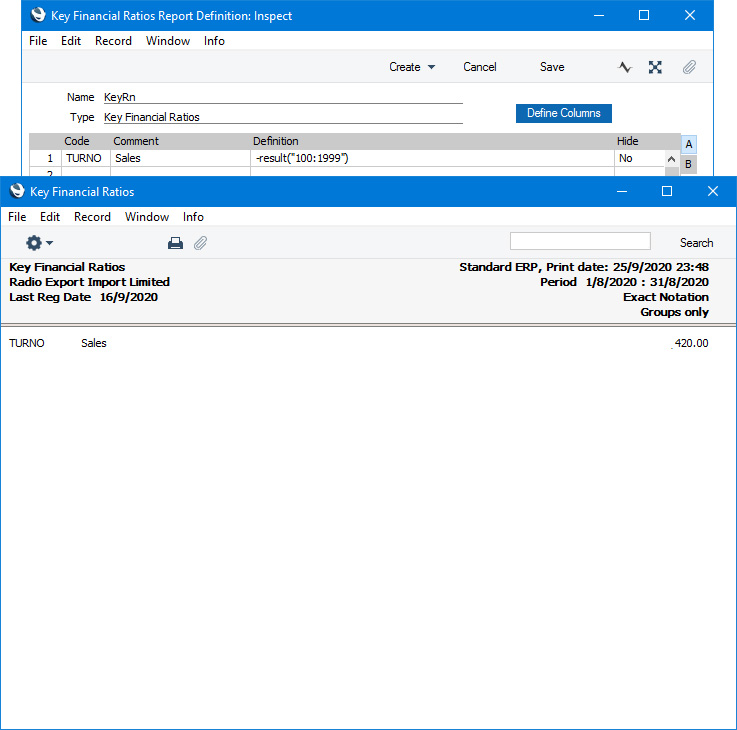
- Place the same formula on each line in the definition:
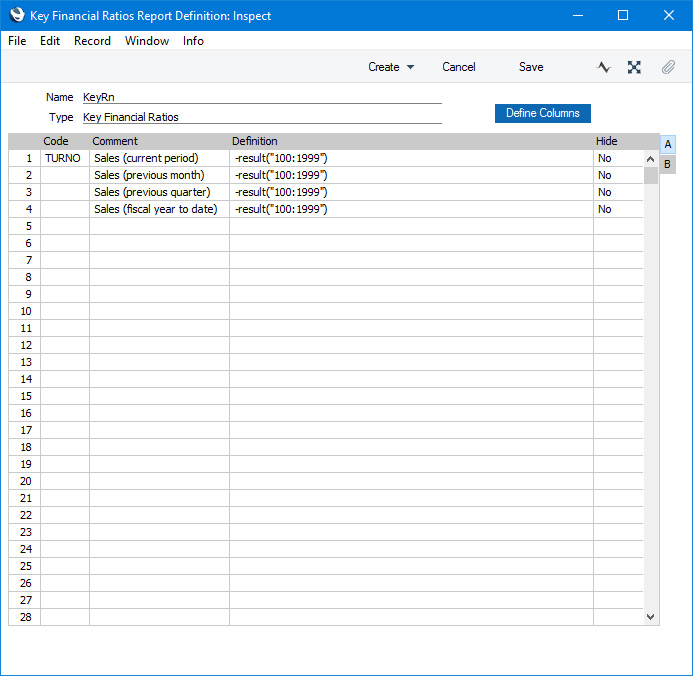
- To set the period for each Key Ratio, go to flip B and use the Period, Offset and Length fields:
This the resulting report: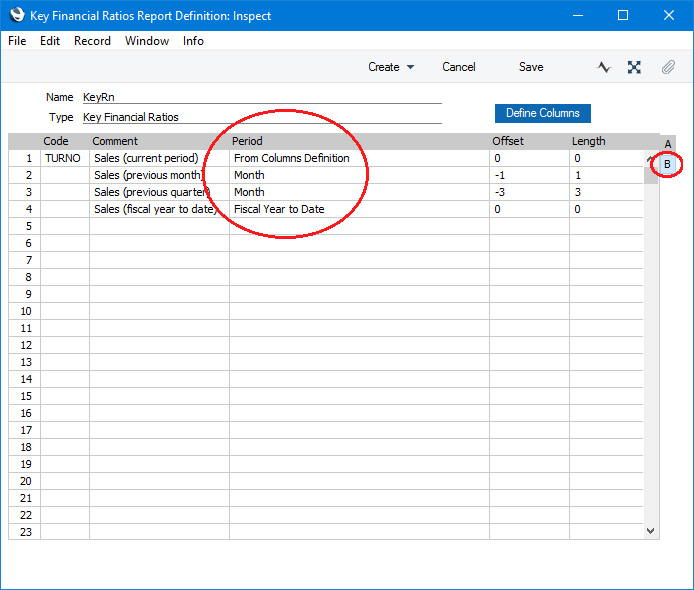
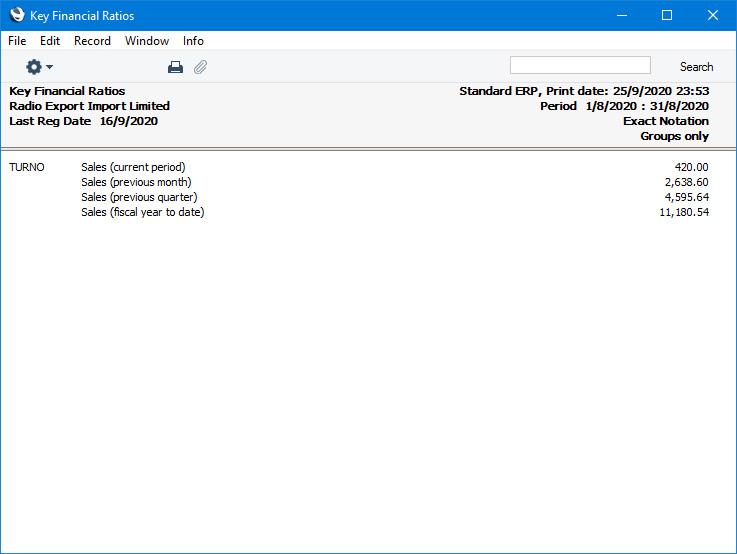
- From Columns Definition
- Select this option if you would like the period for the Key Ratio to be the same as the report period.
- In the example illustrated above, the period specified in the report specification window is August, so the Key Ratio in row 1 will print the sales figures for August.
- The Offset and Length fields are not used with this option.
- In the example illustrated above, the period specified in the report specification window is August, so the Key Ratio in row 1 will print the sales figures for August.
- Month
- Use this option if you would like the period for the Key Ratio to be a particular calendar month or months.
- Use the Offset field to specify when the Key Ratio period is to start. For example, if the Offset is 0, the Key Ratio period will begin on the same date as the report period. If the Offset is -1, the Key Ratio period will begin one month before the start of the report period. If the Offset is 1, the Key Ratio period will begin one month after the start of the report period.
- If the Offset is not 0, you must also specify a Length. The Length is the number of months in the Key Ratio period. For example, if the Offset is -3 and the Length is 3, the Key Ratio period will begin three months before the report period and will be three months in duration. In the example illustrated above, if the report period is August, the period for the Key Ratio in row 3 will run from May 1 to July 31. If the Offset is 0 and you do not specify a Length, the Length will be assumed to be 1 (i.e. the Key Ratio period will be the first month in the report period).
- Use the Offset field to specify when the Key Ratio period is to start. For example, if the Offset is 0, the Key Ratio period will begin on the same date as the report period. If the Offset is -1, the Key Ratio period will begin one month before the start of the report period. If the Offset is 1, the Key Ratio period will begin one month after the start of the report period.
- Year
- Use this option if you would like the period for the Key Ratio to be a particular calendar year or years.
- Use the Offset field to specify when the Key Ratio period is to start. For example, if the Offset is 0, the Key Ratio period will begin on the same date as the report period. If the Offset is -1, the Key Ratio period will begin one year before the start of the report period. If the Offset is 1, the Key Ratio period will begin one year after the start of the report period.
- You must also specify a Length (i.e. the Length should not be 0). The Length is the number of years in the Key Ratio period. For example, if the Offset is -3 and the Length is 3, the Key Ratio period will begin three years before the report period and will be three years in duration. If the report period is the month of August, the Key Ratio period will begin in August three years previously and end the day before the report period begins.
- Use the Offset field to specify when the Key Ratio period is to start. For example, if the Offset is 0, the Key Ratio period will begin on the same date as the report period. If the Offset is -1, the Key Ratio period will begin one year before the start of the report period. If the Offset is 1, the Key Ratio period will begin one year after the start of the report period.
- Fiscal Year to Date
- If you select this option, the period for the Key Ratio will run from the beginning of the fiscal year in which the start date in the report period falls to the end of the report period.
- In the example illustrated above, if the report period is August, and fiscal years begin on January 1, the period for the Key Ratio in row 4 will run from January 1 to August 31.
- You can use the Offset field to move the beginning of the period to a different year. For example, if the Offset is -1, the start of the period will be the beginning of the previous fiscal year (January 1 in the previous year in the example). The end of the Key Ratio period will always be the same as the end of the report period, so positive Offsets are not useful.
- The Length field is not used with this option.
- In the example illustrated above, if the report period is August, and fiscal years begin on January 1, the period for the Key Ratio in row 4 will run from January 1 to August 31.
- Fiscal Year
- Select this option if the period for the Key Ratio is to be the fiscal year in which the start date in the report period falls.
- For example, if the report period is August and fiscal years begin on January 1, the period for the Key Ratio will run from January 1 to December 31 in the same year as the report period.
- You can use the Offset field to choose a different year, and the Length field to choose the number of years in the period. For example, if the Offset is -1 and the Length is 1, the period will be the fiscal year before the report period. If the Offset is 0 and the Length is 3, the period will be the three fiscal years starting with the fiscal year in which the start date in the report period falls.
- If you specify an Offset, you must also specify a Length.
- For example, if the report period is August and fiscal years begin on January 1, the period for the Key Ratio will run from January 1 to December 31 in the same year as the report period.
---
Please follow the links below for more details about the Key Financial Ratios report:
- Introduction
- The Definition of the Key Financial Ratios report
- Example - Key Ratios for Different Periods
- Example - Adding Columns to the report
- Example - Objects
- Additional Column Options
- Assisted Formula Entry
- Multiple Key Ratio Report Definitions
- Printing the Key Financial Ratios Report
Reports in the Nominal Ledger:
- Introduction
- Definition of Nominal Ledger Reports
- Drill-down
- The Operations Menu
- Account Reconciliation
- Accrual Report
- Analytical Balance
- Analytical Balance (Fiscal purposes)
- Balance Sheet
- Bank Reconciliation
- Bank Statement
- Bank Transactions
- Base Currency Rate Change
- Budget Journal
- Cash Flow
- Chart of Accounts
- Correction List
- Corresponding Accounts
- Creditors Account
- Currency A/C Rate Change
- Daily Balances
- Debtors Account
- Forward Balance Journal
- Income & Expense Book
- Key Financial Ratios
- Liquidity Forecast
- Multicurrency Accounts Rate Difference
- N/L Accrual Transactions
- N/L Transfer, Subsystems
- Nominal Ledger
- Profit & Loss
- Revised Budget Journal
- Simulation Journal
- Tag/Object Results
- Tag/Object/Quantity Results
- Tax Account Balances
- Tax Calculations
- Tax Transactions for Registers
- Template Transaction Journal
- Test Corresponding Rules
- Transaction Journal
- Transaction Summary
- Trial Balance
- VAT Listing
- VAT Report
- VAT Report Purchases
- VAT Report Sales
- VAT Transaction Journal
- XBRL Report
Go back to:
- Home page for Nominal Ledger manual
- Home page for Standard ERP manual
Key Financial Ratios - Example - Adding Columns to the Report
This page describes adding columns to a Key Financial Ratios report. Please refer here for descriptions of the commands you can include in a Key Ratios report definition.---
If you have many Key Ratios, listing them with various periods as described in the previous example might result in a long report in which comparison between the various periods is not easy. An alternative is to add column definitions to the report. This will allow you to display information from different periods in columns.
To add column definitions, click the [Define Columns] button in the 'Key Financial Ratios Report Definitions' window (in this illustration we have removed rows 2-4 from the previous example as they are no longer needed):
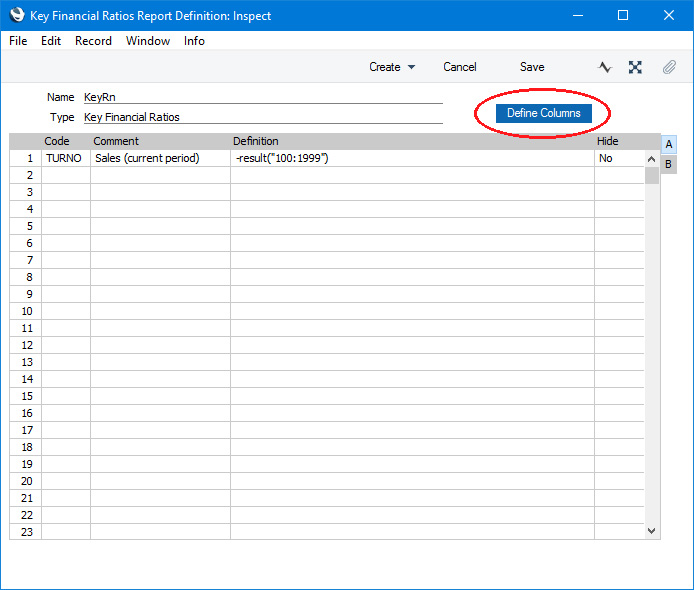
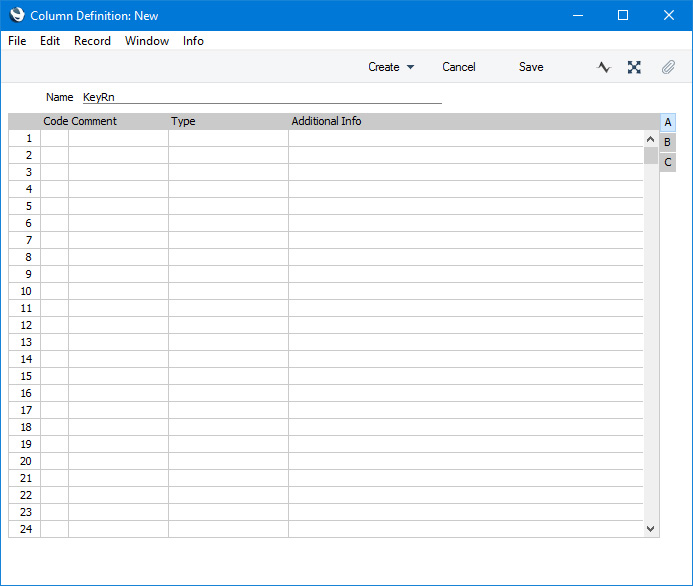
In its standard form and as shown in the illustrations so far, the Key Ratios report will contain three columns: the Code, Comment and Value columns. When you use the 'Column Definition' window to add columns to the report, you should first add three columns to represent the three that are already there:
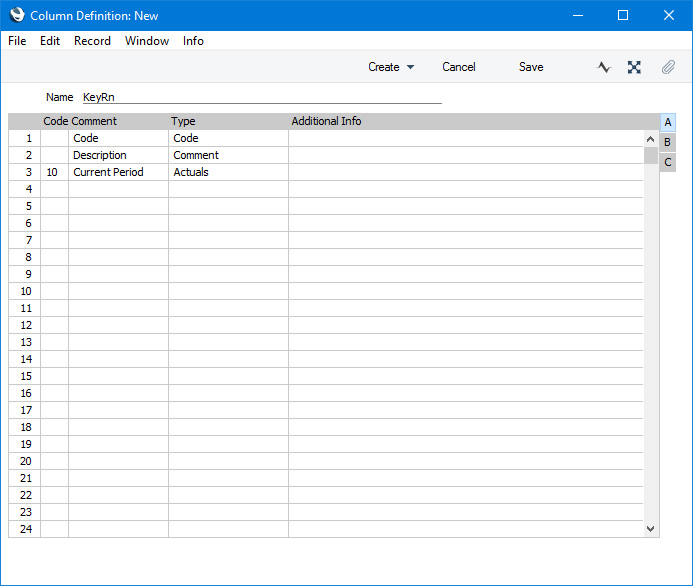
- Code
- Enter a Code for each column. There's no need to specify a Code if the Type (below) is "Code" or "Comment", but you must do so otherwise. If the columns in a report all contain the same figures or do not contain any figures at all, the probable reason is that the columns do not have Codes.
- Comment
- Enter the column heading of each column here.
- Type
- Paste Special
Choice of possible entries
The column type will determine what will be printed in the column, as follows:
- Code
- The Key Ratio Code (i.e. the Code in the row in the 'Key Financial Ratios Report Definitions' window) will be printed.
- Comment
- The Key Ratio Comment will be printed.
- Actuals
- Figures calculated using the Key Ratio formula will be printed.
- Columns Sumup
- Allows you to apply mathematical operations to values in previous columns (e.g. to add the values in various columns together, to subtract the value in one column from the value in another, or to express the value in one column as a percentage of the value in another). Enter the mathematical operation in the Additional Info field to the right using the format column("Code") (e.g. column("10")+column("20")+column("30"), column("10")-column("20"), column("10")/column("20")*100).
- Budget
- Budget figures for the Account(s) used in the Key Ratio formula will be printed.
- Revised Budget
- Revised Budget figures for the Account(s) used in the Key Ratio formula will be printed.
- Purchase Order Commitments
- Will print the total value of open Purchase Order rows in which the Purch. A/C is one of the Accounts used in the Key Ratio formula. An open Purchase Order row is one where the Recvd. OK figure is less than the Qty (i.e. you have ordered but not yet received the Items). Only rows in Purchase Orders that have been marked as OK and that are not Closed will be included.
- For example, if the Key Ratio formula is RESULT("820") and there is an open Purchase Order row in which the Purch A/C is 820, the value of this row will be included in the column figure.
- For example, if the Key Ratio formula is RESULT("820") and there is an open Purchase Order row in which the Purch A/C is 820, the value of this row will be included in the column figure.
- Goods Receipt Accruals
- Will print the total value of uninvoiced Purchase Order rows in which the Purch. A/C is one of the Accounts used in the Key Ratio formula. An uninvoiced Purchase Order row is one where the Invoiced figure is less than the Recvd. OK figure (i.e. you have received the Items but not yet been invoiced for them). Only rows in Purchase Orders that have been marked as OK and that are not Closed will be included.
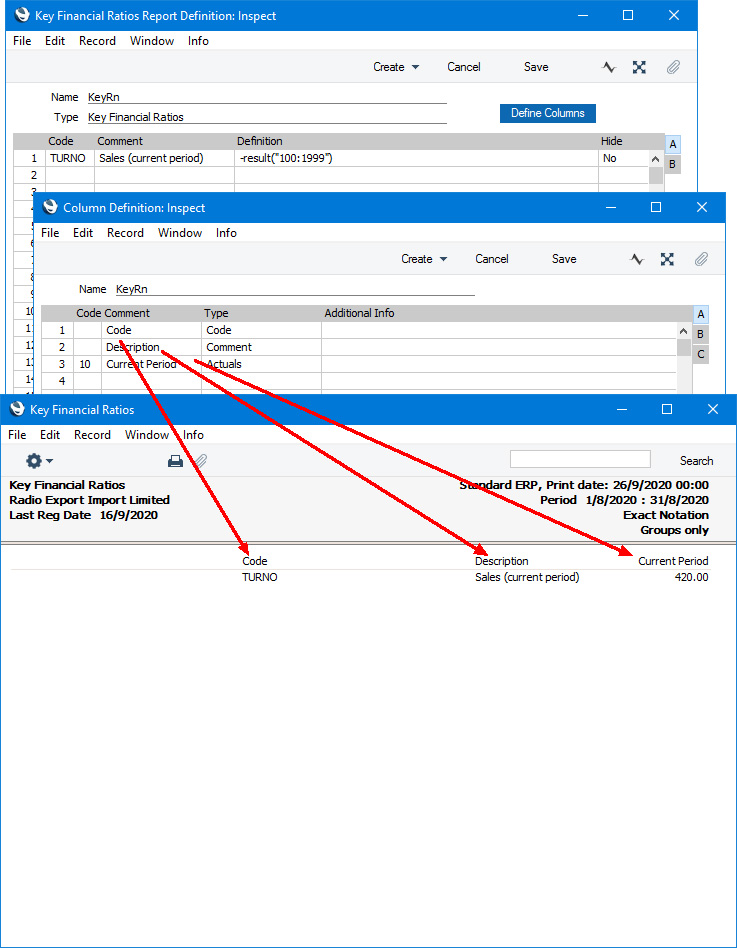
- 0
- The column will be placed on the left-hand side of the report.
- 1
- The column will be placed on the right-hand side of the report.
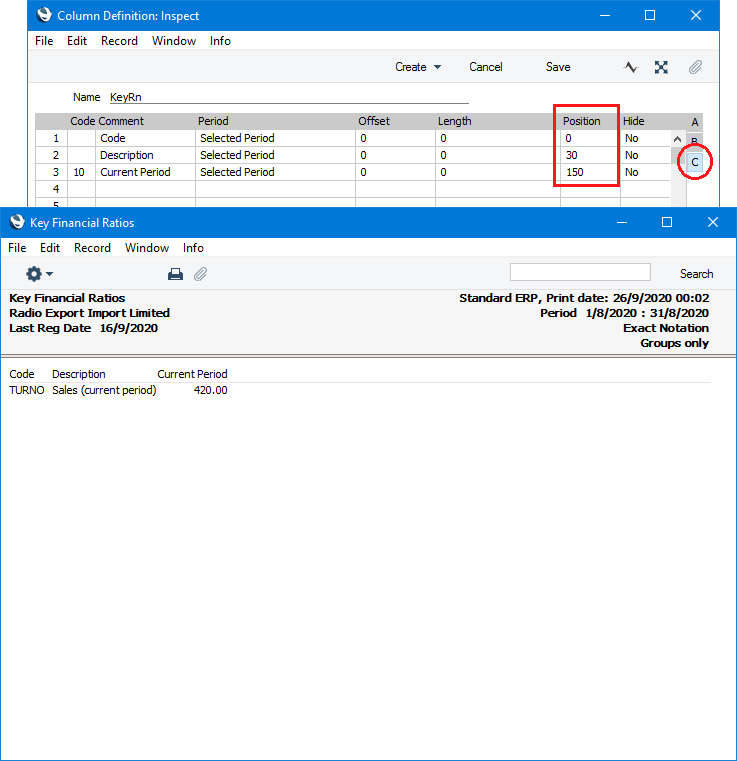
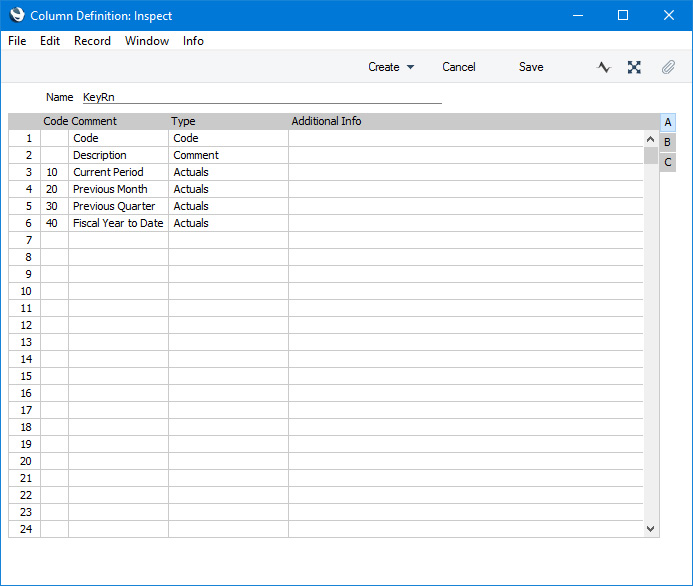
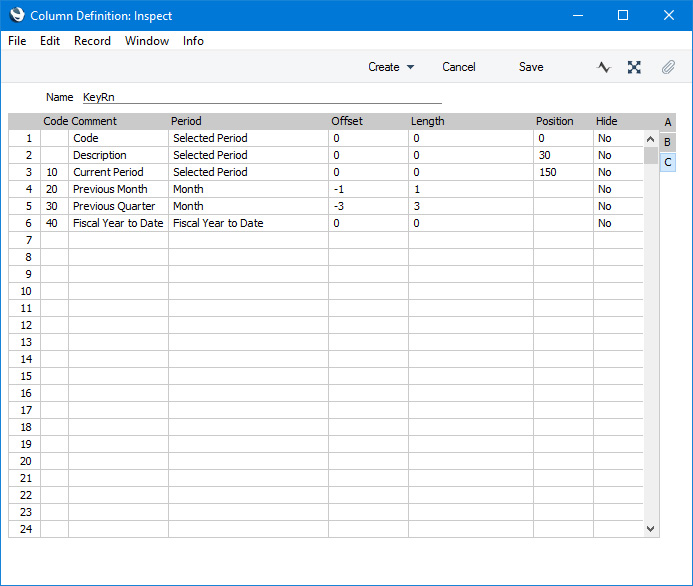
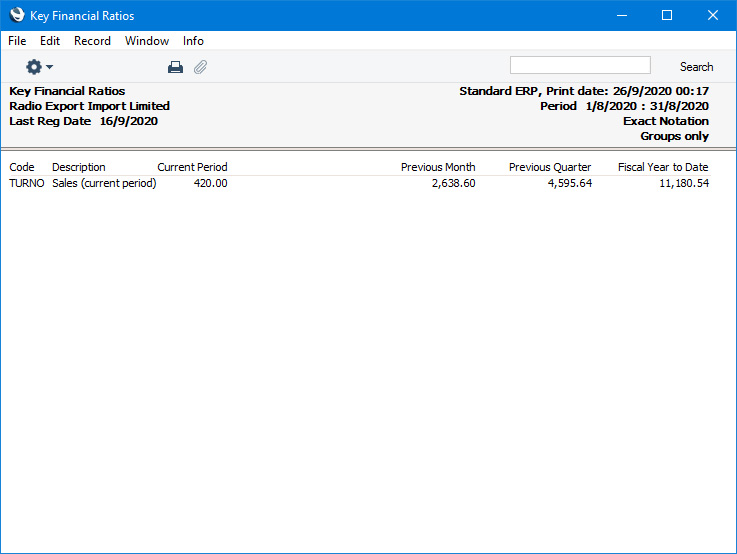
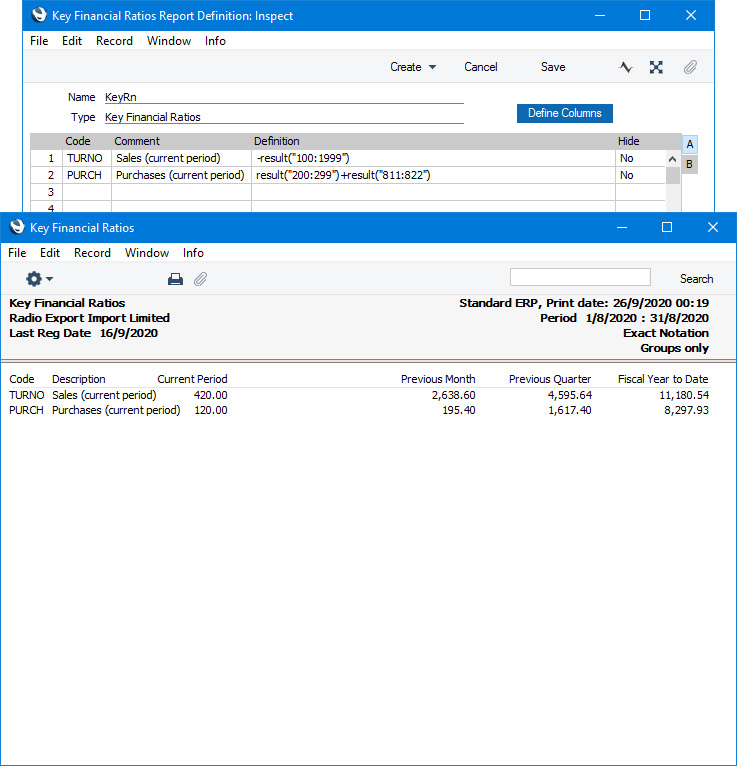
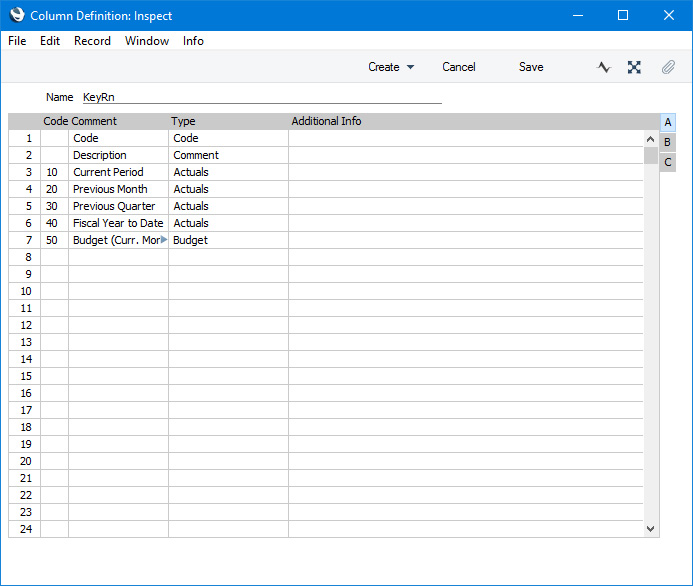
The Period on flip C of the Budget column definition is "Selected Period", so the total Budgeted amounts will be calculated from Budget rows with dates falling in the period in the report specification window. For example:
- If you have monthly Budget figures and the report period is one month, the Budget figure for that month will be included in the report.
- If you have quarterly Budget figures and the report period is one month, a pro rata amount calculated from the Budget figure for the relevant quarter will be included in the report.
This is the resulting report:
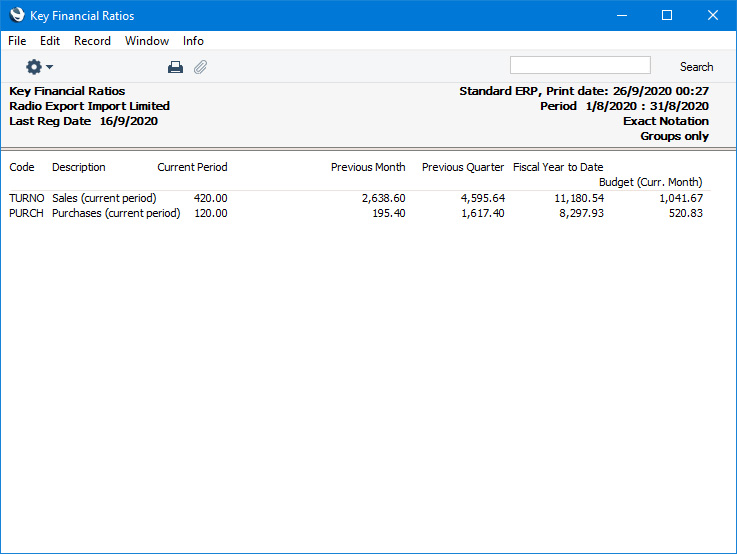
In the example illustrated below, we've added two columns comparing actual and Budget figures. In the first one (row 8), the formula is:
- COLUMN("10")-COLUMN("50")
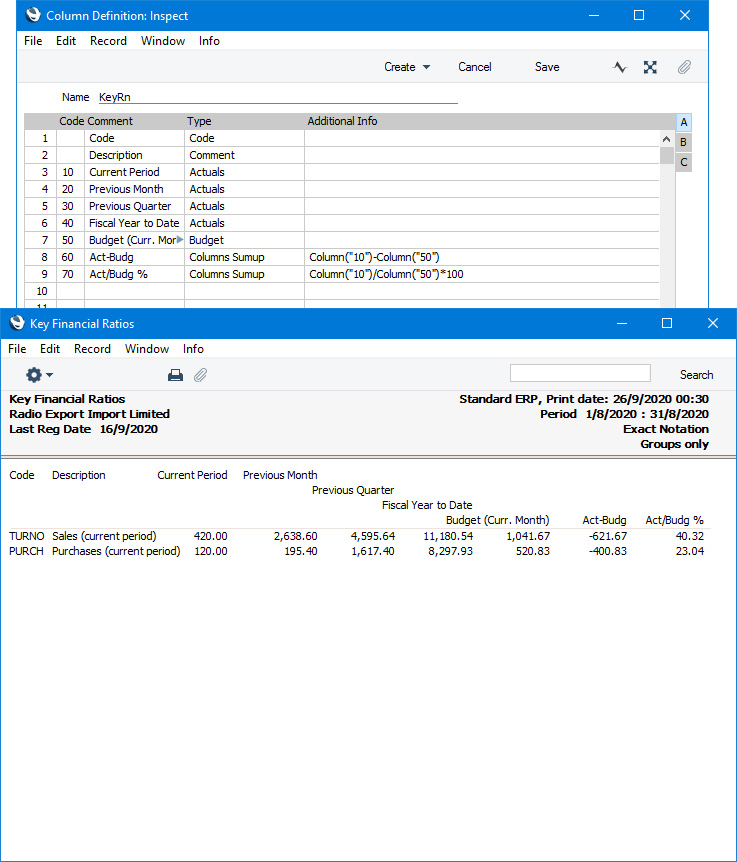
To use the Assisted Formula Entry feature, follow these steps:
- Simply activate 'Paste Special' from the Additional Info field in the relevant row:
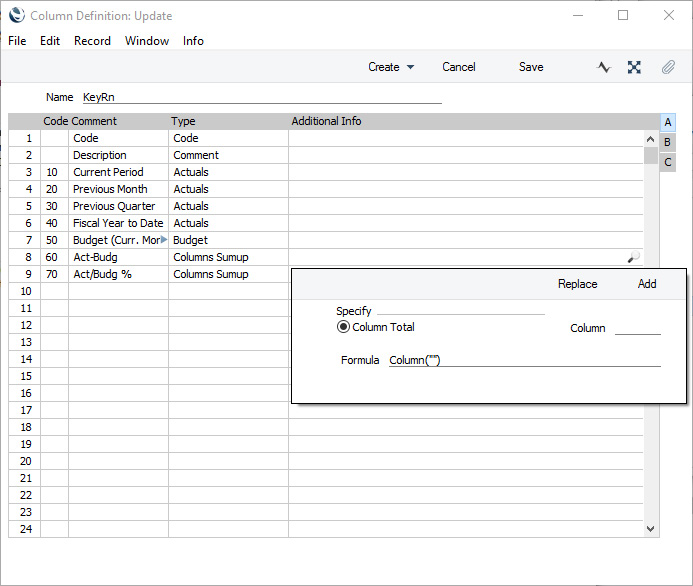
- Enter the Code of the previous column in the Column field:
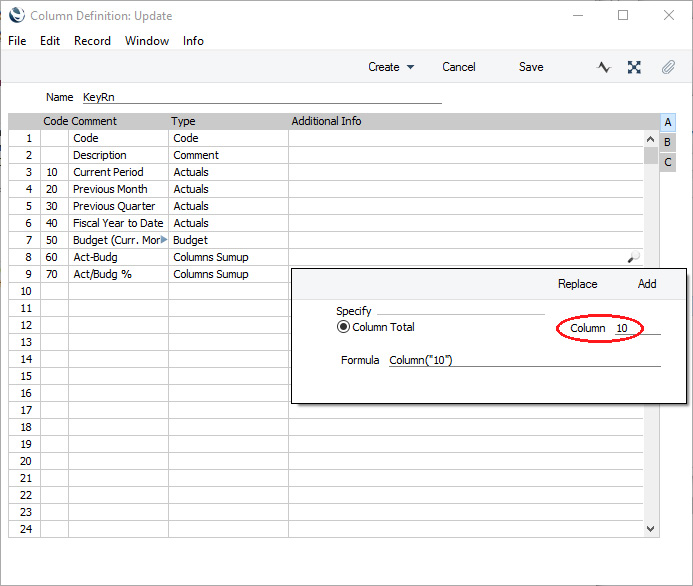
- Then press the [Replace] or [Add] buttons as follows:
- Replace
- The new formula will be placed in the Additional Info field, replacing what was previously there.
- Add
- The new formula will be placed in the Additional Info field, in addition to what is already there.
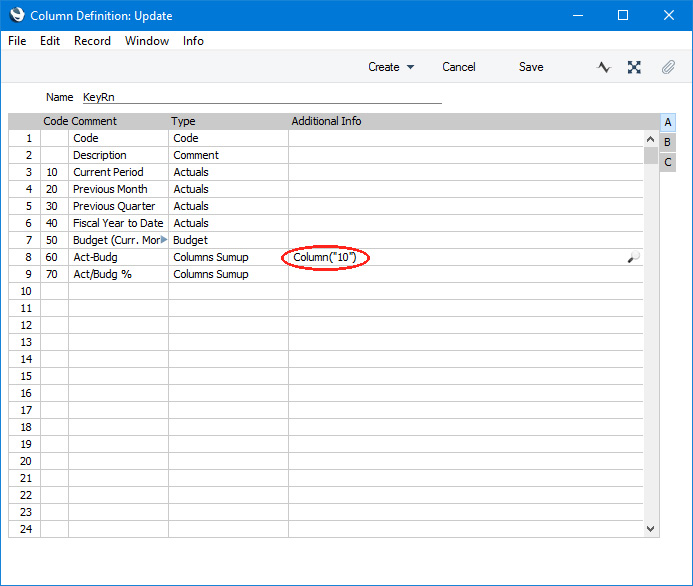
- Replace
- Type a mathematical operator in the Additional Info field.
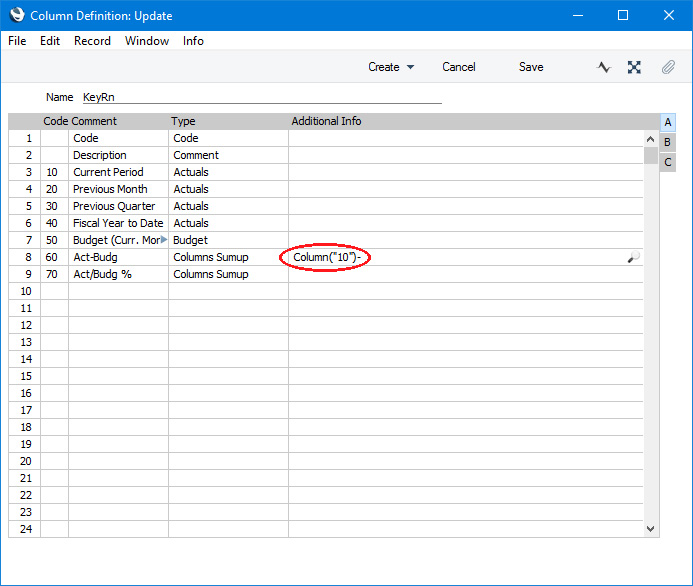
- Type in a second column reference or open 'Paste Special' once again, enter a Column Code and click the [Add] button to have the column reference added to the formula.
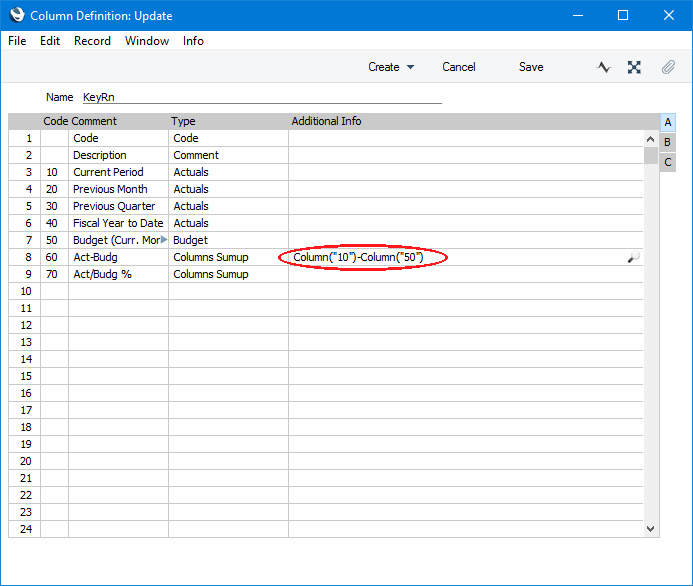
---
Please follow the links below for more details about the Key Financial Ratios report:
- Introduction
- The Definition of the Key Financial Ratios report
- Example - Key Ratios for Different Periods
- Example - Adding Columns to the report
- Example - Objects
- Additional Column Options
- Assisted Formula Entry
- Multiple Key Ratio Report Definitions
- Printing the Key Financial Ratios Report
Reports in the Nominal Ledger:
- Introduction
- Definition of Nominal Ledger Reports
- Drill-down
- The Operations Menu
- Account Reconciliation
- Accrual Report
- Analytical Balance
- Analytical Balance (Fiscal purposes)
- Balance Sheet
- Bank Reconciliation
- Bank Statement
- Bank Transactions
- Base Currency Rate Change
- Budget Journal
- Cash Flow
- Chart of Accounts
- Correction List
- Corresponding Accounts
- Creditors Account
- Currency A/C Rate Change
- Daily Balances
- Debtors Account
- Forward Balance Journal
- Income & Expense Book
- Key Financial Ratios
- Liquidity Forecast
- Multicurrency Accounts Rate Difference
- N/L Accrual Transactions
- N/L Transfer, Subsystems
- Nominal Ledger
- Profit & Loss
- Revised Budget Journal
- Simulation Journal
- Tag/Object Results
- Tag/Object/Quantity Results
- Tax Account Balances
- Tax Calculations
- Tax Transactions for Registers
- Template Transaction Journal
- Test Corresponding Rules
- Transaction Journal
- Transaction Summary
- Trial Balance
- VAT Listing
- VAT Report
- VAT Report Purchases
- VAT Report Sales
- VAT Transaction Journal
- XBRL Report
Go back to:
- Home page for Nominal Ledger manual
- Home page for Standard ERP manual
Key Financial Ratios - Example - Tags/Objects
This page describes adding two- and three-dimensional Tag/Object analysis to a Key Financial Ratios report definition. For clarity, the term "Object" has been used in this description. Please refer here for descriptions of the commands you can include in a Key Ratios report definition.---
The first step is to use the OBJRESULT command in Key Ratio definitions. This command will print the net change over the report period for a specified Account or Accounts, only including postings with a particular Object. In this example in which Accounts 100:199 are Sales Accounts, we have created Key Ratios to compare the sales figures of various product types. Each product type has its own Object:
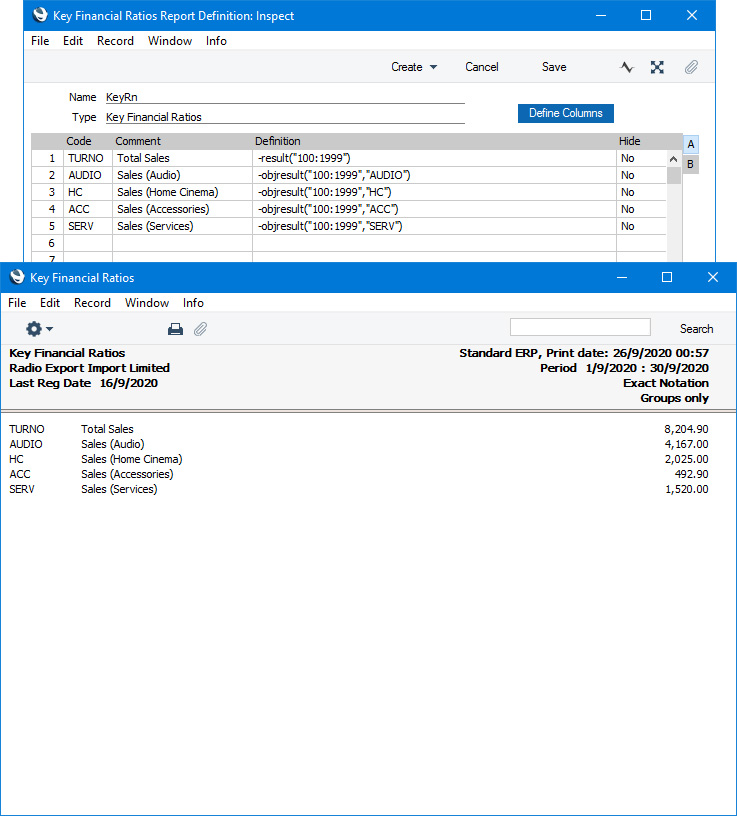
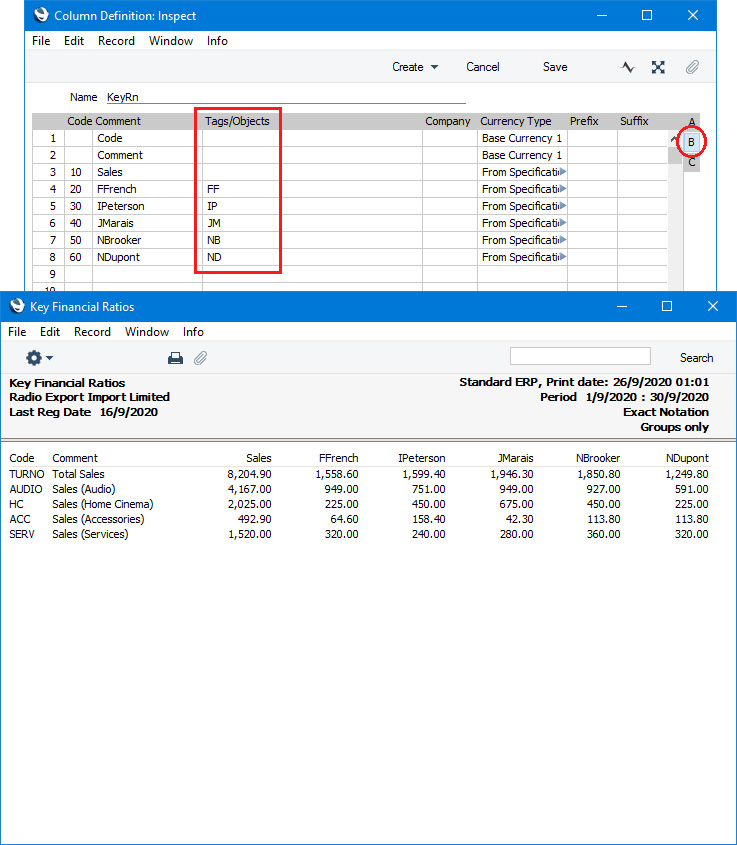
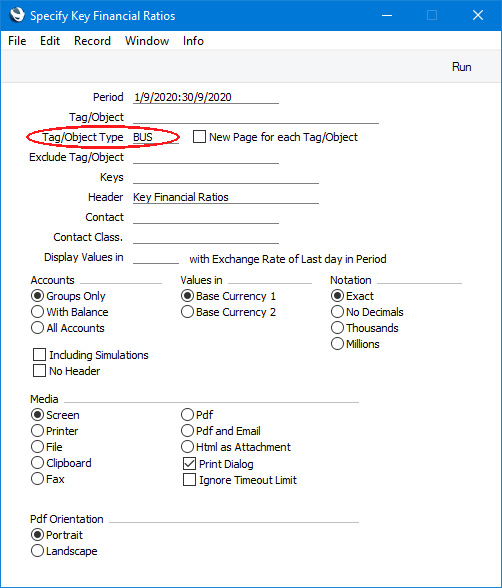
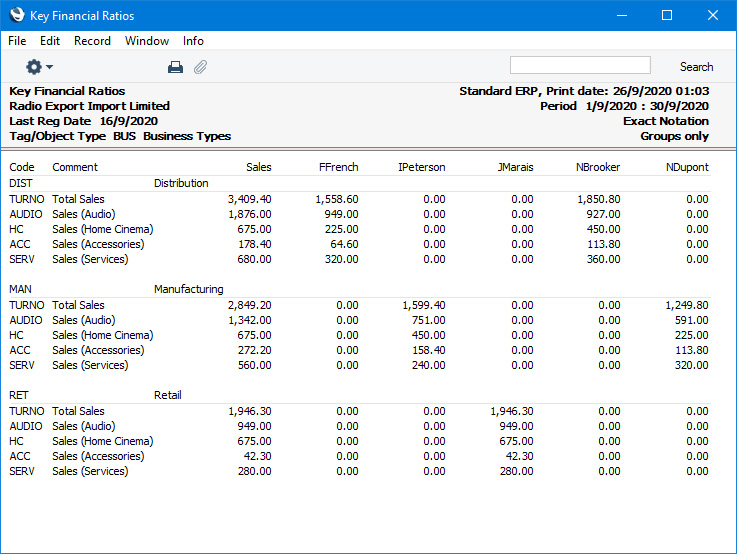
Please follow the links below for more details about the Key Financial Ratios report:
- Introduction
- The Definition of the Key Financial Ratios report
- Example - Key Ratios for Different Periods
- Example - Adding Columns to the report
- Example - Objects
- Additional Column Options
- Assisted Formula Entry
- Multiple Key Ratio Report Definitions
- Printing the Key Financial Ratios Report
Reports in the Nominal Ledger:
- Introduction
- Definition of Nominal Ledger Reports
- Drill-down
- The Operations Menu
- Account Reconciliation
- Accrual Report
- Analytical Balance
- Analytical Balance (Fiscal purposes)
- Balance Sheet
- Bank Reconciliation
- Bank Statement
- Bank Transactions
- Base Currency Rate Change
- Budget Journal
- Cash Flow
- Chart of Accounts
- Correction List
- Corresponding Accounts
- Creditors Account
- Currency A/C Rate Change
- Daily Balances
- Debtors Account
- Forward Balance Journal
- Income & Expense Book
- Key Financial Ratios
- Liquidity Forecast
- Multicurrency Accounts Rate Difference
- N/L Accrual Transactions
- N/L Transfer, Subsystems
- Nominal Ledger
- Profit & Loss
- Revised Budget Journal
- Simulation Journal
- Tag/Object Results
- Tag/Object/Quantity Results
- Tax Account Balances
- Tax Calculations
- Tax Transactions for Registers
- Template Transaction Journal
- Test Corresponding Rules
- Transaction Journal
- Transaction Summary
- Trial Balance
- VAT Listing
- VAT Report
- VAT Report Purchases
- VAT Report Sales
- VAT Transaction Journal
- XBRL Report
Go back to:
- Home page for Nominal Ledger manual
- Home page for Standard ERP manual
Key Financial Ratios - Additional Column Options
This page describes various options on Flip B of the Key Ratio Column Definition window. Please refer here for more details about adding columns to a Key Ratio report definition.---
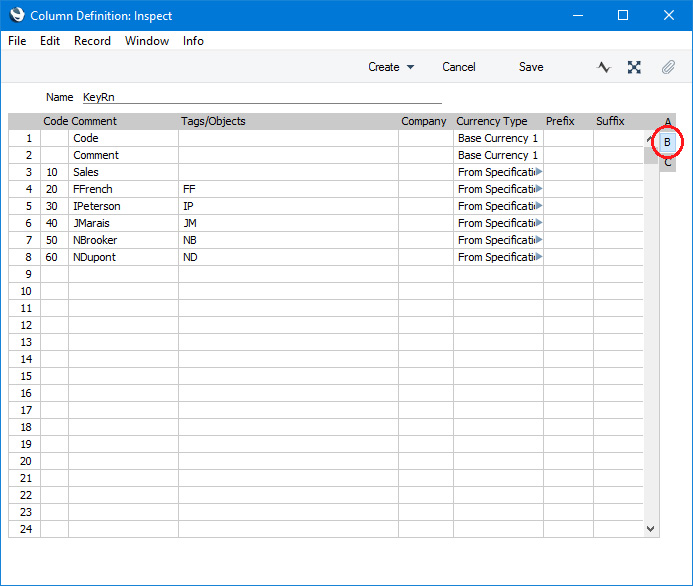
- Company
- Paste Special
Companies in the database
- If you have more than one Company in your database, you can use this field if you need the column to display figures from a particular Company. Leave the field empty to display figures from the Company you are in (i.e. the Company in which the Key Ratio report definition is stored).
- Currency Type
- Paste Special
Choice of possible entries
- Use this field to specify whether the figures in the column will be in Base Currency 1 or 2, as follows:
- Base Currency 1
- Choose this option if the figures are to be in Base Currency 1.
- Base Currency 2
- Choose this option if the figures are to be in Base Currency 2.
- From Specification
- Choose this option if you would like to choose the Base Currency when printing the report, using the Values in options in the report specification window.
Note that if you specify a Currency in the Display Values in field in the report specification window, the figures in the report will be in that Currency so this Currency Type will be ignored.
- Base Currency 1
- Prefix
- If you would like every figure in the column to be printed with a prefix, specify that prefix here.
- Suffix
- If you would like every figure in the column to be printed with a suffix, specify that suffix here.
Please follow the links below for more details about the Key Financial Ratios report:
- Introduction
- The Definition of the Key Financial Ratios report
- Example - Key Ratios for Different Periods
- Example - Adding Columns to the report
- Example - Objects
- Additional Column Options
- Assisted Formula Entry
- Multiple Key Ratio Report Definitions
- Printing the Key Financial Ratios Report
Reports in the Nominal Ledger:
- Introduction
- Definition of Nominal Ledger Reports
- Drill-down
- The Operations Menu
- Account Reconciliation
- Accrual Report
- Analytical Balance
- Analytical Balance (Fiscal purposes)
- Balance Sheet
- Bank Reconciliation
- Bank Statement
- Bank Transactions
- Base Currency Rate Change
- Budget Journal
- Cash Flow
- Chart of Accounts
- Correction List
- Corresponding Accounts
- Creditors Account
- Currency A/C Rate Change
- Daily Balances
- Debtors Account
- Forward Balance Journal
- Income & Expense Book
- Key Financial Ratios
- Liquidity Forecast
- Multicurrency Accounts Rate Difference
- N/L Accrual Transactions
- N/L Transfer, Subsystems
- Nominal Ledger
- Profit & Loss
- Revised Budget Journal
- Simulation Journal
- Tag/Object Results
- Tag/Object/Quantity Results
- Tax Account Balances
- Tax Calculations
- Tax Transactions for Registers
- Template Transaction Journal
- Test Corresponding Rules
- Transaction Journal
- Transaction Summary
- Trial Balance
- VAT Listing
- VAT Report
- VAT Report Purchases
- VAT Report Sales
- VAT Transaction Journal
- XBRL Report
Go back to:
- Home page for Nominal Ledger manual
- Home page for Standard ERP manual
Key Financial Ratios - Assisted Formula Entry
As described on the Defining Key Ratios page, there are a number of commands that you can use when defining Key Ratio formulae. You can type these commands directly into the Definition field in the 'Key Financial Ratios Report Definition' window, or you can use the Assisted Formula Entry feature to have the command constructed for you. This feature will be helpful when you don't remember a Key Ratio command or the correct syntax.To use the Assisted Formula Entry feature, simply activate 'Paste Special' from the Definition field in the Key Ratio row:
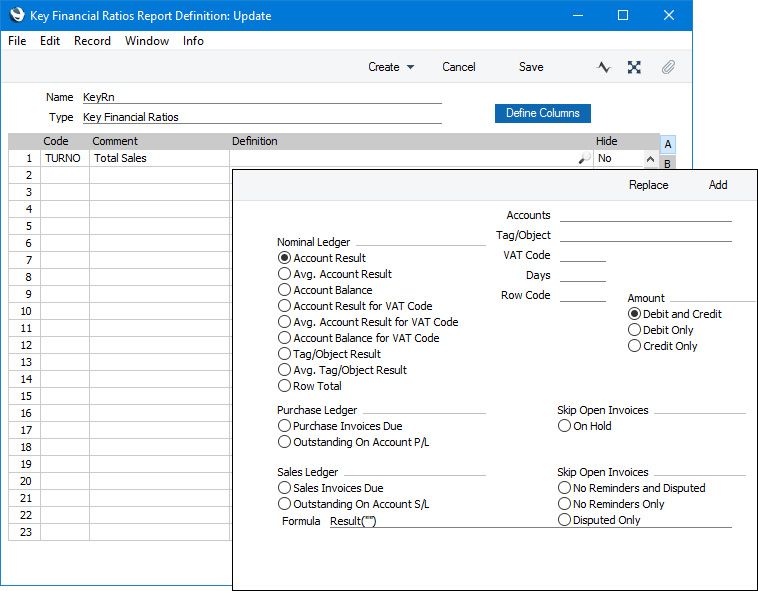
When the formula is complete, press the [Replace] or [Add] buttons as follows:
- Replace
- The new formula will be placed in the Definition field in the Key Ratio row, replacing what was previously there.
- Add
- The new formula will be placed in the Definition field in the Key Ratio row, in addition to what is already there. This will be useful if you are constructing a Definition that will contain more than one Key Ratio command.
- Nominal Ledger
- Choose one of these options if you need the Key Ratio to print information from the Nominal Ledger.
- Account Result
- Prints the net change over the report period in the balance of a particular Account or Accounts.
- Additional details required:
- Specify an Account, range of Accounts separated by a colon or individual Accounts separated by commas in the Accounts field. Use 'Paste Special' to choose the Accounts if necessary.
- Select the Debit Only option if you only need the debit result to be printed.
- Select the Credit Only option if you only need the credit result to be printed.
Equivalent Key Ratio commands: Result, DebResult, CredResult
- Additional details required:
- Avg. Account Result
- Prints the prints the average monthly net change over the report period in the balance of a particular Account or Accounts.
- Additional details required:
- Specify an Account, range of Accounts separated by a colon or individual Accounts separated by commas in the Accounts field. Use 'Paste Special' to choose the Accounts if necessary.
- Select the Debit Only option if you only need the average monthly net change on the debit side to be printed.
- Select the Credit Only option if you only need the average monthly net change on the credit side to be printed.
Equivalent Key Ratio commands: AvgResult, AvgDebResult, AvgCredResult
- Additional details required:
- Account Balance
- Prints the balance of a particular Account or Accounts on the last day of the report period.
- Additional details required:
- Specify an Account, range of Accounts separated by a colon or individual Accounts separated by commas in the Accounts field. Use 'Paste Special' to choose the Accounts if necessary.
- Select the Debit Only option if you only need the debit balance to be printed.
- Select the Credit Only option if you only need the credit balance to be printed.
Equivalent Key Ratio commands: Balance, DebBalance, CredBalance
- Additional details required:
- Account Result for VAT Code
- Prints the net change over the report period in the balance of a particular Account or Accounts, calculated from postings with a particular VAT Code.
- Additional details required:
- Specify an Account, range of Accounts separated by a colon or individual Accounts separated by commas in the Accounts field. Use 'Paste Special' to choose the Accounts if necessary.
- Specify a VAT Code in the VAT Code field. Use 'Paste Special' to choose the VAT Code if necessary.
- Select the Debit Only option if you only need the debit result to be printed.
- Select the Credit Only option if you only need the credit result to be printed.
Equivalent Key Ratio commands: VATResult, VATDebResult, VATCredResult
- Additional details required:
- Avg. Account Result for VAT Code
- Prints the prints the average monthly net change over the report period in the balance of a particular Account or Accounts, calculated from postings with a particular VAT Code.
- Additional details required:
- Specify an Account, range of Accounts separated by a colon or individual Accounts separated by commas in the Accounts field. Use 'Paste Special' to choose the Accounts if necessary.
- Specify a VAT Code in the VAT Code field. Use 'Paste Special' to choose the VAT Code if necessary.
- Select the Debit Only option if you only need the average monthly net change on the debit side to be printed.
- Select the Credit Only option if you only need the average monthly net change on the credit side to be printed.
Equivalent Key Ratio commands: AvgVATResult, AvgVATDebResult, AvgVATCredResult
- Additional details required:
- Account Balance for VAT Code
- Prints the balance of a particular Account or Accounts on the last day of the report period, calculated from postings with a particular VAT Code.
- Additional details required:
- Specify an Account, range of Accounts separated by a colon or individual Accounts separated by commas in the Accounts field. Use 'Paste Special' to choose the Accounts if necessary.
- Specify a VAT Code in the VAT Code field. Use 'Paste Special' to choose the VAT Code if necessary.
- Select the Debit Only option if you only need the debit balance to be printed.
- Select the Credit Only option if you only need the credit balance to be printed.
Equivalent Key Ratio commands: VATBalance, VATDebBalance, VATCredBalance
- Additional details required:
- Tag/Object Result
- Prints the net change over the report period in the balance of a particular Account or Accounts, calculated from postings with a particular Tag/Object.
- Additional details required:
- Specify an Account, range of Accounts separated by a colon or individual Accounts separated by commas in the Accounts field. Use 'Paste Special' to choose the Accounts if necessary.
- Specify a Tag/Object in the Tag/Object field. Use 'Paste Special' to choose the Tag/Object if necessary.
- Select the Debit Only option if you only need the debit result to be printed.
- Select the Credit Only option if you only need the credit result to be printed.
Equivalent Key Ratio commands: ObjResult, ObjDebResult, ObjCredResult
- Additional details required:
- Avg. Tag/Object Result
- Prints the prints the average monthly net change over the report period in the balance of a particular Account or Accounts, calculated from postings with a particular Tag/Object.
- Additional details required:
- Specify an Account, range of Accounts separated by a colon or individual Accounts separated by commas in the Accounts field. Use 'Paste Special' to choose the Accounts if necessary.
- Specify a Tag/Object in the Tag/Object field. Use 'Paste Special' to choose the Tag/Object if necessary.
- Select the Debit Only option if you only need the average monthly net change on the debit side to be printed.
- Select the Credit Only option if you only need the average monthly net change on the credit side to be printed.
Equivalent Key Ratio commands: AvgObjResult, AvgObjCredResult, AvgObjDebResult
- Additional details required:
- Row Total
- Select this option to include the result of another Key Ratio calculation in the formula.
- Additional details required:
- Enter the Code of the other Key Ratio in the Row Code field.
Equivalent Key Ratio command: Key
- Additional details required:
- Account Result
- Purchase Ledger
- Choose one of these options if you need the Key Ratio to print information from the Purchase Ledger.
- Purchase Invoices Due
- Prints the total amount in the Purchase Ledger that is overdue for payment on the last day of the report period.
- Additional details required:
- If you need to see how much is overdue by more than a particular number of days on the last day of the report period, enter that number of days in the Days field.
- If you want to exclude Purchase Invoices that have been marked as On Hold, select the On Hold option.
- Equivalent Key Ratio commands: APDue, APOHDue
- Additional details required:
- Outstanding On Account P/L
- Prints the On Account balance in the Purchase Ledger on the last day of the report period (including open On Account Payments and Prepayments).
- Equivalent Key Ratio command: APOnAcc
- Purchase Invoices Due
- Sales Ledger
- Choose one of these options if you need the Key Ratio to print information from the Sales Ledger.
- Sales Invoices Due
- Prints the total amount in the Sales Ledger that is overdue for payment on the last day of the report period.
- Additional details required:
- If you need to see how much is overdue by more than a particular number of days on the last day of the report period, enter that number of days in the Days field.
- If you want to exclude Invoices that have been marked as Disputed, select the Disputed Only option.
- If you want to exclude Invoices that have been marked as No Reminders, select the No Reminders Only option.
- If you want to exclude Invoices that have been marked as Disputed, and Invoices that have been marked as No Reminders, select the No Reminders and Disputed option.
- Equivalent Key Ratio commands: ARDue, ARDPDue, ARNRDue, ARDPNRDue
- Additional details required:
- Outstanding On Account S/L
- Prints the On Account balance in the Sales Ledger on the last day of the report period (including open On Account Receipts and Prepayments).
- Equivalent Key Ratio command: AROnAcc
- Sales Invoices Due
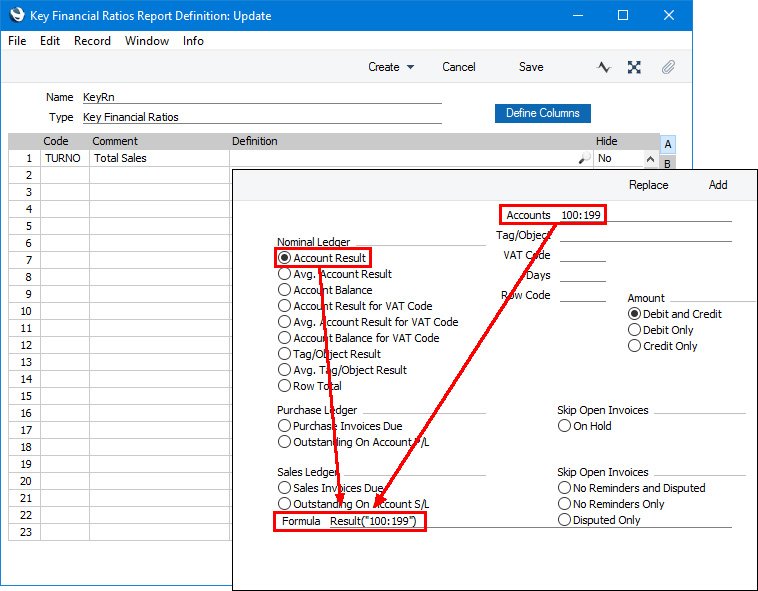
Please follow the links below for more details about the Key Financial Ratios report:
- Introduction
- The Definition of the Key Financial Ratios report
- Example - Key Ratios for Different Periods
- Example - Adding Columns to the report
- Example - Objects
- Additional Column Options
- Assisted Formula Entry
- Multiple Key Ratio Report Definitions
- Printing the Key Financial Ratios Report
Reports in the Nominal Ledger:
- Introduction
- Definition of Nominal Ledger Reports
- Drill-down
- The Operations Menu
- Account Reconciliation
- Accrual Report
- Analytical Balance
- Analytical Balance (Fiscal purposes)
- Balance Sheet
- Bank Reconciliation
- Bank Statement
- Bank Transactions
- Base Currency Rate Change
- Budget Journal
- Cash Flow
- Chart of Accounts
- Correction List
- Corresponding Accounts
- Creditors Account
- Currency A/C Rate Change
- Daily Balances
- Debtors Account
- Forward Balance Journal
- Income & Expense Book
- Key Financial Ratios
- Liquidity Forecast
- Multicurrency Accounts Rate Difference
- N/L Accrual Transactions
- N/L Transfer, Subsystems
- Nominal Ledger
- Profit & Loss
- Revised Budget Journal
- Simulation Journal
- Tag/Object Results
- Tag/Object/Quantity Results
- Tax Account Balances
- Tax Calculations
- Tax Transactions for Registers
- Template Transaction Journal
- Test Corresponding Rules
- Transaction Journal
- Transaction Summary
- Trial Balance
- VAT Listing
- VAT Report
- VAT Report Purchases
- VAT Report Sales
- VAT Transaction Journal
- XBRL Report
Go back to:
- Home page for Nominal Ledger manual
- Home page for Standard ERP manual
Key Financial Ratios - Multiple Key Ratio Report Definitions
You can create as many of your own Key Financial Ratio reports as you need. Please refer to the Multiple Balance Sheet Definitions page for full details about creating new reports. After creating a new report, you should then enter a definition for it, as described on the Defining Key Ratios page.If you have added column definitions to the definition of the built-in Key Financial Ratios report as described on the Adding Columns to the Report page, these column definitions will also be used in the new reports unless you explicitly add column definitions to those reports. If you do not want these column definitions to be used for a particular report, save an empty column definition for that report (click the [Define Columns] button in the 'Key Financial Ratios Report Definitions' window and immediately press the [Save] button when the 'Column Definition: New' window opens).
---
Please follow the links below for more details about the Key Financial Ratios report:
- Introduction
- The Definition of the Key Financial Ratios report
- Example - Key Ratios for Different Periods
- Example - Adding Columns to the report
- Example - Objects
- Additional Column Options
- Assisted Formula Entry
- Multiple Key Ratio Report Definitions
- Printing the Key Financial Ratios Report
Reports in the Nominal Ledger:
- Introduction
- Definition of Nominal Ledger Reports
- Drill-down
- The Operations Menu
- Account Reconciliation
- Accrual Report
- Analytical Balance
- Analytical Balance (Fiscal purposes)
- Balance Sheet
- Bank Reconciliation
- Bank Statement
- Bank Transactions
- Base Currency Rate Change
- Budget Journal
- Cash Flow
- Chart of Accounts
- Correction List
- Corresponding Accounts
- Creditors Account
- Currency A/C Rate Change
- Daily Balances
- Debtors Account
- Forward Balance Journal
- Income & Expense Book
- Key Financial Ratios
- Liquidity Forecast
- Multicurrency Accounts Rate Difference
- N/L Accrual Transactions
- N/L Transfer, Subsystems
- Nominal Ledger
- Profit & Loss
- Revised Budget Journal
- Simulation Journal
- Tag/Object Results
- Tag/Object/Quantity Results
- Tax Account Balances
- Tax Calculations
- Tax Transactions for Registers
- Template Transaction Journal
- Test Corresponding Rules
- Transaction Journal
- Transaction Summary
- Trial Balance
- VAT Listing
- VAT Report
- VAT Report Purchases
- VAT Report Sales
- VAT Transaction Journal
- XBRL Report
Go back to:
- Home page for Nominal Ledger manual
- Home page for Standard ERP manual
Key Financial Ratios - Printing
This page describes printing the Key Financial Ratios report.---
Having entered a definition for the Key Financial Ratios report as described here, you will be ready to print the report. Ensure you are in the Nominal Ledger, click (Windows/macOS) or tap (iOS/Android) the [Reports] button in the Navigation Centre and then double-click or tap 'Key Financial Ratios' in the 'Reports' list. The 'Specify Key Financial Ratios' window will be opened.
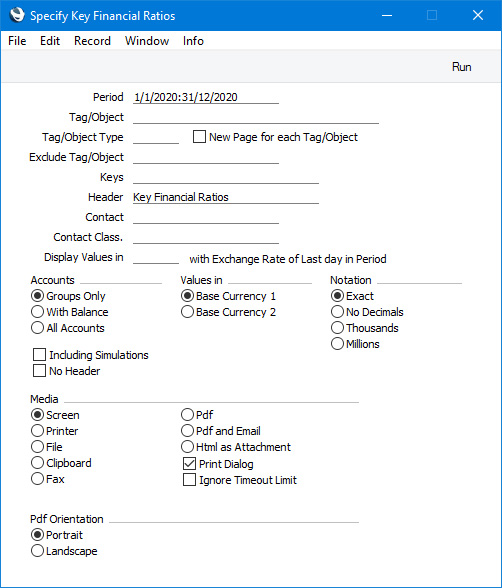
- Period
- Paste Special
Reporting Periods setting, System module
- Enter the report period.
- If you are using the Leading Zero before Day, Leading Zero before Month and/or Century options in your Date and Numeric Format, you do not need to type the leading zeros or the century digits as these will be inserted automatically. For example, if you type "1-1-20", this will be converted to "01-01-2020" automatically (if you are using all three of the options mentioned).
- If your report period is a single day, just enter the date once and this will be converted to a period format automatically.
- The default value will be taken from the first row of the Reporting Periods setting.
- You can set different periods for individual Key Ratios and in column definitions, using the Period, Offset and Length fields on flip C in each case. When you do so, the different periods will all be related to the overall report period that you have chosen in this field. For example, you can enter Key Ratios and/or column definitions for the month, quarter or year prior to the overall report period. Please refer here for more details.
- If you are using the Leading Zero before Day, Leading Zero before Month and/or Century options in your Date and Numeric Format, you do not need to type the leading zeros or the century digits as these will be inserted automatically. For example, if you type "1-1-20", this will be converted to "01-01-2020" automatically (if you are using all three of the options mentioned).
- Tag/Object
- Paste Special
Tag/Object register, Nominal Ledger/System module
- Enter a Tag/Object here if you want the Key Ratio figures in the report to be calculated from Transaction rows with a particular Tag/Object. If you enter a number of Tags/Objects separated by commas, only those Transaction rows featuring all the Tags/Objects listed will be included in the calculations.
- Specifying a Tag/Object will mean the figures supplied to the Key Ratio definitions will be filtered before the Key Ratio calculations are carried out. For example:
- If you do not specify a Tag/Object here, a Key Ratio with the definition -RESULT("100") will print the total posted to Account 100 during the report period. If you specify Tag/Object 1 in this field, the Key Ratio will print the total posted to Account 100 with Tag/Object 1.
- A Key Ratio with the definition -OBJRESULT("100","1") will by default print the total posted to Account 100 with Tag/Object 1. If you specify Tag/Object 1 in this field, the Key Ratio will be unaffected and the same figure will be printed.
- A Key Ratio with the definition -OBJRESULT("100","2") will by default print the total posted to Account 100 with Tag/Object 2. If you specify Tag/Object 1 in this field, all Transaction rows with Tag/Object 2 will be filtered out before the Key Ratio is calculated, so it will print zero.
- If you have any column definitions in which you have specified Tags/Objects on flip B and you specify Tag/Object 1 in this field, again all Transaction rows with Tags/Objects other than 1 will be filtered out before the column values are calculated, so all columns with Tags/Objects other than 1 will print zero.
- Specifying a Tag/Object will mean the figures supplied to the Key Ratio definitions will be filtered before the Key Ratio calculations are carried out. For example:
- Tag/Object Type
- Paste Special
Tag/Object Types setting, Nominal Ledger
- Specifying a Tag/Object Type in this field will have two effects on the report:
- The Key Ratio figures in the report will be calculated from Transaction rows with Tags/Objects belonging to that Tag/Object Type only.
- The report will contain separate sections for each Tag/Object belonging to the Tag/Object Type. Each Key Ratio will be printed separately for each Tag/Object. For example, if you specify a Tag/Object Type that contains Tags/Objects 1, 2 and 3, each Key Ratio will be printed three times, once for each Tag/Object.
- The Key Ratio figures in the report will be calculated from Transaction rows with Tags/Objects belonging to that Tag/Object Type only.
- New Page for each Tag/Object
- If you have specified a Tag/Object Type in the field immediately to the left, select this option if you would like each Tag/Object to be printed on a separate page. This applies when the report is printed to a printer or to PDF only.
- Keys
- If you do not want every Key Ratio to be included in the report, specify here which ones are to be included. If you specify more than one, separate them using commas (e.g. "TURNO,CR,EMP").
- Header
- Specify a title for the report here. This title will be printed in the report header, and will also appear in the title bar of the report window if you print the report to screen.
- Contact
- Paste Special
Customers, Suppliers and Contact Persons in Contact register
- Range Reporting Alpha
- If you have Key Ratios that use the APRESULT, APPAIDRESULT, ARRESULT or ARPAIDRESULT commands, you can specify here the Supplier or Customer (or the range of Suppliers or Customers) for which the Key Ratios are to be calculated.
- As described for the Object field above, specifying a Supplier or Customer here will mean the figures supplied to the Key Ratio definitions will be filtered before the Key Ratio calculations are carried out. So, if you have specified Suppliers or Customers in the Key Ratio definitions, specifying a different Supplier or Customer here will cause those Key Ratios to print zeros.
- If you have Key Ratios that use the APRESULT, APPAIDRESULT, ARRESULT or ARPAIDRESULT commands, you can specify here the Supplier or Customer (or the range of Suppliers or Customers) for which the Key Ratios are to be calculated.
- Contact Class.
- Paste Special
Contact Classifications setting, CRM module
- If you have Key Ratios that use the APRESULT, APPAIDRESULT, ARRESULT or ARPAIDRESULT commands, you can specify here that the Key Ratios are to be calculated for all Suppliers or Customers with a particular Contact Classification.
- If you enter a number of Classifications separated by commas, only those Suppliers or Customers featuring all the Classifications will be included in the calculations.
- If you enter a number of Classifications separated by commas, only those Suppliers or Customers featuring all the Classifications will be included in the calculations.
- Display Values in
- Paste Special
Currency register, System module
- Specify a Currency here if you would like the Key Ratio figures in the report to be calculated from Transaction rows that have the specified Currency shown on flip C. The calculations will use the figures on flip C of those Transaction rows, so the figures in the report will be in that Currency.
- If you leave this field blank, all Transaction rows will be included in the calculations. In this case, choose whether the figures in the report will be in Base Currency 1 or 2 as follows:
- If you have added column definitions to the Key Ratio report definition, you can use the Currency Type field on flip B of the 'Column Definition' window to specify whether the figures in a particular column will always be in Base Currency 1 or 2.
- If the Key Ratio report definition does not have columns, or the Currency Type in a column is "From Specification", use the Values in options in the specification window (described below) to choose whether the figures in the report will be in Base Currency 1 or 2.
This field is only used by Key Ratios that are calculated directly from Transaction rows (e.g. RESULT, BALANCE, OBJRESULT). Other Key Ratios (e.g. APDUE, ARDUE and their relations) will not use this field and their figures will always be in Base Currency 1 or 2.
- If you leave this field blank, all Transaction rows will be included in the calculations. In this case, choose whether the figures in the report will be in Base Currency 1 or 2 as follows:
- Accounts
- Use these options to choose how you want the Accounts to be printed in the report.
- Groups Only
- This option will simply print a single figure for each Key Ratio. For example, if the Key Ratio definition is -RESULT(100:199), a single total result figure for the Accounts in the range will be printed.
- With Balance
- As well as a single figure for each Key Ratio, this option will also list Accounts that have a closing result or balance (depending on the Key Ratio command) individually. For example, if the Key Ratio definition is -RESULT(100:199), every Account in the range that has a result at the end of the report or column period will be listed individually, and this will be followed by the overall total result figure.
- All Accounts
- This option will list every Account in the range individually, whether or not they have been used. For example, if the Key Ratio definition is -RESULT(100:199), every Account in the range will be listed individually, and this will be followed by the overall total result figure.
If you use the With Balance or All Accounts options and you print the report to screen, the lists of Accounts will have the Standard ERP Drill-down feature. Click (Windows/macOS) or tap (iOS/Android) on the Account Number of any Account in the report to open the Nominal Ledger Report for the same Account and period. From the Nominal Ledger report, you can click or tap on any Transaction Number to open an individual Transaction record.
- Groups Only
- Values in
- If you leave the Display Values in field above empty, use these options to specify whether the figures in the report should be in Base Currency 1 or 2.
- If you have any column definitions in which you have set the Currency Type on flip B to "Base Currency 1" or "Base Currency 2", the option that you choose here will be ignored. The figures in the column will always obey the specified Currency Type. If you need your columns to obey the option that you choose here, set the Currency Type in the column definition to "From Specification".
- If you have any column definitions in which you have set the Currency Type on flip B to "Base Currency 1" or "Base Currency 2", the option that you choose here will be ignored. The figures in the column will always obey the specified Currency Type. If you need your columns to obey the option that you choose here, set the Currency Type in the column definition to "From Specification".
- Notation
- Select the printing format for the values in the report.
- Exact
- Shows the balances as stored in the Transactions.
- No Decimals
- Rounds the balances up or down to the nearest whole number.
- Thousands, Millions
- Divide the balances by 1,000 or 1,000,000.
- Exact
- Including Simulations
- Select this option if you simulated transactions from the Simulation register to be included in your report. Simulation rows in which the Status is "Invalid" and "Transferred" will not be included.
- No Header
- Select this option if you want the report to be printed without a header.
---
Please follow the links below for more details about the Key Financial Ratios report:
- Introduction
- The Definition of the Key Financial Ratios report
- Example - Key Ratios for Different Periods
- Example - Adding Columns to the report
- Example - Objects
- Additional Column Options
- Assisted Formula Entry
- Multiple Key Ratio Report Definitions
- Printing the Key Financial Ratios Report
Reports in the Nominal Ledger:
- Introduction
- Definition of Nominal Ledger Reports
- Drill-down
- The Operations Menu
- Account Reconciliation
- Accrual Report
- Analytical Balance
- Analytical Balance (Fiscal purposes)
- Balance Sheet
- Bank Reconciliation
- Bank Statement
- Bank Transactions
- Base Currency Rate Change
- Budget Journal
- Cash Flow
- Chart of Accounts
- Correction List
- Corresponding Accounts
- Creditors Account
- Currency A/C Rate Change
- Daily Balances
- Debtors Account
- Forward Balance Journal
- Income & Expense Book
- Key Financial Ratios
- Liquidity Forecast
- Multicurrency Accounts Rate Difference
- N/L Accrual Transactions
- N/L Transfer, Subsystems
- Nominal Ledger
- Profit & Loss
- Revised Budget Journal
- Simulation Journal
- Tag/Object Results
- Tag/Object/Quantity Results
- Tax Account Balances
- Tax Calculations
- Tax Transactions for Registers
- Template Transaction Journal
- Test Corresponding Rules
- Transaction Journal
- Transaction Summary
- Trial Balance
- VAT Listing
- VAT Report
- VAT Report Purchases
- VAT Report Sales
- VAT Transaction Journal
- XBRL Report
Go back to:
- Home page for Nominal Ledger manual
- Home page for Standard ERP manual
Liquidity Forecast
This page describes the Liquidity Forecast report in the Nominal Ledger.---
The Liquidity Forecast report is a forecast of future incoming and outgoing payments that will be useful for cash flow prediction purposes. The forecast will be based on the following records (depending on the options that you select when running the report):
- Open (unpaid) Purchase and Sales Invoices. The report will predict that these Invoices will be paid on their Due Dates.
If you have agreed a different payment date with a Customer or Supplier, you can register that date in a record in the Liquidity Report Info setting. The report will take the agreed date into account if you produce it using the Detailed incl. Liq. Info. option.
- Simulation rows that post to the Cash and Bank Accounts specified in the Payment Modes setting and in which the Status is "Active". You would have entered these Simulations in advance to predict payments that will not be recorded in the Sales and Purchase Ledgers (examples might be Simulations that represent the future payments of rent and salaries).
- If you are subscribing to the Cheques module, you can also include Cheques and Own Cheques in the Liquidity Forecast report. (Accepted and Deposited Cheques and Accepted Own Cheques will not be included.)
Running the Liquidity Forecast report will open the following window:
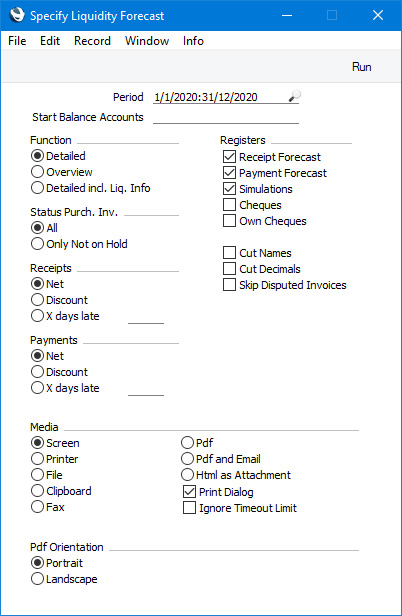
- Period
- Paste Special
Reporting Periods setting, System module
- Enter the report period.
- If you are using the Leading Zero before Day, Leading Zero before Month and/or Century options in your Date and Numeric Format, you do not need to type the leading zeros or the century digits as these will be inserted automatically. For example, if you type "1-1-20", this will be converted to "01-01-2020" automatically (if you are using all three of the options mentioned).
- If your report period is a single day, just enter the date once and this will be converted to a period format automatically.
- The default value will be taken from the first row of the Reporting Periods setting.
- If you are using the Leading Zero before Day, Leading Zero before Month and/or Century options in your Date and Numeric Format, you do not need to type the leading zeros or the century digits as these will be inserted automatically. For example, if you type "1-1-20", this will be converted to "01-01-2020" automatically (if you are using all three of the options mentioned).
- Start Balance Accounts
- Paste Special
Account register, Nominal Ledger/System module
- Range Reporting Alpha
- If you specify an Account here (e.g. a Bank or Cash Account), the report will contain an opening balance for that Account, incremented balances after each Receipt, Payment or other transaction, and a theoretical closing balance. If you specify a range of Accounts separated by a colon (:), the opening balance for the report will be the sum of the opening balances of the Accounts in the range.
- If you specify an Account here (e.g. a Bank or Cash Account), the report will contain an opening balance for that Account, incremented balances after each Receipt, Payment or other transaction, and a theoretical closing balance. If you specify a range of Accounts separated by a colon (:), the opening balance for the report will be the sum of the opening balances of the Accounts in the range.
- Function
- Use these options to control the level of detail shown in the report.
- Detailed
- The Detailed option produces a report listing each transaction in expected payment date order. The calculation of the expected payment dates will depend on the Receipts and Payments options that you choose below. The estimated payment amounts will be the outstanding amounts for each Invoice (if an Invoice is payable in Instalments, the Instalments will be listed individually). The outstanding amount for an Invoice in Currency will be converted to your home Currency using the Exchange Rate for the report date.
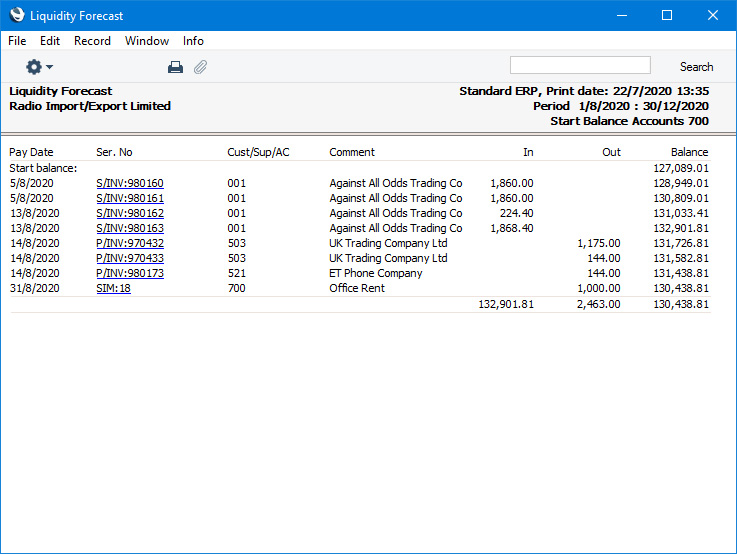
- Overview
- The Overview contains a single line summary for each day on which it is expected a payment will be made or received. Expected payment dates, payment amounts and Currency conversion will be determined in the same way as in the Detailed report described above.
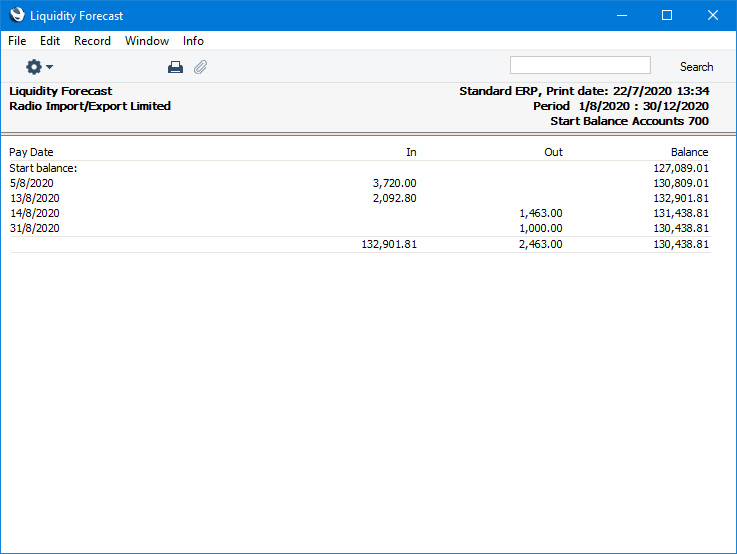
- Detailed incl. Liq. Info.
- The Liquidity Report Info setting allows you to change the Due Date of a Sales or Purchase Invoice solely for this report (i.e. without changing the Invoice itself). You can also use this setting to re-schedule the payment of an Invoice into instalments. If you are using this setting, select this option to include the information in the setting in the report.
- In the example illustrated below, the expected payment date for Invoice 980160 has been delayed by one month and the payment for Invoice 980161 has been divided into three instalments.
Please refer here for details about the Liquidity Report Info setting.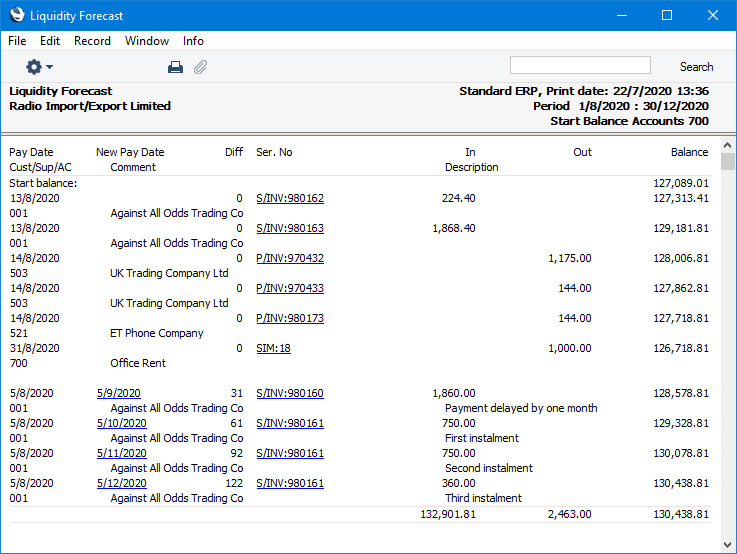
- In the example illustrated below, the expected payment date for Invoice 980160 has been delayed by one month and the payment for Invoice 980161 has been divided into three instalments.
- Detailed
- Registers
- Use these options to include records from various registers in the report.
- Receipt Forecast
- Select this option if you need open (unpaid) Sales Invoices to be included in the report. For an Invoice to be included in the report, its Due Date must fall within the report period.
- Payment Forecast
- Select this option if you need open (unpaid) Sales Invoices to be included in the report. For a Purchase Invoice to be included in the report, its Due Date must fall within the report period.
- Simulations
- Select this option if you need Simulation rows to be included in the report. A Simulation row will be included in the report if it meets the following criteria:
- The Status in the Simulation row must be "Active".
- The Simulation row must post to one of the Accounts that you have used with Payment Modes whose Type is "Free", "Credit Card". "Debit Card", "Cash", "On Account", "Bank Transfer", "Received Cheques" or "Own Cheques".
- The row must be included in a Simulation whose Trans. Date falls within the report period.
- The Status in the Simulation row must be "Active".
- Cheques
- If you are subscribing to the Cheques module, you can use this option if you need Cheques to be included in the report. A Cheque will be included in the report if it meets the following criteria:
- It is not an Accepted or Deposited Cheque.
- Its Estimated Cl. Date falls within the report period.
- It is not an Accepted or Deposited Cheque.
- Own Cheques
- If you are subscribing to the Cheques module, you can use this option if you need Own Cheques to be included in the report. An Own Cheque will be included in the report if it meets the following criteria:
- It is not an Accepted Own Cheque.
- Its Effect Date falls within the report period.
- It is not an Accepted Own Cheque.
- Receipt Forecast
- Status Purch. Inv.
- Select the Only Not on Hold option if you do not want Purchase Invoices that have been marked as On Hold to be included in the report. Usually you will not pay a Purchase Invoice that you have marked as On Hold.
- Receipts, Payments
- Use these options to specify how the estimated payment dates for Sales and Purchase Invoices will be calculated.
- Net
- Select this option if you need the report to show that payments will be received or issued on the relevant Due Date.
- Discount
- Select this option if Invoices with settlement discount terms will be paid on their Discount Dates. The Discount Date is the date when a settlement discount expires. The payment amount shown in the report will include the deduction for the settlement discount.
- X days late
- Select this option when you assume that all Invoices will be paid on average a specified number of days later than their Due Dates. Specify the number of days in the field to the right of this option.
- Net
- Cut Names
- If you are using the Detailed option, the Customer or Supplier Name will be shown for each Invoice, and each Simulation Text will be printed in full. Select this option if you would like to cut these Names and Comments so that only the first 15 characters are printed.
- Cut Decimals
- Select this option if you would like whole numbers only to be shown in the report. For example, an amount of 5.88 will be shown as 5 if you use this option.
- Skip Disputed Invoices
- Select this option if you would like Sales Invoices that you have marked as Disputed to be excluded from the report.
Reports in the Nominal Ledger:
- Introduction
- Definition of Nominal Ledger Reports
- Drill-down
- The Operations Menu
- Account Reconciliation
- Accrual Report
- Analytical Balance
- Analytical Balance (Fiscal purposes)
- Balance Sheet
- Bank Reconciliation
- Bank Statement
- Bank Transactions
- Base Currency Rate Change
- Budget Journal
- Cash Flow
- Chart of Accounts
- Correction List
- Corresponding Accounts
- Creditors Account
- Currency A/C Rate Change
- Daily Balances
- Debtors Account
- Forward Balance Journal
- Income & Expense Book
- Key Financial Ratios
- Liquidity Forecast
- Multicurrency Accounts Rate Difference
- N/L Accrual Transactions
- N/L Transfer, Subsystems
- Nominal Ledger
- Profit & Loss
- Revised Budget Journal
- Simulation Journal
- Tag/Object Results
- Tag/Object/Quantity Results
- Tax Account Balances
- Tax Calculations
- Tax Transactions for Registers
- Template Transaction Journal
- Test Corresponding Rules
- Transaction Journal
- Transaction Summary
- Trial Balance
- VAT Listing
- VAT Report
- VAT Report Purchases
- VAT Report Sales
- VAT Transaction Journal
- XBRL Report
Go back to:
- Home page for Nominal Ledger manual
- Home page for Standard ERP manual
Multicurrency Accounts Rate Difference
This page describes the Multicurrency Accounts Rate Difference report in the Nominal Ledger.---
The Multicurrency Accounts Rate Difference report summarises the postings made to a particular Account in a specified Currency or in all Currencies (except Base Currencies 1 and 2). Three versions of each balance will be shown: in the original Currency; in Base Currency 1 using the Exchange Rate at the time of each posting; and in Base Currency 1 using the Exchange Rate for a specified date. The report will also show the difference between the two Base Currency figures. The report will therefore show the losses or gains that will result from applying the Exchange Rate to old Transactions.
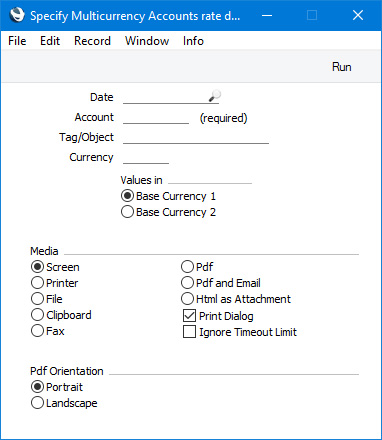
- Date
- Paste Special
Choose date
- The report will use the date that you specify here for the following purposes:
- The first two columns in the report will display the total postings to the specified Account up to this date in two Currencies: the Currency of the posting and Base Currency 1 (your home Currency).
- The third column in the report will display the Currency balance of each Account converted to Base Currency 1 using the Exchange Rate applying on this date.
- You must specify a date, otherwise the report will be empty.
- The first two columns in the report will display the total postings to the specified Account up to this date in two Currencies: the Currency of the posting and Base Currency 1 (your home Currency).
- Account
- Paste Special
Account register, Nominal Ledger/System module
- The report will summarise the postings made to the Account that you specify here. For example, if you have posted to a particular Account in Currencies JPY and USD, the report will contain two lines, one for the JPY postings and one for the USD postings. If you only need one of those lines, specify the relevant Currency in the field below. Postings made after the date specified above will not be included.
- You must specify a single Account, otherwise the report will be empty.
- You must specify a single Account, otherwise the report will be empty.
- Tag/Object
- Paste Special
Tag/Object register, Nominal Ledger/System module
- If you only need postings with a particular Tag/Object to be included in the report, specify that Tag/Object here.
- Currency
- Paste Special
Currency register, System module
- By default, the report will summarise the postings made to the Account specified above, with each Currency that you have used occupying a separate line in the report. If you only need the report to contain a single line for a particular Currency, specify that Currency here.
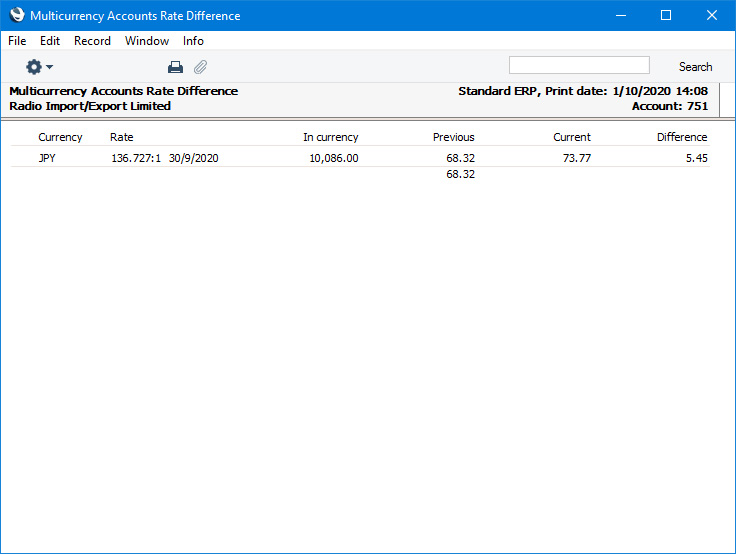
- In currency
- The total value posted to the Account up to the specified date expressed in JPY.
- Previous
- The total value posted to the Account up to the specified date expressed in Base Currency 1, using the values converted and stored at the time of posting.
- Current
- The total value posted to the Account up to the specified date expressed in Base Currency 1, converted using the Exchange Rate from 30 September 2020.
- Difference
- The difference between the Previous and Current figures.
Reports in the Nominal Ledger:
- Introduction
- Definition of Nominal Ledger Reports
- Drill-down
- The Operations Menu
- Account Reconciliation
- Accrual Report
- Analytical Balance
- Analytical Balance (Fiscal purposes)
- Balance Sheet
- Bank Reconciliation
- Bank Statement
- Bank Transactions
- Base Currency Rate Change
- Budget Journal
- Cash Flow
- Chart of Accounts
- Correction List
- Corresponding Accounts
- Creditors Account
- Currency A/C Rate Change
- Daily Balances
- Debtors Account
- Forward Balance Journal
- Income & Expense Book
- Key Financial Ratios
- Liquidity Forecast
- Multicurrency Accounts Rate Difference
- N/L Accrual Transactions
- N/L Transfer, Subsystems
- Nominal Ledger
- Profit & Loss
- Revised Budget Journal
- Tag/Object Results
- Tag/Object/Quantity Results
- Tax Account Balances
- Tax Calculations
- Tax Transactions for Registers
- Template Transaction Journal
- Test Corresponding Rules
- Transaction Journal
- Transaction Summary
- Trial Balance
- VAT Listing
- VAT Report
- VAT Report Purchases
- VAT Report Sales
- VAT Transaction Journal
- XBRL Report
Go back to:
- Home page for Nominal Ledger manual
- Home page for Standard ERP manual
N/L Accrual Transactions
The N/L Accrual Transactions report allows you to preview the Transactions that will be created if you run the 'Generate N/L Accrual Transactions' Maintenance function. The specification windows used for this report and Maintenance function are the same: please refer to the description of the 'Generate N/L Accrual Transactions' Maintenance function for details.---
Reports in the Nominal Ledger:
- Introduction
- Definition of Nominal Ledger Reports
- Drill-down
- The Operations Menu
- Account Reconciliation
- Accrual Report
- Analytical Balance
- Analytical Balance (Fiscal purposes)
- Balance Sheet
- Bank Reconciliation
- Bank Statement
- Bank Transactions
- Base Currency Rate Change
- Budget Journal
- Cash Flow
- Chart of Accounts
- Correction List
- Corresponding Accounts
- Creditors Account
- Currency A/C Rate Change
- Daily Balances
- Debtors Account
- Forward Balance Journal
- Income & Expense Book
- Key Financial Ratios
- Liquidity Forecast
- Multicurrency Accounts Rate Difference
- N/L Accrual Transactions
- N/L Transfer, Subsystems
- Nominal Ledger
- Profit & Loss
- Revised Budget Journal
- Tag/Object Results
- Tag/Object/Quantity Results
- Tax Account Balances
- Tax Calculations
- Tax Transactions for Registers
- Template Transaction Journal
- Test Corresponding Rules
- Transaction Journal
- Transaction Summary
- Trial Balance
- VAT Listing
- VAT Report
- VAT Report Purchases
- VAT Report Sales
- VAT Transaction Journal
- XBRL Report
Go back to:
- Home page for Nominal Ledger manual
- Home page for Standard ERP manual
N/L Transfer, Subsystems
This page describes the N/L Transfer, Subsystems report in the Nominal Ledger.---
The integration between the different modules in Standard ERP means that Nominal Ledger Transactions can be generated automatically from records in other ledgers and modules ("Sub Systems"). For example, when saving an Invoice that you have marked as OK can cause a Nominal Ledger Transaction to be generated automatically. This Transaction will debit a Debtor Account and credit at least one Sales Account and, if appropriate, a VAT Account. This feature is controlled using the Sub Systems setting in the Nominal Ledger.
If you are not having Nominal Ledger Transactions generated automatically from Sub System records (i.e. if you are not using any of the options in the Sub Systems setting), you will need to enter them to the Transaction register yourself. This report will help you with this task, as it is a list of the Account postings that should result from the records entered in a specified Sub System (e.g. from Invoices entered in the Sales Ledger). Alternatively you can create the Transactions in batches using the 'Create NL Transactions' Maintenance function in the Nominal Ledger and in the System module, in which case this report will list the Transactions that will be created by that function.
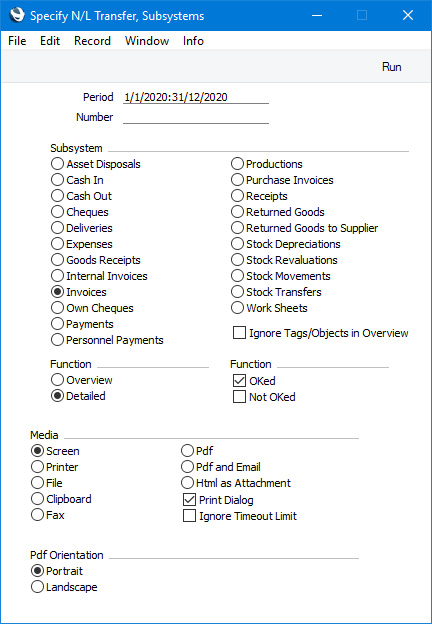
- Period
- Paste Special
Reporting Periods setting, System module
- Enter the start and end date of the report period, separated by a colon (:). Records in the Sub System register specified below with Transaction Dates from within this period will be listed in the report.
- Number
- Paste Special
Numeric
- Use this field if you need to list particular records in your chosen Sub System register. These records must have Transaction Dates that fall within the period specified above, otherwise the report will be empty.
- For example, to report on Purchase Invoices 20 to 30, enter "20:30" here and select "Purchase Invoices" as the Sub System option below.
- For example, to report on Purchase Invoices 20 to 30, enter "20:30" here and select "Purchase Invoices" as the Sub System option below.
- Subsystem
- Select one Sub System for the report.
- Ignore Tags/Objects in Overview
- Please refer to the description of the Overview version of the report below for details about this option.
- Function
- Use these options to specify the level of detail that is to be shown in the report.
- Overview
- This option is a list of Sub System record (Invoices, Payments etc.) showing the total value of each one. There will then be a list of the total values that should be debited or credited to each Account-Tag/Object combination as a result of those Sub System records. This information will allow you to the summarise the Sub System records in a single Nominal Ledger Transaction.
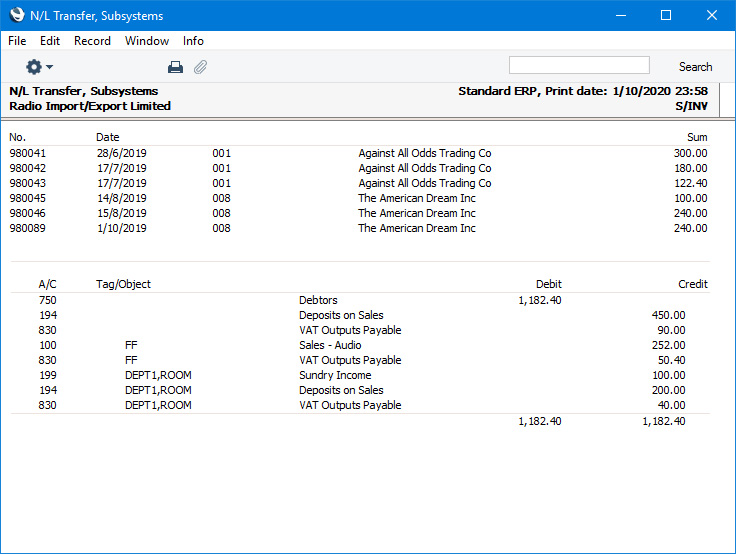
- If you have selected the Ignore Tags/Objects in Overview option above, the second section will not include Tag/Objects and so will simply be a list of Accounts showing the values that should be debited or credited to each one.
- If you have selected the Ignore Tags/Objects in Overview option above, the second section will not include Tag/Objects and so will simply be a list of Accounts showing the values that should be debited or credited to each one.
- Detailed
- This option shows the Account-Tag/Object combinations used by each Sub System record, allowing you to enter a separate Nominal Ledger Transaction for each Sub System transaction. As with the Overview option, a summary of the postings to in each Account-Tag/Object combination will be shown at the end of the report.
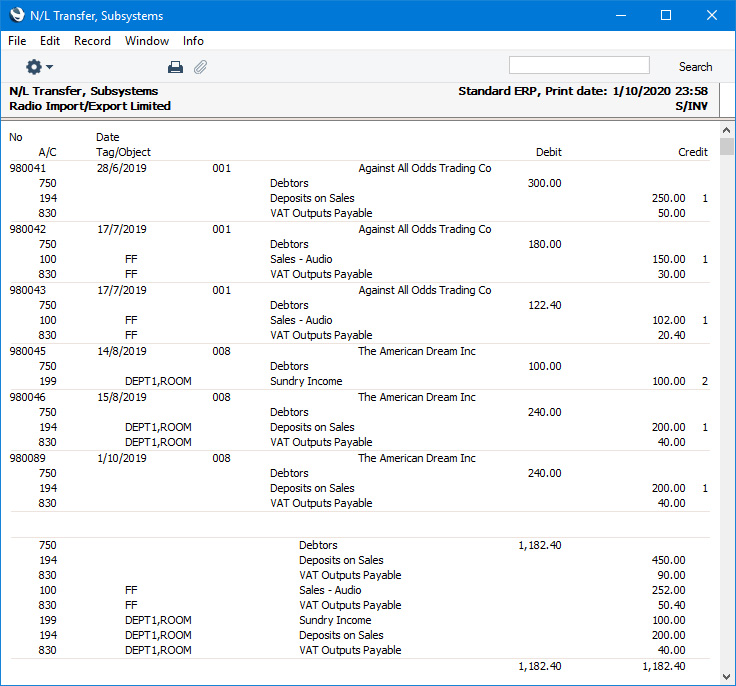
- Overview
- Function
- Use these options to specify whether Sub System records that you have marked as OK, those you have not yet marked as OK or both are to be listed in the report.
- OKed
- You will tend to use this option if you are not using the feature whereby Nominal Ledger Transactions are created automatically when you save Sub System records that you have marked as OK. You can then enter the equivalent Nominal Ledger Transactions yourself, taking the information from this report.
- Not OKed
- You will tend to use this option if you are using the feature whereby Nominal Ledger Transactions are created automatically when you save Sub System records that you have marked as OK. You can produce this report for a particular Sub System record before marking it as OK to see in advance the Nominal Ledger Transaction that will result.
- OKed
Reports in the Nominal Ledger:
- Introduction
- Definition of Nominal Ledger Reports
- Drill-down
- The Operations Menu
- Account Reconciliation
- Accrual Report
- Analytical Balance
- Analytical Balance (Fiscal purposes)
- Balance Sheet
- Bank Reconciliation
- Bank Statement
- Bank Transactions
- Base Currency Rate Change
- Budget Journal
- Cash Flow
- Chart of Accounts
- Correction List
- Corresponding Accounts
- Creditors Account
- Currency A/C Rate Change
- Daily Balances
- Debtors Account
- Forward Balance Journal
- Income & Expense Book
- Key Financial Ratios
- Liquidity Forecast
- Multicurrency Accounts Rate Difference
- N/L Accrual Transactions
- N/L Transfer, Subsystems
- Nominal Ledger
- Profit & Loss
- Revised Budget Journal
- Tag/Object Results
- Tag/Object/Quantity Results
- Tax Account Balances
- Tax Calculations
- Tax Transactions for Registers
- Template Transaction Journal
- Test Corresponding Rules
- Transaction Journal
- Transaction Summary
- Trial Balance
- VAT Listing
- VAT Report
- VAT Report Purchases
- VAT Report Sales
- VAT Transaction Journal
- XBRL Report
Go back to:
- Home page for Nominal Ledger manual
- Home page for Standard ERP manual
Nominal Ledger
This page describes the Nominal Ledger report in the Nominal Ledger. Please refer here for some examples illustrating the use of this report. For clarity, the term "Object" has been used in this description instead of "Tag/Object".---
The Nominal Ledger report is a list of the Transaction rows (i.e. of the journal postings) entered during the report period.
This report offers exceptionally powerful multi-level Tag/Object analysis. You can search for Transaction rows with several different Tags/Objects, and you can control subtotalling. For example, if you have Tag/Object Types of DEPT (Departments) and PERS (Persons), you can create a report with the Transaction rows sorted by Account and department and with subtotals per person within each department. These features are illustrated in detail on the Examples page.
When printed to screen, the Nominal Ledger report has the Standard ERP Drill-down feature. Click (Windows/macOS) or tap (iOS/Android) on any Transaction Number to open an individual Transaction record.
You can specify whether figures in the Nominal Ledger report will be positive or negative depending on Account Type. To do this, use the check boxes in column 2 in the Presentation of Balances setting. For example, figures in the report for Asset Accounts will obey the Assets check box in column 2 in the Presentation of Balances setting.
Double-clicking or tapping 'Nominal Ledger' in the 'Reports' list in the Nominal Ledger opens the following window:
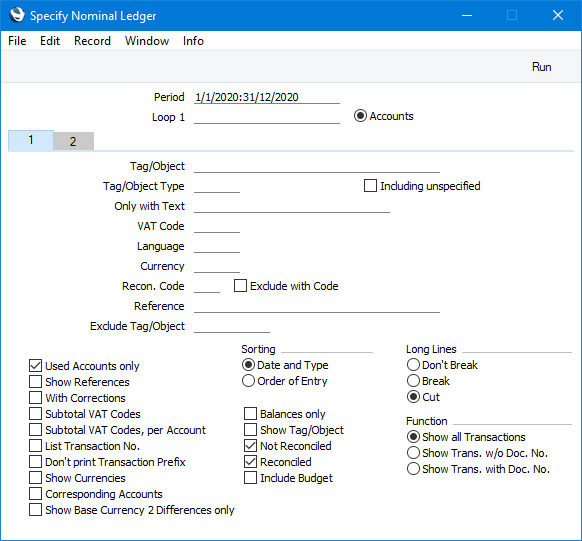
Header
- Period
- Paste Special
Reporting Periods setting, System module
- Specify a report period. The report will be a list of journal postings entered during this period (i.e. of rows in Transactions entered during this period).
- If you are using the Leading Zero before Day, Leading Zero before Month and/or Century options in your Date and Numeric Format, you do not need to type the leading zeros or the century digits as these will be inserted automatically. For example, if you type "1-1-20", this will be converted to "01-01-2020" automatically (if you are using all three of the options mentioned).
- If your report period is a single day, just enter the date once and this will be converted to a period format automatically.
- The first period in the Reporting Periods setting will be offered as the default value.
- If you are using the Leading Zero before Day, Leading Zero before Month and/or Century options in your Date and Numeric Format, you do not need to type the leading zeros or the century digits as these will be inserted automatically. For example, if you type "1-1-20", this will be converted to "01-01-2020" automatically (if you are using all three of the options mentioned).
- Loop 1, Loop 2, Loop 3
- (Loop 2 and Loop 3 are on card 2.)
- You can enter a range of Accounts, a range of Objects or an Object Type to each of these fields. The following examples illustrate how you can use these fields:
Eg Entry Report contains 1 Loop 1: 100:199 [Accounts] Transaction rows posting to Accounts in the range 100:199, sorted by Account 2 Loop 1: 100,199 [Accounts] Transaction rows posting to the specific Accounts 100 and 199, sorted by Account 3 Loop 1: SALES [Object] Transaction rows with the SALES Object, sorted by Object 4 Loop 1: DEPT [Object Type] Transaction rows with Objects belonging to the DEPT Object Type, sorted by Object 5 Loop 1: 100:199 [Accounts] Loop 2: DEPT [Object Type] Transaction rows with Objects belonging to the DEPT Object Type and posting to Accounts in the range 100:199, sorted by Account then Object 6 Loop 1: DEPT [Object Type] Loop 2: 100:199 [Accounts] As 5 but sorted by Object then Account 7 Loop 1: 100:199 [Accounts] Loop 2: DEPT [Object Type] Loop 3: PERS [Object Type] Transaction rows with Objects belonging to the DEPT Object Type and to the PERS Object Type and posting to Accounts in the range 100:199, sorted by Account, by DEPT Objects and finally by PERS Objects - You must make an entry in the Loop 1 field before using Loops 2 and 3, or the report will be blank.
- Please refer to the Examples page for more information about how to use these fields.
- In multi-user systems, you can use Access Groups to prevent the postings to sensitive Accounts such as salary Accounts being listed in this report, depending on the user producing the report. To do this, list the sensitive Accounts in the Block Accounts field in each Access Group as appropriate.
- You can enter a range of Accounts, a range of Objects or an Object Type to each of these fields. The following examples illustrate how you can use these fields:
- Accounts
- Next to each Loop field there is an Accounts radio button. You should select this radio button if you wish to enter an Account or range of Accounts in the corresponding Loop field, for two reasons:
- If you select the Accounts radio button, you are signifying that what you have entered in the Loop field is an Account or range of Accounts, so Standard ERP will search for matching Transaction rows accordingly. If you do not select the Accounts radio button, Standard ERP will assume that the Loop field contains an Object, a range of Objects or an Object Type.
- If you select the Accounts radio button, you can use 'Paste Special' from the Loop field to open a list of Accounts from which you can choose the appropriate one. If you do not select the Accounts radio button, 'Paste Special' will open a list of Objects.
- If you select the Accounts radio button, you are signifying that what you have entered in the Loop field is an Account or range of Accounts, so Standard ERP will search for matching Transaction rows accordingly. If you do not select the Accounts radio button, Standard ERP will assume that the Loop field contains an Object, a range of Objects or an Object Type.
Card 1
- Tag/Object
- Paste Special
Tag/Object register, Nominal Ledger/System module
- Enter an Object Code in this field if you need the report to list Transaction rows with a particular Object. If the field is empty, all Transaction rows, with and without Objects, will be listed. If you enter a number of Objects separated by commas, only those Transaction rows featuring all the Objects listed will be included in the report.
- Tag/Object Type
- Paste Special
Tag/Object Types setting, Nominal Ledger
- Enter an Object Type Code in this field if you need the report to list Transaction rows with Objects belonging to a particular Object Type.
- If a Transaction row has more than one Object, the Show Tag/Object option (below) will usually cause all those Objects to be printed in the relevant line in the report. However if you specify an Object Type here and select the Show Tag/Object option, only the Object belonging to the Object Type will be printed. This is illustrated on the 'Examples' page.
- If a Transaction row has more than one Object, the Show Tag/Object option (below) will usually cause all those Objects to be printed in the relevant line in the report. However if you specify an Object Type here and select the Show Tag/Object option, only the Object belonging to the Object Type will be printed. This is illustrated on the 'Examples' page.
- Including Unspecified
- If you specify an Object Type above, the report will only list Transaction rows with Objects belonging to that Object. If you select this option as well, every Transaction row will be listed in the report. If you also select the Show Tag/Object option below, only those Objects belonging to the specified Object Type will printed in the relevant lines in the report. In other words, this combination of options will list every Transaction row in a way that allows you to distinguish the Transaction rows with Objects belonging to the specified Object Type from the other Transaction rows.
- Only with Text
- Enter a search string in this field if you need the report to list Transaction rows with certain Descriptions. For example, assuming that you have used the default entries in the Description field of each Transaction row, you can enter an Account Name here to report on all postings to that Account. Note that you do not have to enter the complete text string: "Sales" will find "Sales Type 1", "Sales Type 2", etc.
- VAT Code
- Paste Special
VAT Codes setting, Nominal Ledger
- Enter a VAT Code here if you need the report to list Transaction rows with a particular VAT Code.
- Language
- Paste Special
Languages setting, System module
- You can produce the Nominal Ledger report in different Languages: enter the required Language Code here. The appropriate translations of the Account Names will be taken from the 'Texts' card of each Account record.
- Currency
- Paste Special
Currency register, System module
- If you enter a Currency here, the report will only list those Transaction rows with that Currency shown on flip C. The figures shown in the report will be taken from flip C of those Transaction rows: i.e. they will be in the specified Currency. If you leave this field blank, all Transaction rows will be included in the report, with figures taken from the Base 1 or Base 2 Debit or Credit fields on flip B (choose which Base Currency is to be used using the Values in options on card 2).
- Recon. Code, Exclude with Code
- If you want to list Transaction rows that you have reconciled (using the Account Reconciliation register) with a particular Recon. Code, enter that Recon. Code here. To list all reconciled Transaction rows except those with a particular Recon. Code, select the Exclude With Code option as well.
- You must also select the Reconciled option (below) if you want to use this field and check box.
- You must also select the Reconciled option (below) if you want to use this field and check box.
- Reference
- Enter a Reference here if you need the report to list Transaction rows from Transactions with a particular Reference specified in the header. You should enter the complete Reference: "Accrual" will not find "Accrual Posting", etc.
- If you would like the Reference to be printed in the report, select the Show References option (below).
- If you would like the Reference to be printed in the report, select the Show References option (below).
- Exclude Tag/Object
- Paste Special
Tag/Object register, Nominal Ledger/System module
- Enter an Object Code here if you need to remove Transaction rows with a particular Object from the report.
- Used Accounts only
- Select this option if you need to exclude from the report Accounts that were not used during the report period. Accounts not used but with a balance brought forward will be included in the report.
- Show References
- Select this option if you would like the Reference from the Transaction header to be included in the label marking the Transaction rows in the report. The Reference will be placed at the beginning of each label, before the Text (and the changed Description if there is one).
- If the resulting label contains many characters, it may be truncated or spread over several lines, depending on the Long Lines option that you choose below.
- Please refer to the description of the Long Lines options below for details about how these labels will be constructed.
- If the resulting label contains many characters, it may be truncated or spread over several lines, depending on the Long Lines option that you choose below.
- With Corrections
- By default, invalidated Transaction rows will not be included in the report. An invalidated Transaction row is one that you have marked with a red line using the 'Update Mark' function or by invalidating the originating Sub System record. Select this option if you need invalidated Transaction rows to be included in the report: they will be marked in the report by red lines and they will not be included in any totals.
- Subtotal VAT Codes
- This option will add a section to the end of the report listing the VAT Codes used in the Transaction rows in the report. This section will display the overall total debit and credit amounts posted to all Accounts with each VAT Code.
- Subtotal VAT Codes, per Account
- The Nominal Ledger report is a list of Transaction rows sorted by Account and with subtotals for each Account. After each individual Account this option will add a section listing the VAT Codes used in the Transaction rows posting to that Account. This section will display the total debit and credit amounts posted to the Account with each VAT Code.
- List Transaction No.
- If you select this option, the Transaction Numbers of all Transactions that fall within the reporting period, together with debit and credit totals, will be listed at the end of the report.
- Don't Print Transaction Prefix
- Transaction Numbers will usually be printed in the report together with their Fiscal Year or Sub System prefixes (as shown in the 'Transactions: Browse' window). The Number of a Transaction that you entered directly to the Transaction register, for example, will be printed as "2020.3" while the Number of a Transaction created from a Sub System are printed as, for example, "S/INV.200003". Select this option if you do not want these prefixes to be printed in the report (i.e. in the examples, to omit "2020." and "S/INV.").
- If you use the 'Lock N/L' Maintenance function to close an accounting period, a Document Number (also known as a Sequence Number) will be assigned permanently to every Transaction in the newly closed period. If you print the report using this option, these Document Numbers will be printed in place of the usual Transaction Numbers. The usual Transaction Number (without prefix) will be printed if there is no Document Number (i.e. when a Transaction belongs to a period that you have not yet closed). You can use the Function options below to restrict the report to Transactions with or without Document Numbers.
- If you use the 'Lock N/L' Maintenance function to close an accounting period, a Document Number (also known as a Sequence Number) will be assigned permanently to every Transaction in the newly closed period. If you print the report using this option, these Document Numbers will be printed in place of the usual Transaction Numbers. The usual Transaction Number (without prefix) will be printed if there is no Document Number (i.e. when a Transaction belongs to a period that you have not yet closed). You can use the Function options below to restrict the report to Transactions with or without Document Numbers.
- Show Currencies
- For Transaction rows in foreign Currencies (i.e. not Base Currency 1 or 2), select this option if you want to show values in Currency as well as in Base Currency 1 or 2 (choose which Base Currency is to be used using the Values in options on card 2). Total Currency balances for each Account will also be shown, together with the overall Account balance in the home Currency.
- Corresponding Accounts
- By default, the Signatures of the users who created each Transaction will be shown for each Transaction row Choose this option if you need the Corresponding Accounts for each Transaction row to be shown instead of the user Signatures. (User Signatures will not be shown in the report in Finland (i.e. when the VAT Law in the Company Info setting is "Finnish".)
- Show Base Currency 2 Differences only
- Use this option if you want the report to list any Transaction rows where the value in Base Currency 2 is not correct, according to the Exchange and Base Rate for the Transaction Date. This may be because you used an ad hoc Exchange or Base Rate in the Transaction row in question, or because you changed an Exchange or Base Rate record some time after you entered it. Changing existing Exchange or Base Rate records is not recommended.
- This option does not calculate values in Base Currency 2 by applying current Exchange and Base Rates to old Transactions rows. To do this, use the Base Currency Rate Change report.
- This option does not calculate values in Base Currency 2 by applying current Exchange and Base Rates to old Transactions rows. To do this, use the Base Currency Rate Change report.
- Sorting
- Transaction rows posting to each Account will be listed in date order. Use these options to specify the order that will be used for Transaction rows with the same date:
- Date and Type
- Transaction rows with the same date will be sorted by type. For example, a Transaction row entered directly to the Transaction register will be listed above a Transaction row created from an Invoice.
- Order of Entry
- Transaction rows with the same date will be sorted by time of entry.
- Date and Type
- Balances only
- Select this option if you only need to show debit, credit and final balances for each Account, instead of having every Transaction row listed individually.
- Show Tag/Object
- By default, the Signatures of the users who created each Transaction will be shown for each Transaction row. Select this option if you need the Objects used in each Transaction row to be shown instead of the user Signatures.
- If you select this option and the Corresponding Accounts option above, the Corresponding Accounts option will be given priority so Objects will not be shown.
- If you select this option and the Corresponding Accounts option above, the Corresponding Accounts option will be given priority so Objects will not be shown.
- Not Reconciled
- Select this option if you need Transaction rows that you have not reconciled (using the Account Reconciliation register) to be included in the report.
- Reconciled
- Select this option if you need Transaction rows that you have reconciled (using the Account Reconciliation register) to be included in the report.
- Include Budget
- Selecting this option will cause Budget figures for each Account to be shown in the report.
- If the matrix in a Budget record is empty or only contains rows whose dates are outside the report period, figures from that record will not be included in the report. You do not need to mark a Budget record as OK for its figures to appear in the report.
- If the matrix in a Budget record is empty or only contains rows whose dates are outside the report period, figures from that record will not be included in the report. You do not need to mark a Budget record as OK for its figures to appear in the report.
- Long Lines
- By default, each Transaction row in the report will be marked with a label that will be constructed as follows:
- The Text in the header of the relevant Transaction will be used as the label.
- If the Description field in the Transaction row does not contain the Account Name (i.e. if the default Description has been changed), the Description will be added to the Text, separated by a comma.
- If the Text field is empty, the Description in the Transaction row alone will be used as the label (irrespective of whether or not it has been changed.
If you select the Show References option above, the Reference from the Transaction header will be included in this label together with the Text (and the changed Description if there is one).
- Use these options to specify how the resulting label will be shown in the report if it contains many characters.
- If you use a landscape Page Setup and/or reduce the page magnification, the space available for long descriptions (i.e. the width of the description column) will be increased.
- Don't Break
- The full length of a label will be printed on one line. If it interferes with figures in the next column, they will be moved to the next line.
- Break
- The full length of a label will be printed, spread over several lines if necessary.
- Cut
- Only the first 16 characters of a label will be printed, so that it fits onto in a single line in the allocated column.
- The Text in the header of the relevant Transaction will be used as the label.
- Function
- If you use the 'Lock N/L' Maintenance function to close an accounting period, a Document Number (also known as a Sequence Number) will be assigned permanently to every Transaction in the newly closed period. Use these options to choose whether the report is to include every Transaction in the report period, those with Document Numbers only (i.e. those from closed periods only) or those without Document Numbers only.
Card 2
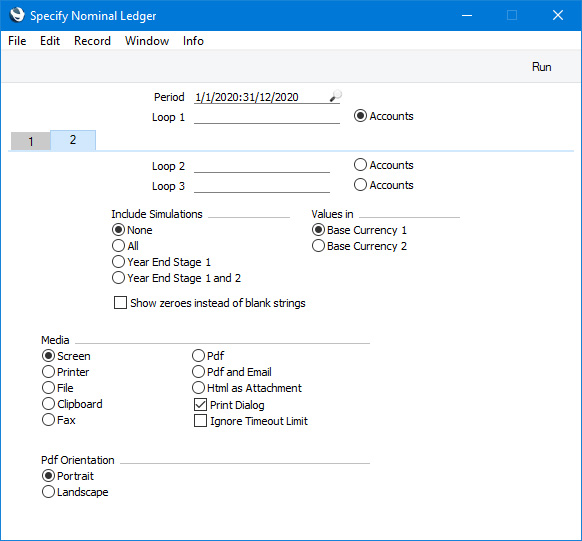
- Include Simulations
- Choose one of these options if you need simulated transactions from the Simulation register to be included in the report. If you choose the "All" option, Simulation rows in which the Status is "Invalid" or "Transferred" will not be included.
- Values in
- If you are using the Dual-Base system, use these options to specify whether the values in the report are to be shown in Base Currency 1 or 2.
- If you are not using the Dual-Base system, use the Base Currency 1 option to produce a report in your home Currency.
- If you have entered a Currency in the Currency field on card 1, the figures in the report will be in that Currency.
- If you are not using the Dual-Base system, use the Base Currency 1 option to produce a report in your home Currency.
- Show zeroes instead of blank strings
- By default, blank values will be shown in the report on the opposite side to each posting to each Account. For example, if a Transaction row posts a credit amount to an Account, the debit amount will be shown to be blank.
- Select this option if you would prefer "0.00" to be printed instead of the blanks.
Please refer here for some examples illustrating the use of the Nominal Ledger report.
---
Reports in the Nominal Ledger:
- Introduction
- Definition of Nominal Ledger Reports
- Drill-down
- The Operations Menu
- Account Reconciliation
- Accrual Report
- Analytical Balance
- Analytical Balance (Fiscal purposes)
- Balance Sheet
- Bank Reconciliation
- Bank Statement
- Bank Transactions
- Base Currency Rate Change
- Budget Journal
- Cash Flow
- Chart of Accounts
- Correction List
- Corresponding Accounts
- Creditors Account
- Currency A/C Rate Change
- Daily Balances
- Debtors Account
- Forward Balance Journal
- Income & Expense Book
- Key Financial Ratios
- Liquidity Forecast
- Multicurrency Accounts Rate Difference
- N/L Accrual Transactions
- N/L Transfer, Subsystems
- Nominal Ledger, including:
- Profit & Loss
- Revised Budget Journal
- Tag/Object Results
- Tag/Object/Quantity Results
- Tax Account Balances
- Tax Calculations
- Tax Transactions for Registers
- Template Transaction Journal
- Test Corresponding Rules
- Transaction Journal
- Transaction Summary
- Trial Balance
- VAT Listing
- VAT Report
- VAT Report Purchases
- VAT Report Sales
- VAT Transaction Journal
- XBRL Report
Go back to:
- Home page for Nominal Ledger manual
- Home page for Standard ERP manual
Nominal Ledger - Examples
This page uses the Transactions resulting from a day's invoicing to illustrate the features offered by the Nominal Ledger report. Each Invoice carries an Object representing the sales person and one representing the office making the sale. The Objects representing the sales people belong to the "PERS" Object Type, while those representing the offices belong to the "OFF" Object Type. For clarity, the term "Object" has been used in this description instead of "Tag/Object".The Transactions involved are as follows:
| Trans No | Account | Objects | Debit | Credit |
| 5013 | 750 Debtors | 408.50 | ||
| 110 Sales - Video | NB,TALL | 64.00 | ||
| 100 Sales - Audio | NB,TALL | 284.00 | ||
| 830 VAT Outputs Payable | 60.50 | |||
| 5014 | 750 Debtors | 306.68 | ||
| 110 Sales - Video | IP,TALL | 48.00 | ||
| 100 Sales - Audio | IP,TALL | 213.00 | ||
| 830 VAT Outputs Payable | 45.68 | |||
| 5015 | 750 Debtors | 715.58 | ||
| 110 Sales - Video | JM,LOND | 112.00 | ||
| 100 Sales - Audio | JM,LOND | 497.00 | ||
| 830 VAT Outputs Payable | 106.58 | |||
| 5016 | 750 Debtors | 102.23 | ||
| 110 Sales - Video | FF,LOND | 16.00 | ||
| 100 Sales - Audio | FF,LOND | 71.00 | ||
| 830 VAT Outputs Payable | 15.23 |
First, use the Nominal Ledger report to list the journal postings to each Sales Account (i.e. to list Transaction rows with Sales Accounts):
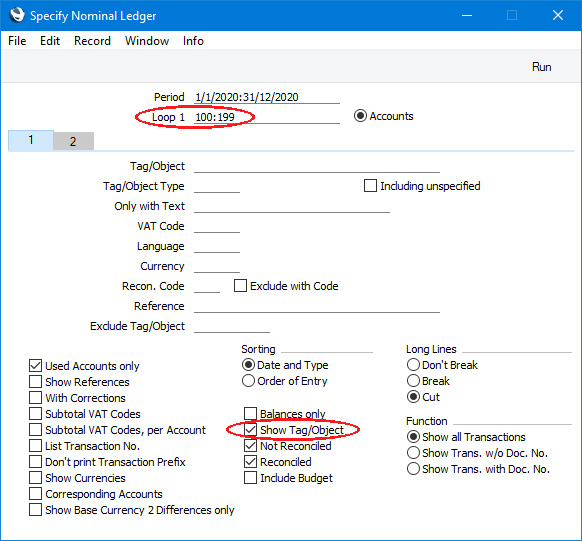
This is the resulting report:
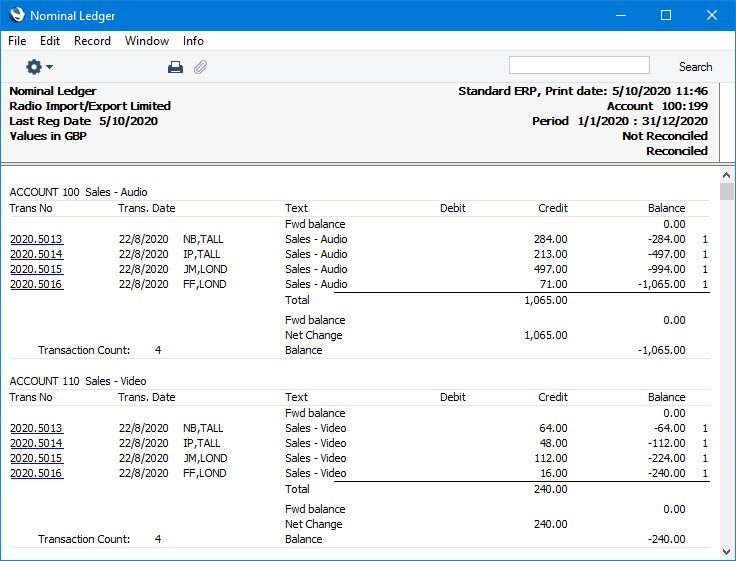
The next example is a list of Transaction rows with Objects belonging to a particular Object Type. As well as again entering the Sales Account range in the Loop 1 field, enter "PERS" in the Object Type field, with the aim of listing all Transaction rows that have an Object representing a sales person:
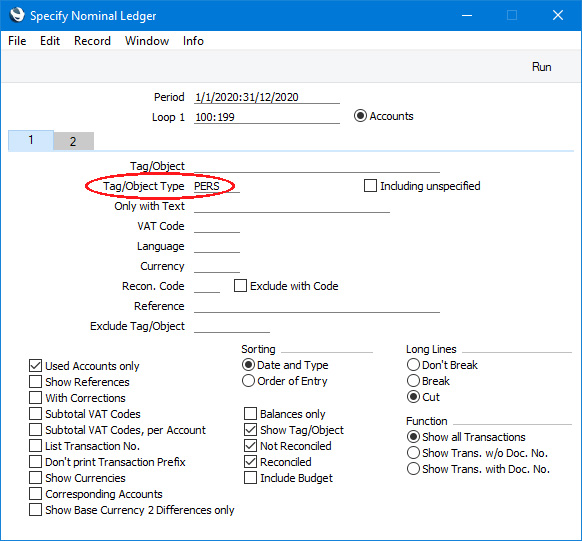
- There are no opening balances. While the Accounts have been used prior to the report period, the Objects have not; and
- Because we specified an Object Type and we are using the Show Tag/Object option, only those Objects belonging to the Object Type are shown for each Transaction row.
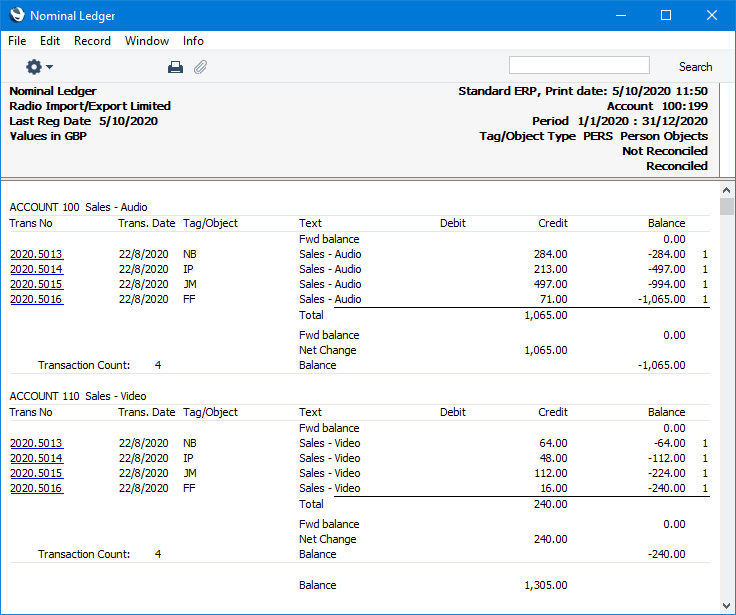
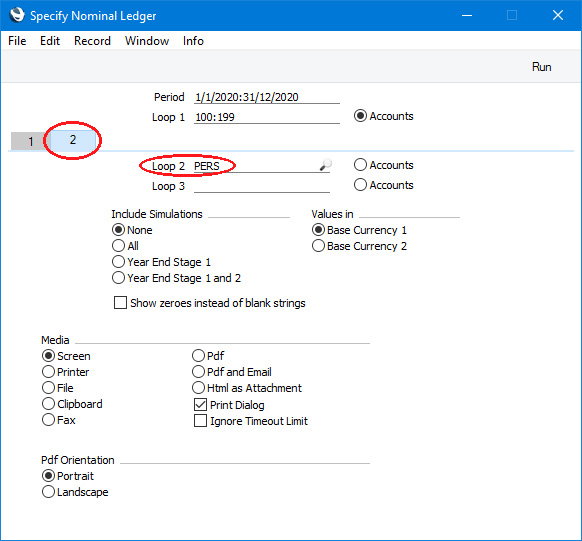
In general terms, you should use Loops 1, 2 and 3 to impose a sort order on the report. As you have entered the Account range in the Loop 1 field, the top level sort order is by Account. Entering the "PERS" Object Type in the Loop 2 field means that the second level sort order is by the Objects belonging to that Type. Subtotals are provided at the lowest level of sorting. So, in this case, the report is sorted by Account and then by Object, with subtotals for each Object:
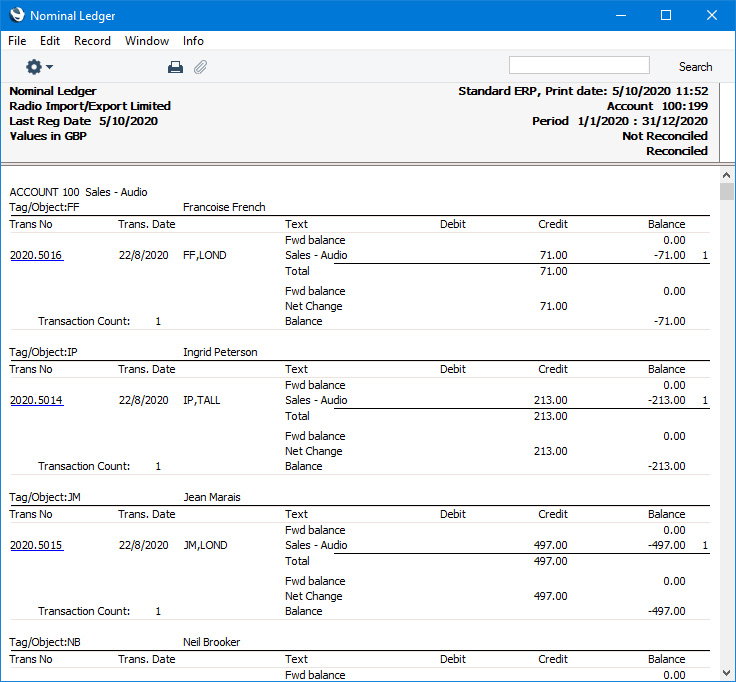
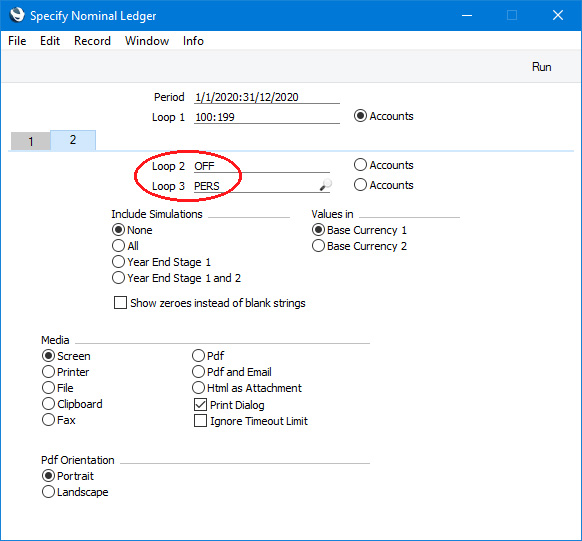
Again, the resulting report is structured on an Account-by-Account basis (i.e. the top level sort is by Account). This time, within each Account the postings are sorted first at the Loop 2 level (i.e. by office) and then at the Loop 3 level (i.e. by sales person). Within each Loop 2 Object (i.e. within each office) subtotals are provided for each Loop 3 Object (i.e. for each sales person):
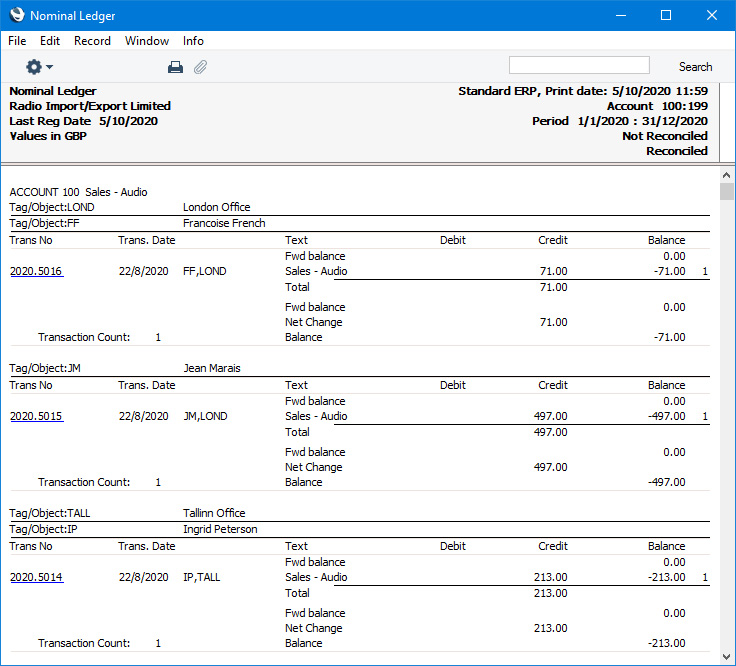
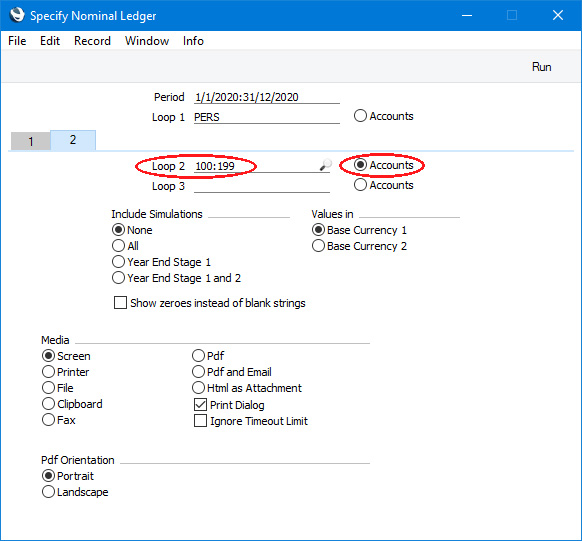
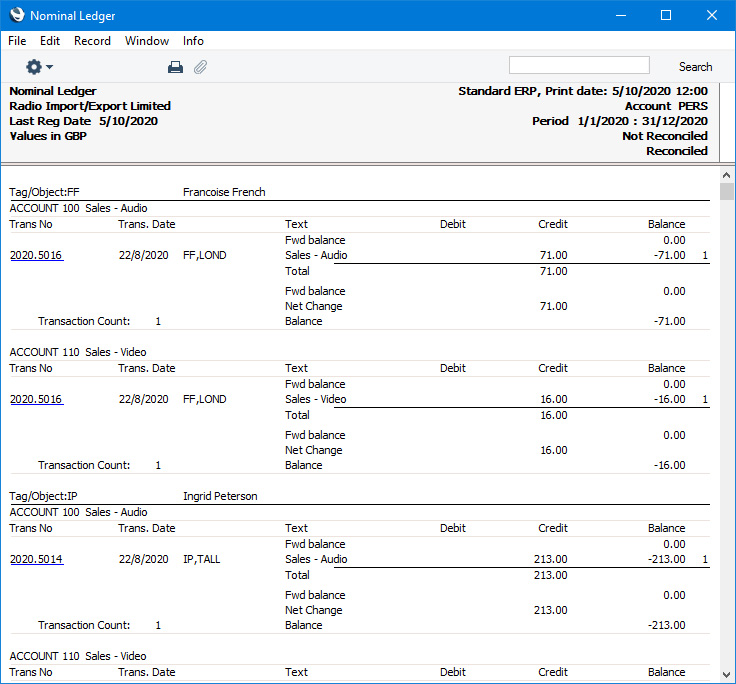
Reports in the Nominal Ledger:
- Introduction
- Definition of Nominal Ledger Reports
- Drill-down
- The Operations Menu
- Account Reconciliation
- Accrual Report
- Analytical Balance
- Analytical Balance (Fiscal purposes)
- Balance Sheet
- Bank Reconciliation
- Bank Statement
- Bank Transactions
- Base Currency Rate Change
- Budget Journal
- Cash Flow
- Chart of Accounts
- Correction List
- Corresponding Accounts
- Creditors Account
- Currency A/C Rate Change
- Daily Balances
- Debtors Account
- Forward Balance Journal
- Income & Expense Book
- Key Financial Ratios
- Liquidity Forecast
- Multicurrency Accounts Rate Difference
- N/L Accrual Transactions
- N/L Transfer, Subsystems
- Nominal Ledger, including:
- Examples
- Profit & Loss
- Revised Budget Journal
- Tag/Object Results
- Tag/Object/Quantity Results
- Tax Account Balances
- Tax Calculations
- Tax Transactions for Registers
- Template Transaction Journal
- Test Corresponding Rules
- Transaction Journal
- Transaction Summary
- Trial Balance
- VAT Listing
- VAT Report
- VAT Report Purchases
- VAT Report Sales
- VAT Transaction Journal
- XBRL Report
Go back to:
- Home page for Nominal Ledger manual
- Home page for Standard ERP manual
Profit & Loss
This page introduces the Profit & Loss report in the Nominal Ledger.---
The Profit & Loss report shows the sales turnover achieved by your company in the specified period. It also shows the total cost of sales and thus the gross profit, and the total overheads and thus the net profit of your business.
When printed to screen, the Profit & Loss report has the Standard ERP Drill-down feature. Click (Windows/macOS) or tap (iOS/Android) on the Account Number of any Account in the report to open the Nominal Ledger Report for the same Account and period. When in the Nominal Ledger report, you can click or tap on any Transaction Number to open an individual Transaction record.
Please follow the links below for more details about the Profit & Loss report:
- The definition of the Profit & Loss report
- Printing the Profit & Loss report.
Reports in the Nominal Ledger:
- Introduction
- Definition of Nominal Ledger Reports
- Drill-down
- The Operations Menu
- Account Reconciliation
- Accrual Report
- Analytical Balance
- Analytical Balance (Fiscal purposes)
- Balance Sheet
- Bank Reconciliation
- Bank Statement
- Bank Transactions
- Base Currency Rate Change
- Budget Journal
- Cash Flow
- Chart of Accounts
- Correction List
- Corresponding Accounts
- Creditors Account
- Currency A/C Rate Change
- Daily Balances
- Debtors Account
- Forward Balance Journal
- Income & Expense Book
- Key Financial Ratios
- Liquidity Forecast
- Multicurrency Accounts Rate Difference
- N/L Accrual Transactions
- N/L Transfer, Subsystems
- Nominal Ledger
- Profit & Loss
- Revised Budget Journal
- Tag/Object Results
- Tag/Object/Quantity Results
- Tax Account Balances
- Tax Calculations
- Tax Transactions for Registers
- Template Transaction Journal
- Test Corresponding Rules
- Transaction Journal
- Transaction Summary
- Trial Balance
- VAT Listing
- VAT Report
- VAT Report Purchases
- VAT Report Sales
- VAT Transaction Journal
- XBRL Report
Go back to:
- Home page for Nominal Ledger manual
- Home page for Standard ERP manual
Profit & Loss - Defining
This page describes the configuration of the Profit & Loss report.---
Before producing a Profit & Loss report for the first time, you should define the structure of the report to suit your requirements. This is done in the same way as defining the Balance Sheet: please refer to the Balance Sheet Definition page for full details. You can also create up to 15 of your own Profit & Loss reports as required. Please refer to the Multiple Balance Sheet Definitions page for full details.
Please follow the links below for more details about the Profit & Loss report:
- The Definition of the Profit & Loss report
- Printing the Profit & Loss report
Reports in the Nominal Ledger:
- Introduction
- Definition of Nominal Ledger Reports
- Drill-down
- The Operations Menu
- Account Reconciliation
- Accrual Report
- Analytical Balance
- Analytical Balance (Fiscal purposes)
- Balance Sheet
- Bank Reconciliation
- Bank Statement
- Bank Transactions
- Base Currency Rate Change
- Budget Journal
- Cash Flow
- Chart of Accounts
- Correction List
- Corresponding Accounts
- Creditors Account
- Currency A/C Rate Change
- Daily Balances
- Debtors Account
- Forward Balance Journal
- Income & Expense Book
- Key Financial Ratios
- Liquidity Forecast
- Multicurrency Accounts Rate Difference
- N/L Accrual Transactions
- N/L Transfer, Subsystems
- Nominal Ledger
- Profit & Loss
- Revised Budget Journal
- Tag/Object Results
- Tag/Object/Quantity Results
- Tax Account Balances
- Tax Calculations
- Tax Transactions for Registers
- Template Transaction Journal
- Test Corresponding Rules
- Transaction Journal
- Transaction Summary
- Trial Balance
- VAT Listing
- VAT Report
- VAT Report Purchases
- VAT Report Sales
- VAT Transaction Journal
- XBRL Report
Go back to:
- Home page for Nominal Ledger manual
- Home page for Standard ERP manual
Profit & Loss - Printing
This page describes printing the Profit & Loss report.---
Having entered a definition for the Profit & Loss as described here, you will be ready to print the report. After ensuring you are in the Nominal Ledger, click (Windows/macOS) or tap (iOS/Android) the [Reports] button in the Navigation Centre and then double-click or tap 'Profit & Loss' in the 'Reports' list. The 'Specify Profit & Loss Report' window will be opened.
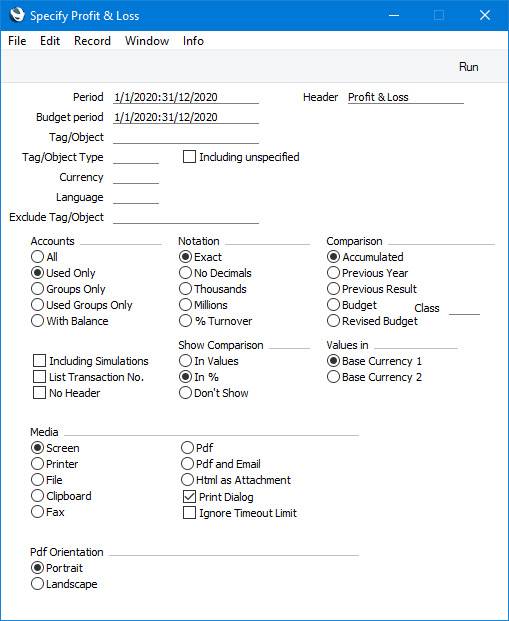
- Period
- Paste Special
Reporting Periods setting, System module
- The report period. Enter the start and end dates separated by a colon (:). The Account balances in the report will be calculated from postings (i.e. from Transaction rows) recorded during the period specified here. The first period in the Reporting Periods setting will be offered as the default.
- Budget period
- Paste Special
Reporting Periods setting, System module
- If you are using the "Budget" or "Revised Budget" Comparison options (below), specify the Budget period here. The first period in the Reporting Periods setting will be offered as the default. If you leave this field blank, the report period above will be used.
- Header
- Enter your own title for the report. This title will be printed in the report header, and will also appear in the title bar of the report window if you print the report to screen.
- Tag/Object
- Paste Special
Tag/Object register, Nominal Ledger/System module
- Enter a Tag/Object Code here if you need the Account balances in the report to be calculated from postings with a particular Tag/Object. You can also enter a number of Tags/Objects separated by commas, in which case Account balances will be calculated from postings with all the Tags/Objects listed. If you leave this field empty, Account balances will be calculated from all postings, with and without Tags/Objects.
- Tag/Object Type
- Paste Special
Tag/Object Types setting, Nominal Ledger
- Enter a Tag/Object Type Code in this field if you want the report to show Account balances calculated from postings with Tags/Objects belonging to a particular Tag/Object Type.
- Including Unspecified
- Select this option if, for each Account, you want to show a balance figure calculated from postings (i.e. Transaction rows) with Tags/Objects belonging to the Tag/Object Type specified above and a second balance calculated from all other Transaction rows.
- Currency
- Paste Special
Currency register, System module
- If you specify a Currency here, the Account balances in the report will be calculated only from those Transaction rows with the specified Currency shown on flip C. The balances will be calculated using the figures on flip C of those Transaction rows (i.e. they will be in the chosen Currency). If you leave this field blank, all Transaction rows will be included in the calculations. In this case the calculation will use the figures in the Base 1 or Base 2 Debit or Credit fields on flip A (choose which Base Currency is to be used using the Values in options described below).
- Language
- Paste Special
Languages setting, System module
- You can produce the Profit & Loss report in different Languages: enter the required Language Code here. The appropriate translations of the Account Names will be taken from the 'Texts' card of each Account record, while the translations for each report heading or sub-heading will be taken from the report definition (please refer to the Balance Sheet Definition page for full details).
- If you do not enter a Language here, but you have entered a Language in the Company Info setting in the System module, the report will be produced in that Language if you are using the Account Description in Company Language option in the Transaction Settings setting in the Nominal Ledger.
- If you do not enter a Language here, but you have entered a Language in the Company Info setting in the System module, the report will be produced in that Language if you are using the Account Description in Company Language option in the Transaction Settings setting in the Nominal Ledger.
- Exclude Tag/Object
- Paste Special
Tag/Object register, Nominal Ledger/System module
- Enter a Tag/Object Code here if you need postings with a particular Tag/Object to be excluded from the balance calculations.
- Accounts
- Use these options to specify which Accounts are to be printed in the report and how their balances will be displayed.
- All
- This option will list all the Accounts that have been included in the Profit & Loss report definition.
- Used Only
- When you use this option together with the "Accumulated" Comparison option, the report will only list Accounts that have been used. This option is similar to With Balance below, with the exception that it also includes Accounts that have been used in the period in such a way that they have no closing balances.
- When you use this option together with the "Previous Year" or "Previous Result" Comparison options, the report will list Accounts that have a closing balance either in the report period or in the same period last year.
- When you use this option together with the "Budget" or "Revised Budget" Comparison options, the report will list Accounts that either have a Budget or Revised Budget for the report period or have been used during the report period.
- When you use this option together with the "Previous Year" or "Previous Result" Comparison options, the report will list Accounts that have a closing balance either in the report period or in the same period last year.
- Groups Only
- This option does not print balances for individual Accounts. Instead, it simply prints an overall balance for each line in the Profit & Loss report definition.
- Used Groups Only
- This option only prints balances for lines in the Profit & Loss report definition that have been used.
- With Balance
- When you use this option together with the "Accumulated" Comparison option, the report will only show Accounts that have a balance for the report period. An Account that has been used in the period in such a way that it also has no closing balance will not be shown in the report. If you want such an Account to be included in the report, use the Used Only option above.
- When you use this option together with the "Previous Year" or "Previous Result" Comparison options, the report will only show Accounts that have a closing balance in both the report period and in the same period last year.
- When you use this option together with the "Budget" or "Revised Budget" Comparison options, the report will only show Accounts that have a Budget or Revised Budget for the report period. Providing this criterion is met, the Account does not need to have a closing balance to be shown in the report.
- When you use this option together with the "Previous Year" or "Previous Result" Comparison options, the report will only show Accounts that have a closing balance in both the report period and in the same period last year.
- All
- Notation
- Use these options to control the presentation of amounts in the report.
- Exact
- Shows the balances as stored in the Transactions.
- No Decimals
- Rounds the balances up or down to the nearest whole number.
- Thousands, Millions
- Divide the balances by 1,000 or 1,000,000.
- % Turnover
- Shows each account balance as a percentage of overall turnover. This option requires you to have defined "turnover" in a Key Ratio that has the Code "TURNO". Please refer to the page describing the definition of the Key Financial Ratios report for an illustration.
- Exact
- Comparison
- Select one option for the comparison column in the report.
- Accumulated
- This option compares the report period with the Year To Date.
- Previous Year
- This compares the report period with the same period last year.
- Previous Result
- This compares the report period with the previous period. For example, if the report period is a calendar month, the compared period will be the previous month.
- Budget, Revised Budget
- These options compare the report period with the Budget or Revised Budget figures for the Budget period. The Budget or Revised Budget figures will be calculated from the Budget or Revised Budget matrix rows with dates that fall within the report period. If the matrix in a Budget or Revised Budget record is empty or only contains rows whose dates are outside the report period, figures from that record will not be included in the report. You do not need to mark a Budget or Revised Budget record as OK for its figures to appear in the report.
- If you use Tags/Objects, you should create Budget (and, if you are using them, Revised Budget) records for each Tag/Object - Account combination and overall Budgets/Revised Budgets for each Account without Tags/Objects. This will allow you to use the Budget or Revised Budget options with a particular Tag/Object, and with no Tag/Object.
- If you select either of these options, you can also choose a Budget Class using 'Paste Special' from the Class field. The Budget or Revised Budget figures will then be taken from the Budget or Revised Budget records with the specified Class. If you do not specify a Class, figures will be taken from the Budget or Revised Budget records in which the Class is blank.
- If you use Tags/Objects, you should create Budget (and, if you are using them, Revised Budget) records for each Tag/Object - Account combination and overall Budgets/Revised Budgets for each Account without Tags/Objects. This will allow you to use the Budget or Revised Budget options with a particular Tag/Object, and with no Tag/Object.
If you choose any option except "Accumulated", use the Show Comparison options below to choose whether the differences between the actual figures and the compared figures are to be shown as values or percentages.
- Accumulated
- Including Simulations
- Select this option to you need simulated transactions from the Simulation register to be included in the report. Simulation rows in which the Status is "Invalid" and "Transferred" will not be included.
- List Transaction No.
- If you select this option, the Transaction Numbers of all Transactions that fall within the reporting period, together with debit and credit totals, will be listed at the end of the report.
- No Header
- Check this box if you want the report to be printed without a header.
- Show Comparison
- If you choose any of the Comparison options except "Accumulated", an extra column will be added to the report showing the differences between the actual figures for the period with the compared figures. Use these options to specify whether this added difference column should contain values or percentage. You can also choose not to have the difference column added to the report.
- Values in
- If you are using the Dual-Base system, use these options to specify whether the values in the report are to be shown in Base Currency 1 or 2.
- If you are not using the Dual-Base system, use the Base Currency 1 option to produce a report in your home Currency.
- If you have entered a Currency in the Currency field above, the figures in the report will be in that Currency.
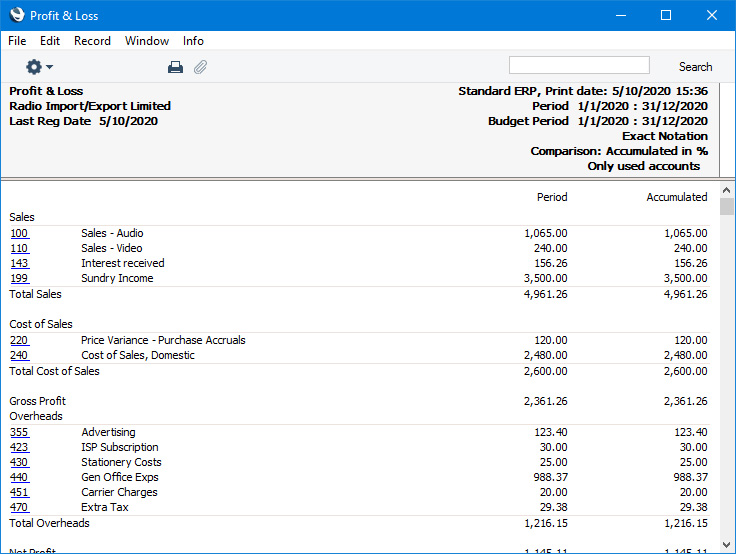
- If you are not using the Dual-Base system, use the Base Currency 1 option to produce a report in your home Currency.
Please follow the links below for more details about the Profit & Loss report:
- The Definition of the Profit & Loss report
- Printing the Profit & Loss report
Reports in the Nominal Ledger:
- Introduction
- Definition of Nominal Ledger Reports
- Drill-down
- The Operations Menu
- Account Reconciliation
- Accrual Report
- Analytical Balance
- Analytical Balance (Fiscal purposes)
- Balance Sheet
- Bank Reconciliation
- Bank Statement
- Bank Transactions
- Base Currency Rate Change
- Budget Journal
- Cash Flow
- Chart of Accounts
- Correction List
- Corresponding Accounts
- Creditors Account
- Currency A/C Rate Change
- Daily Balances
- Debtors Account
- Forward Balance Journal
- Income & Expense Book
- Key Financial Ratios
- Liquidity Forecast
- Multicurrency Accounts Rate Difference
- N/L Accrual Transactions
- N/L Transfer, Subsystems
- Nominal Ledger
- Profit & Loss
- Revised Budget Journal
- Tag/Object Results
- Tag/Object/Quantity Results
- Tax Account Balances
- Tax Calculations
- Tax Transactions for Registers
- Template Transaction Journal
- Test Corresponding Rules
- Transaction Journal
- Transaction Summary
- Trial Balance
- VAT Listing
- VAT Report
- VAT Report Purchases
- VAT Report Sales
- VAT Transaction Journal
- XBRL Report
Go back to:
- Home page for Nominal Ledger manual
- Home page for Standard ERP manual
Revised Budget Journal
This page describes the Revised Budget Journal report in the Nominal Ledger.---
The Revised Budget Journal is a list of the records in the Revised Budget register.
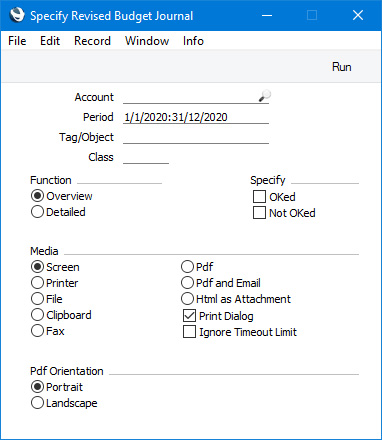
- Account
- Paste Special
Account register, Nominal Ledger/System module
- Range Reporting Alpha
- If you need the report to list Revised Budgets for a particular Account, specify that Account here. You can also enter a range of Accounts separated by a colon (:).
- If you need the report to list Revised Budgets for a particular Account, specify that Account here. You can also enter a range of Accounts separated by a colon (:).
- Period
- Paste Special
Reporting Periods setting, System module
- Enter the start and end date of the period whose Revised Budgets are to be shown in the report. The first record in the Reporting Periods setting will be used as a default.
- All Revised Budgets that are relevant to the report period will be listed in the report. For example, if the report period is June 1st to June 30th, Revised Budgets starting or ending in June will be included, and Revised Budgets starting before June and ending after June will also be shown.
- All Revised Budgets that are relevant to the report period will be listed in the report. For example, if the report period is June 1st to June 30th, Revised Budgets starting or ending in June will be included, and Revised Budgets starting before June and ending after June will also be shown.
- Tag/Object
- Paste Special
Tag/Object register, Nominal Ledger/System module
- To list Revised Budgets with a particular Tag/Object, enter that Tag/Object here. For a Revised Budget to be included in the report, its Tags/Objects and those in this field must match exactly. So, a Revised Budget with the Tags/Objects "AB,10101" will not be included in the report if you enter "AB" in this field.
- Class
- Paste Special
Budget Classes setting, Nominal Ledger
- If you need the report to list Revised Budgets with a particular Class, specify that Class here.
- Function
- Use these options to specify the level of detail that you need to be included in the report.
- Overview
- This option will produce a report that contains a single summary line for each Revised Budget, showing the Account Number and Name, Tag/Object, Class, Start and End Date and Sum.
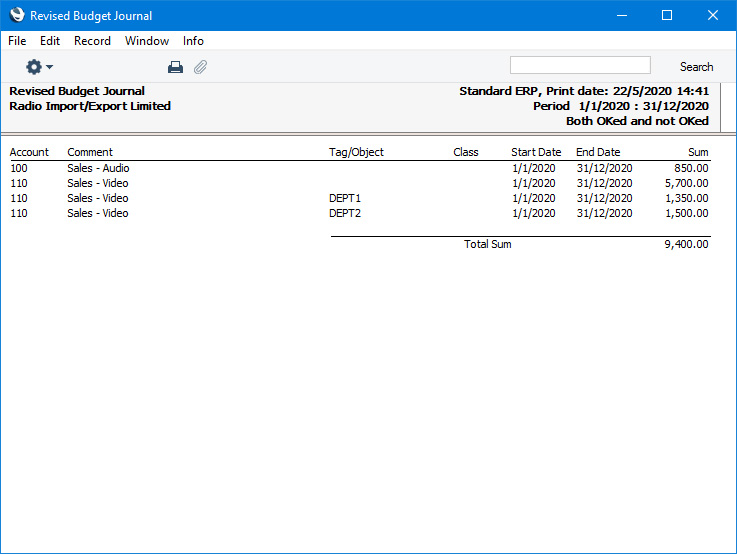
- Detailed
- In addition to the information shown in the Overview, this option also lists the monthly, quarterly or other periodic totals in each Revised Budget.
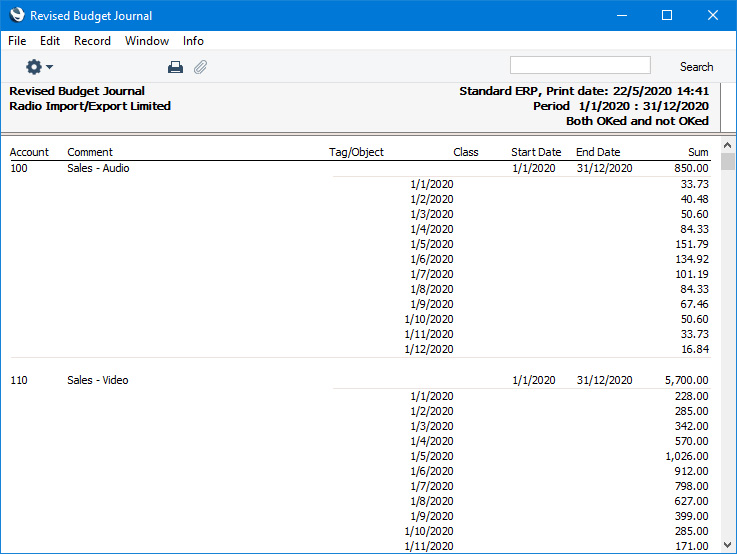
- Overview
- Specify
- Use these options to specify whether Revised Budgets that have been marked as OK, Revised Budgets that have not been marked as OK or both are to be included in the report. You must choose at least one option, otherwise the report will be empty.
Reports in the Nominal Ledger:
- Introduction
- Definition of Nominal Ledger Reports
- Drill-down
- The Operations Menu
- Account Reconciliation
- Accrual Report
- Analytical Balance
- Analytical Balance (Fiscal purposes)
- Balance Sheet
- Bank Reconciliation
- Bank Statement
- Bank Transactions
- Base Currency Rate Change
- Budget Journal
- Cash Flow
- Chart of Accounts
- Correction List
- Corresponding Accounts
- Creditors Account
- Currency A/C Rate Change
- Daily Balances
- Debtors Account
- Forward Balance Journal
- Key Financial Ratios
- Liquidity Forecast
- Multicurrency Accounts Rate Difference
- N/L Accrual Transactions
- N/L Transfer, Subsystems
- Nominal Ledger
- Profit & Loss
- Revised Budget Journal
- Simulation Journal
- Tag/Object Results
- Tag/Object/Quantity Results
- Tax Account Balances
- Tax Calculations
- Tax Transactions for Registers
- Template Transaction Journal
- Test Corresponding Rules
- Transaction Journal
- Transaction Summary
- Trial Balance
- VAT Listing
- VAT Report
- VAT Report Purchases
- VAT Report Sales
- VAT Transaction Journal
- XBRL Report
Go back to:
- Home page for Nominal Ledger manual
- Home page for Standard ERP manual
Simulation Journal
This page describes the Simulation Journal report in the Nominal Ledger.---
The Simulation Journal is a list of the records in the Simulation register.
When printed to screen, the Simulation Journal has the Standard ERP Drill-down feature. Click (Windows/macOS) or tap (iOS/Android) on any Simulation Number in the report to open an individual Simulation record.
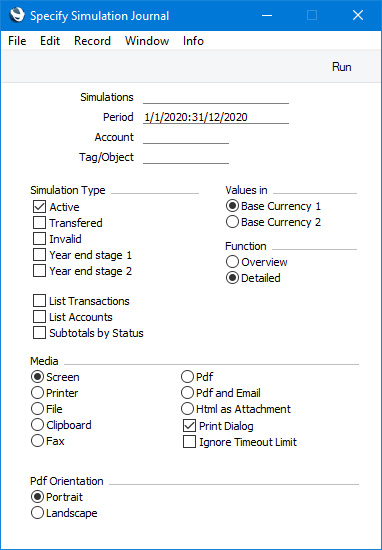
- Simulations
- Range Reporting
Numeric
- Enter a Simulation Number or a range of Numbers separated by a colon (:) here if you would like specific Simulations to be shown in the report.
- Period
- Paste Special
Reporting Periods setting, System module
- Enter the report period. The report will list Simulations whose Transaction Dates fall in the period specified here. The first period listed in the Reporting Periods setting will be used as a default.
- Account
- Paste Special
Account register, Nominal Ledger/System module
- Use this field if you want to list Simulations in which a particular Account has been used in at least one row.
- If you produce the report using the Overview option, the figures in the report for each Simulation will be calculated from the rows with the specified Account. If you use the Detailed option, only the rows with the specified Account will be listed.
- If you produce the report using the Overview option, the figures in the report for each Simulation will be calculated from the rows with the specified Account. If you use the Detailed option, only the rows with the specified Account will be listed.
- Tag/Object
- Paste Special
Tag/Object register, Nominal Ledger/System module
- Use this field if you want to list Simulations in which a particular Tag/Object has been used in at least one row. If you enter a number of Tags/Objects separated by commas, a Simulation will only be included in the report if it has at least one row featuring all the Tags/Objects.
- If you produce the report using the Overview option, the figures in the report for each Simulation will be calculated from the rows with the specified Tag/Object(s). If you use the Detailed option, only the rows with the specified Tag/Object(s) will be listed.
- If you produce the report using the Overview option, the figures in the report for each Simulation will be calculated from the rows with the specified Tag/Object(s). If you use the Detailed option, only the rows with the specified Tag/Object(s) will be listed.
- Simulation Type
- Select one or more of these options if you need to list Simulations in which there is at least one row with a particular Status.
- List Accounts
- If you select this option, each Account used in the Simulations in the report, together with debit and credit totals, will be listed at the end of the report.
- Subtotals by Status
- This option will list each Status used in the Simulations in the report, together with debit and credit totals.
- Values in
- If you are using the Dual-Base system, use these options to specify whether the values in the report are to be shown in Base Currency 1 or 2.
- If you are not using the Dual-Base system, use the Base Currency 1 option to produce a report in your home Currency.
- If you are not using the Dual-Base system, use the Base Currency 1 option to produce a report in your home Currency.
- Function
- Use these options to specify the level of detail required in the report.
- Overview
- This choice produces a report with a single line for each Simulation, showing the Simulation Number, Transaction Date, Reference, Text, Signature of the user who created the Simulation and debit and credit totals.
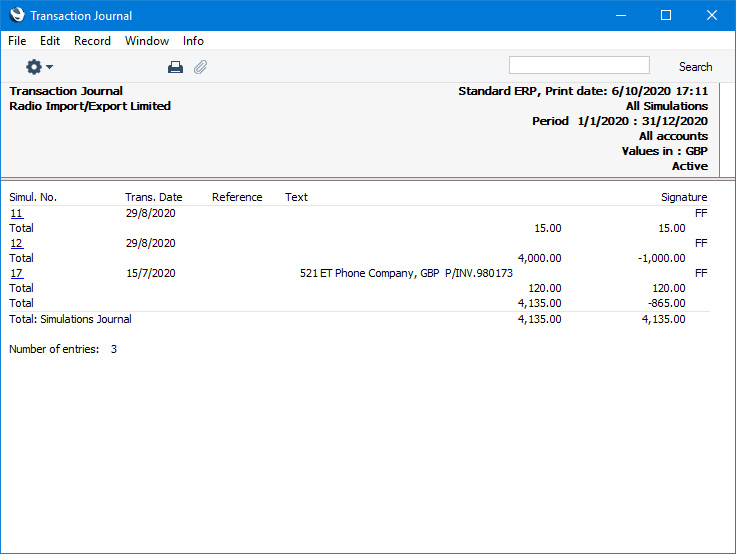
- Detailed
- In addition to the information shown in the Overview, this option lists the Simulation rows individually, showing the Account, Tags/Objects, Transaction Date, Description, Debit or Credit Value and VAT Code.
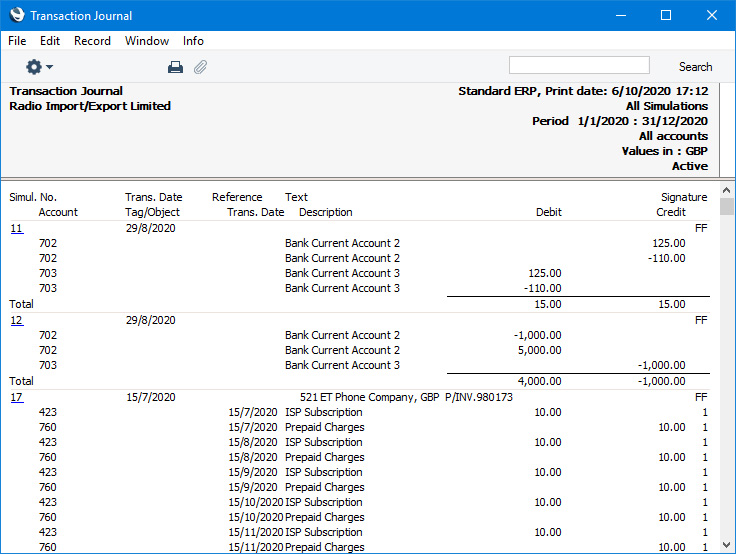
- Overview
Reports in the Nominal Ledger:
- Introduction
- Definition of Nominal Ledger Reports
- Drill-down
- The Operations Menu
- Account Reconciliation
- Accrual Report
- Analytical Balance
- Analytical Balance (Fiscal purposes)
- Balance Sheet
- Bank Reconciliation
- Bank Statement
- Bank Transactions
- Base Currency Rate Change
- Budget Journal
- Cash Flow
- Chart of Accounts
- Correction List
- Corresponding Accounts
- Creditors Account
- Currency A/C Rate Change
- Daily Balances
- Debtors Account
- Forward Balance Journal
- Income & Expense Book
- Key Financial Ratios
- Liquidity Forecast
- Multicurrency Accounts Rate Difference
- N/L Accrual Transactions
- N/L Transfer, Subsystems
- Nominal Ledger
- Profit & Loss
- Revised Budget Journal
- Simulation Journal
- Tag/Object Results
- Tag/Object/Quantity Results
- Tax Account Balances
- Tax Calculations
- Tax Transactions for Registers
- Template Transaction Journal
- Test Corresponding Rules
- Transaction Journal
- Transaction Summary
- Trial Balance
- VAT Listing
- VAT Report
- VAT Report Purchases
- VAT Report Sales
- VAT Transaction Journal
- XBRL Report
Go back to:
- Home page for Nominal Ledger manual
- Home page for Standard ERP manual
Tag/Object Results
This page describes the Tag/Object Results report in the Nominal Ledger module. For clarity, the term "Object" has been used in this description.---
The Tag/Object Results report analyses the profitability of each Object over the report period. For each Object, the report displays the total value posted to Income Accounts over the report period, the total value posted to Expense Accounts, and the gross profit (i.e. the difference between the Income and Expense postings). The report includes an option that allows you to compare the results for the report period with those for a previous period if necessary.
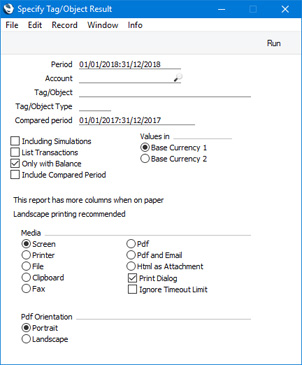
- Period
- Paste Special
Reporting Periods setting, System module
- Enter the first and last date of the report period, separated by a colon (:). For each Object, the report will display the total value posted to Income Accounts over the period specified here, the total value posted to Expense Accounts over the same period, and the gross profit.
- Account
- Paste Special
Account register, Nominal Ledger/System module
- Range Reporting Alpha
- If you need the report to show postings to a particular Account, specify that Account here. You can also enter a range of Accounts, separated by a colon. Remember that the report only includes postings to Income and Expense Accounts, so the report will be empty if you specify an Asset, Equity or Liability Account.
- If you need the report to show postings to a particular Account, specify that Account here. You can also enter a range of Accounts, separated by a colon. Remember that the report only includes postings to Income and Expense Accounts, so the report will be empty if you specify an Asset, Equity or Liability Account.
- Tag/Object
- Paste Special
Tag/Object register, Nominal Ledger/System module
- Range Reporting Alpha
- If you need particular Objects to be included in the report, you have the following options:
- Enter a single Object in this field.
- Enter a range of Objects separated by a colon. The report will list every Object in the range.
- Enter various Objects separated by commas. The report will list the Objects that you have entered.
Note that this behaviour is different to that in most reports in Standard ERP. In most reports, separating Objects with commas will usually means you need to report on postings with a particular combination of Objects.
- If you need particular Objects to be included in the report, you have the following options:
- Tag/Object Type
- Paste Special
Tag/Object Types setting, Nominal Ledger
- Enter an Object Type here if you need to report on the Objects belonging to a particular Object Type.
- Compared period
- Paste Special
Reporting Periods setting, System module
- If you want the report to compare the results from the report period with those from a different period, enter that period here and select the Include Compared Period option below. The default is to a period one year earlier than the main reporting period.
- Including Simulations
- Select this option if you need simulated transactions from the Simulation register to be included in the report. Simulation rows whose Status is "Invalid" or "Transferred" will not be included.
- List Transactions
- If you select this option, the Transaction Number of each Transaction that falls within the reporting period, together with debit and credit totals, will be listed at the end of the report. Every Transaction will be listed, irrespective of Object usage.
- Only with Balance
- If you select this option, the report will only list Objects that were used during the report period. Otherwise, every Object will be listed.
- Include Compared Period
- If you want the report to include a comparison with a different period, select this option and specify that period in the Compared Period field (above).
- Values in
- If you are using the Dual-Base system, values in this report can be shown in either Base Currency. Use these options to choose which Currency is to be used on this occasion.
- If you are not using the Dual-Base system, use the Base Currency 1 option to produce a report in your home Currency.
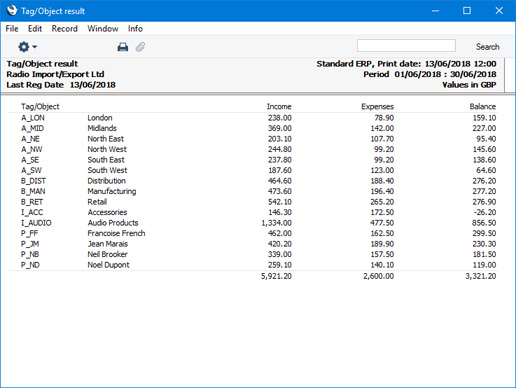
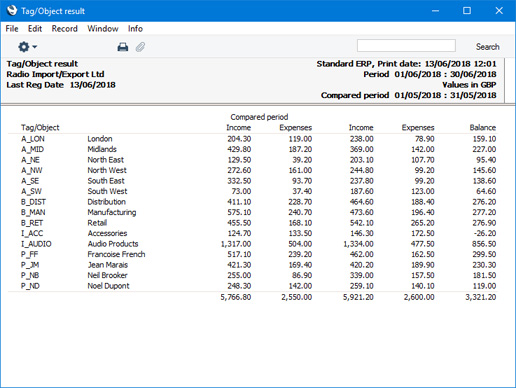
- Ack. Deb
- Displays the total value for each Object posted to Income Accounts for the year to the end of the report period.
- Ack. Cred
- Displays the total value for each Object posted to Expense Accounts for the year to the end of the report period.
- Fwd. Bal
- Ack. Deb - Ack. Cred the gross profit for the year to the end of the report period.
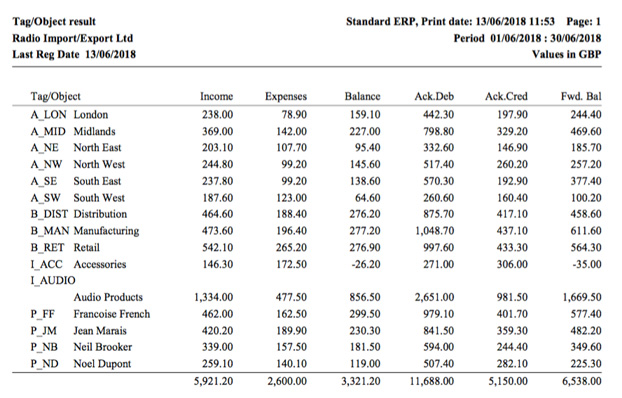
---
Reports in the Nominal Ledger:
- Introduction
- Definition of Nominal Ledger Reports
- Drill-down
- The Operations Menu
- Account Reconciliation
- Accrual Report
- Analytical Balance
- Analytical Balance (Fiscal purposes)
- Balance Sheet
- Bank Reconciliation
- Bank Statement
- Bank Transactions
- Base Currency Rate Change
- Budget Journal
- Cash Flow
- Chart of Accounts
- Correction List
- Corresponding Accounts
- Creditors Account
- Currency A/C Rate Change
- Daily Balances
- Debtors Account
- Forward Balance Journal
- Income & Expense Book
- Key Financial Ratios
- Liquidity Forecast
- Multicurrency Accounts Rate Difference
- N/L Accrual Transactions
- N/L Transfer, Subsystems
- Nominal Ledger
- Profit & Loss
- Revised Budget Journal
- Simulation Journal
- Tag/Object Results
- Tag/Object/Quantity Results
- Tax Account Balances
- Tax Calculations
- Tax Transactions for Registers
- Template Transaction Journal
- Test Corresponding Rules
- Transaction Journal
- Transaction Summary
- Trial Balance
- VAT Listing
- VAT Report
- VAT Report Purchases
- VAT Report Sales
- VAT Transaction Journal
- XBRL Report
Go back to:
- Home page for Nominal Ledger manual
- Home page for Standard ERP manual
Tag/Object/Quantity Results
This page describes the Tag/Object Results report in the Nominal Ledger module. For clarity, the term "Object" has been used in this description.---
The Tag/Object/Quantity Results report provides a detailed analysis of Object usage during the report period. For each Object, the report displays the total values posted to individual Income and Expense Accounts over the report period. For comparison purposes, Budget and Revised Budget figures for the report period are included.
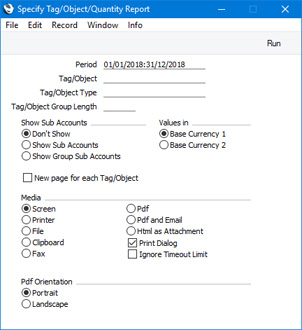
- Period
- Paste Special
Reporting Periods setting, System module
- The reporting period. Enter the first and last date separated by a colon (:).For each Object, the report will display the total values posted to individual Income and Expense Accounts over the period specified here.
- Tag/Object
- Paste Special
Tag/Object register, Nominal Ledger/System module
- Range Reporting Alpha
- If you need the report to show postings with a particular Object, specify that Account here. You can also enter a range of Objects, separated by a colon.
- If you need the report to show postings with a particular Object, specify that Account here. You can also enter a range of Objects, separated by a colon.
- Tag/Object Type
- Paste Special
Tag/Object Types setting, Nominal Ledger
- Enter an Object Type here if you need to report on the Objects that belong to a particular Object Type.
- Tag/Object Group Length
- You should use this field together with the Show Group Sub Accounts option. Please refer to the description of this option below for details.
- Show Sub Accounts
- This report can show subtotals for groups of Accounts or Objects with the same initial characters. Use these option to control this feature.
- Don't Show
- Use this option if you don't want to use the group subtotalling feature.
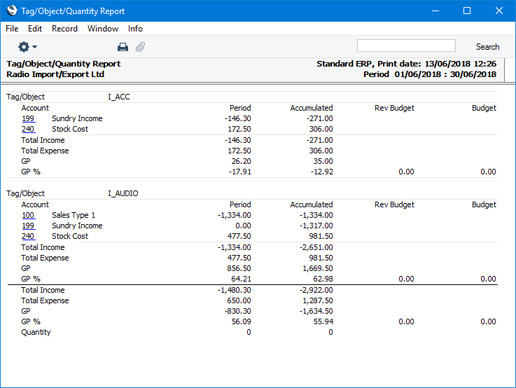
- Show Sub Accounts
- Use this option if you would like the report to show subtotals for groups of Accounts, grouped using the first character of the Account Number.
- For example, if your Sales Accounts are in the range 100-199, the report will show a separate balance for each Account and a balance for all Sales Accounts (because they share the same initial character, "1"). These balances are all per Object.
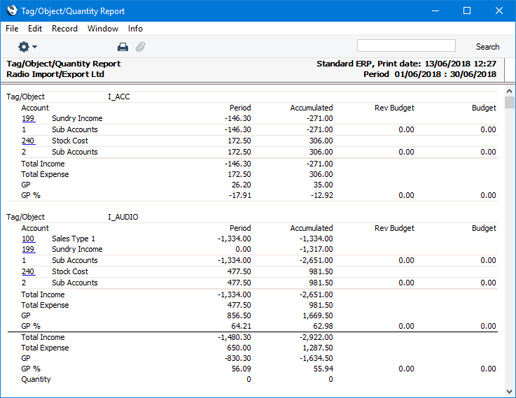
- For example, if your Sales Accounts are in the range 100-199, the report will show a separate balance for each Account and a balance for all Sales Accounts (because they share the same initial character, "1"). These balances are all per Object.
- Show Group Sub Accounts
- Use this option if you would like the report to show subtotals for groups of Objects, grouped using the initial characters of the Object Code. Specify the number of initial characters that are to be the same using the Object Group Length field above.
- For example, if the Object Group Length is 2, the report will contain individual sections for Objects 010, 011, 012 etc. and a separate section for these Objects grouped together (i.e. all Objects with the initial characters of "01").
- This option also provides subtotals for groups of Accounts, as described for the Show Sub Accounts option above.
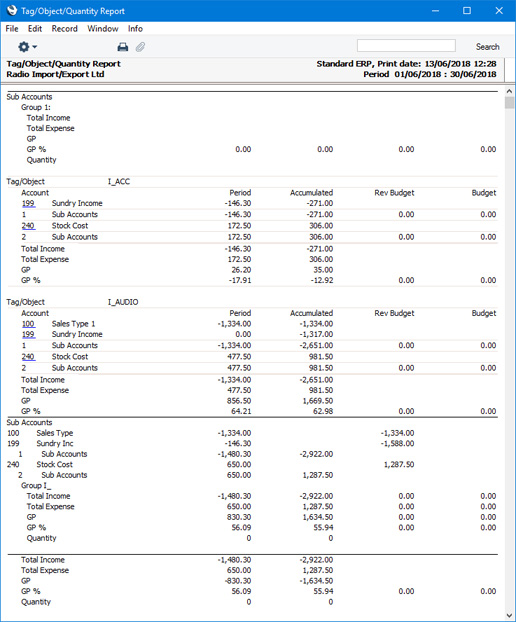
- For example, if the Object Group Length is 2, the report will contain individual sections for Objects 010, 011, 012 etc. and a separate section for these Objects grouped together (i.e. all Objects with the initial characters of "01").
- Don't Show
- Values in
- If you are using the Dual-Base system, values in this report can be shown in either Base Currency. Use these options to choose which Currency is to be used on this occasion.
- If you are not using the Dual-Base system, use the Base Currency 1 option to produce a report in your home Currency.
- If you are not using the Dual-Base system, use the Base Currency 1 option to produce a report in your home Currency.
- New page for each Tag/Object
- Select this option if you are printing the report to a printer and would like each Object to be printed on a separate page.
---
Reports in the Nominal Ledger:
- Introduction
- Definition of Nominal Ledger Reports
- Drill-down
- The Operations Menu
- Account Reconciliation
- Accrual Report
- Analytical Balance
- Analytical Balance (Fiscal purposes)
- Balance Sheet
- Bank Reconciliation
- Bank Statement
- Bank Transactions
- Base Currency Rate Change
- Budget Journal
- Cash Flow
- Chart of Accounts
- Correction List
- Corresponding Accounts
- Creditors Account
- Currency A/C Rate Change
- Daily Balances
- Debtors Account
- Forward Balance Journal
- Income & Expense Book
- Key Financial Ratios
- Liquidity Forecast
- Multicurrency Accounts Rate Difference
- N/L Accrual Transactions
- N/L Transfer, Subsystems
- Nominal Ledger
- Profit & Loss
- Revised Budget Journal
- Simulation Journal
- Tag/Object Results
- Tag/Object/Quantity Results
- Tax Account Balances
- Tax Calculations
- Tax Transactions for Registers
- Template Transaction Journal
- Test Corresponding Rules
- Transaction Journal
- Transaction Summary
- Trial Balance
- VAT Listing
- VAT Report
- VAT Report Purchases
- VAT Report Sales
- VAT Transaction Journal
- XBRL Report
Go back to:
- Home page for Nominal Ledger manual
- Home page for Standard ERP manual
Tax Account Balances
The Tax Account Balances report is used in Russia. Please refer to your local HansaWorld Enterprise representative for details.---
Reports in the Nominal Ledger:
- Introduction
- Definition of Nominal Ledger Reports
- Drill-down
- The Operations Menu
- Account Reconciliation
- Accrual Report
- Analytical Balance
- Analytical Balance (Fiscal purposes)
- Balance Sheet
- Bank Reconciliation
- Bank Statement
- Bank Transactions
- Base Currency Rate Change
- Budget Journal
- Cash Flow
- Chart of Accounts
- Correction List
- Corresponding Accounts
- Creditors Account
- Currency A/C Rate Change
- Daily Balances
- Debtors Account
- Forward Balance Journal
- Income & Expense Book
- Key Financial Ratios
- Liquidity Forecast
- Multicurrency Accounts Rate Difference
- N/L Accrual Transactions
- N/L Transfer, Subsystems
- Nominal Ledger
- Profit & Loss
- Revised Budget Journal
- Simulation Journal
- Tag/Object Results
- Tag/Object/Quantity Results
- Tax Account Balances
- Tax Calculations
- Tax Transactions for Registers
- Template Transaction Journal
- Test Corresponding Rules
- Transaction Journal
- Transaction Summary
- Trial Balance
- VAT Listing
- VAT Report
- VAT Report Purchases
- VAT Report Sales
- VAT Transaction Journal
- XBRL Report
Go back to:
- Home page for Nominal Ledger manual
- Home page for Standard ERP manual
Tax Calculations
Please refer here for a description of this report.---
Reports in the Nominal Ledger:
- Introduction
- Definition of Nominal Ledger Reports
- Drill-down
- The Operations Menu
- Account Reconciliation
- Accrual Report
- Analytical Balance
- Analytical Balance (Fiscal purposes)
- Balance Sheet
- Bank Reconciliation
- Bank Statement
- Bank Transactions
- Base Currency Rate Change
- Budget Journal
- Cash Flow
- Chart of Accounts
- Correction List
- Corresponding Accounts
- Creditors Account
- Currency A/C Rate Change
- Daily Balances
- Debtors Account
- Forward Balance Journal
- Income & Expense Book
- Key Financial Ratios
- Liquidity Forecast
- Multicurrency Accounts Rate Difference
- N/L Accrual Transactions
- N/L Transfer, Subsystems
- Nominal Ledger
- Profit & Loss
- Revised Budget Journal
- Simulation Journal
- Tag/Object Results
- Tag/Object/Quantity Results
- Tax Account Balances
- Tax Calculations
- Tax Transactions for Registers
- Template Transaction Journal
- Test Corresponding Rules
- Transaction Journal
- Transaction Summary
- Trial Balance
- VAT Listing
- VAT Report
- VAT Report Purchases
- VAT Report Sales
- VAT Transaction Journal
- XBRL Report
Go back to:
- Home page for Nominal Ledger manual
- Home page for Standard ERP manual
Tax Transactions for Registers
This report is used in Russia. Please refer to your local HansaWorld Enterprise representative for details.---
Reports in the Nominal Ledger:
- Introduction
- Definition of Nominal Ledger Reports
- Drill-down
- The Operations Menu
- Account Reconciliation
- Accrual Report
- Analytical Balance
- Analytical Balance (Fiscal purposes)
- Balance Sheet
- Bank Reconciliation
- Bank Statement
- Bank Transactions
- Base Currency Rate Change
- Budget Journal
- Cash Flow
- Chart of Accounts
- Correction List
- Corresponding Accounts
- Creditors Account
- Currency A/C Rate Change
- Daily Balances
- Debtors Account
- Forward Balance Journal
- Income & Expense Book
- Key Financial Ratios
- Liquidity Forecast
- Multicurrency Accounts Rate Difference
- N/L Accrual Transactions
- N/L Transfer, Subsystems
- Nominal Ledger
- Profit & Loss
- Revised Budget Journal
- Simulation Journal
- Tag/Object Results
- Tag/Object/Quantity Results
- Tax Account Balances
- Tax Calculations
- Tax Transactions for Registers
- Template Transaction Journal
- Test Corresponding Rules
- Transaction Journal
- Transaction Summary
- Trial Balance
- VAT Listing
- VAT Report
- VAT Report Purchases
- VAT Report Sales
- VAT Transaction Journal
- XBRL Report
Go back to:
- Home page for Nominal Ledger manual
- Home page for Standard ERP manual
Template Transaction Journal
This page describes the Template Transaction Journal report in the Nominal Ledger.---
The Template Transaction Journal report lists the records in the Template Transactions setting.
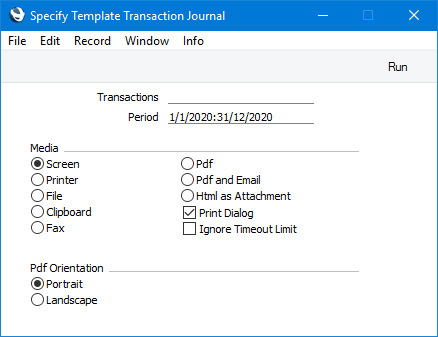
- Transactions
- Range Reporting
Numeric
- Specify the Template Transaction or range of Template Transactions that you want to be printed in the report.
- Period
- Paste Special
Reporting Periods setting, System module
- Enter the start and end date of the period whose Template Transactions are to be shown in the report. The first record in the Reporting Periods setting is used as a default.
Reports in the Nominal Ledger:
- Introduction
- Definition of Nominal Ledger Reports
- Drill-down
- The Operations Menu
- Account Reconciliation
- Accrual Report
- Analytical Balance
- Analytical Balance (Fiscal purposes)
- Balance Sheet
- Bank Reconciliation
- Bank Statement
- Bank Transactions
- Base Currency Rate Change
- Budget Journal
- Cash Flow
- Chart of Accounts
- Correction List
- Corresponding Accounts
- Creditors Account
- Currency A/C Rate Change
- Daily Balances
- Debtors Account
- Forward Balance Journal
- Income & Expense Book
- Key Financial Ratios
- Liquidity Forecast
- Multicurrency Accounts Rate Difference
- N/L Accrual Transactions
- N/L Transfer, Subsystems
- Nominal Ledger
- Profit & Loss
- Revised Budget Journal
- Simulation Journal
- Tag/Object Results
- Tag/Object/Quantity Results
- Tax Account Balances
- Tax Calculations
- Tax Transactions for Registers
- Template Transaction Journal
- Test Corresponding Rules
- Transaction Journal
- Transaction Summary
- Trial Balance
- VAT Listing
- VAT Report
- VAT Report Purchases
- VAT Report Sales
- VAT Transaction Journal
- XBRL Report
Go back to:
- Home page for Nominal Ledger manual
- Home page for Standard ERP manual
Test Corresponding Rules
If you are using the Check Corresponding A/C Rules option in the Transaction Settings setting, the Accounts used on each side (debit/credit) of a Transaction will be subject to certain rules (the "Corresponding Account Rules"). These rules are described in detail on the Transaction Settings setting page: they ensure that it is clear which debit postings are balanced by which credit postings in each Transaction. If you are not using this feature, you can use this report to list the Transactions that would not comply with these rules (i.e. those that would not be permissible if you were using the Check Corresponding A/C Rules option).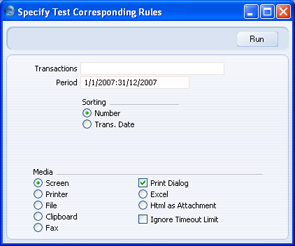
- Transactions
- Range Reporting
Numeric
- If you only want to print a certain range of Transactions, enter the first and the last transaction number, separated by a colon. If you leave the field blank, the whole journal will be printed.
- The Transaction Number must include the prefix as shown in the 'Transactions: Browse' window. To print a Transaction that was entered directly to the Nominal Ledger, enter, for example, "2007.3" or, for a range, "2007.3:2007.10". To print a Transaction that was created from a Sub System, enter, for example, "S/INV.070003" or "S/INV.070003:S/INV.070010" for a range.
- The Transaction Number must include the prefix as shown in the 'Transactions: Browse' window. To print a Transaction that was entered directly to the Nominal Ledger, enter, for example, "2007.3" or, for a range, "2007.3:2007.10". To print a Transaction that was created from a Sub System, enter, for example, "S/INV.070003" or "S/INV.070003:S/INV.070010" for a range.
- Period
- Paste Special
Reporting Periods setting, System module
- Specify the period to be covered by the report.
- Sorting
- The report can be sorted by Transaction Number or Date.
Transaction Journal
This page describes the Transaction Journal report in the Nominal Ledger.---
The Transaction Journal report can be treated as a daily transaction ledger as it is a summary of the entries made in the Transaction Journal. You cannot change the definition of this report.
When printed to screen, the Transaction Journal has the Standard ERP Drill-down feature. Click (Windows/macOS) or tap (iOS/Android) on any Transaction Number in the report to open an individual Transaction record.
To produce this report, ensure you are in the Nominal Ledger and click or tap the [Reports] button in the Navigation Centre. Then double-click or tap 'Transaction Journal' in the 'Reports' list. The 'Specify Transaction Journal' window will be opened.
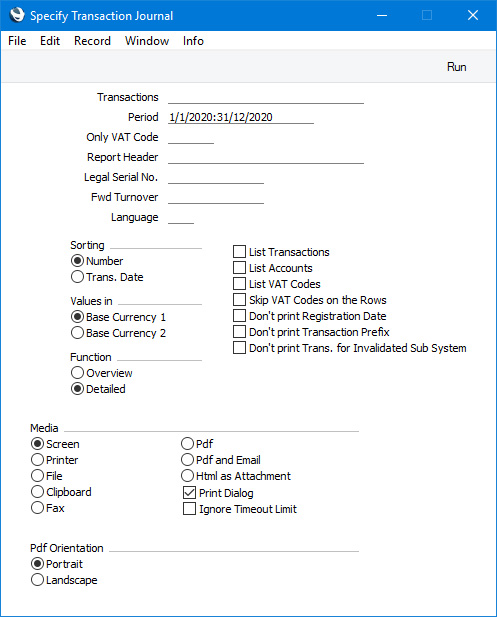
- Transactions
- Range Reporting
Numeric
- If you need the report to list the Transactions in a particular range, enter the first and the last Transaction Numbers in the range, separated by a colon (:). If you leave the field blank, every Transaction from the selected period will be included in the report.
- When entering a Transaction Number here, you must include the Fiscal Year or Sub System prefix (as shown in the 'Transactions: Browse' window). To include a Transaction that you entered directly to the Transaction register in the report, enter, for example, "2020.3" or, for a range, "2020.3:2020.10". To include a Transaction that was created from a Sub System in the report, enter, for example, "S/INV.200003" or "S/INV.200003:S/INV.200010" for a range.
- When entering a Transaction Number here, you must include the Fiscal Year or Sub System prefix (as shown in the 'Transactions: Browse' window). To include a Transaction that you entered directly to the Transaction register in the report, enter, for example, "2020.3" or, for a range, "2020.3:2020.10". To include a Transaction that was created from a Sub System in the report, enter, for example, "S/INV.200003" or "S/INV.200003:S/INV.200010" for a range.
- Period
- Paste Special
Reporting Periods setting, System module
- Enter the period to be covered by the report. The report will list Transactions with Transaction Dates that fall within the period specified here.
- Only VAT Code
- Paste Special
VAT Codes setting, Nominal Ledger
- Use this field to limit the report to Transactions in which there is at least one row with a particular VAT Code.
- Report Header
- Specify the report title here. If you do not specify a title, "Transaction Journal" will be used. This title will be printed in the report header, and will also appear in the title bar of the report window if you print the report to screen.
- Legal Ser No.
- In some countries it is mandatory for all Transactions to follow a single number series, irrespective of their nature. Enter the first number in the series here and select the Don't Print Transaction Prefix option below. Each Transaction will be given a number in the specified series, in place of the usual Transaction Number.
- Fwd Turnover
- If you enter an amount in this field, this amount will be added to the total turnover at the bottom of the report.
- Language
- Paste Special
Languages setting, System module
- You can produce the Transaction Journal in different Languages: enter the required Language Code here. The appropriate translations of the Account Names will be taken from the 'Texts' card of each Account record.
- Sorting
- The Transactions listed in the report can be sorted by Transaction Number or Transaction Date.
- If you sort by Transaction Number, all Transactions of a similar type will be grouped together. For example, Transactions resulting from Sales Invoices will be grouped together, Transactions resulting from Purchase Invoices will be grouped together, and so on. This allows the report to provide debit and credit turnover figures for each type. If you have used different Number Series, then debit and credit turnover figures will be provided for each Number Series, identified by the Comment from the Number Series. For example, if you have created Invoices using three Number Series, the resulting Transactions in this report will be divided into three sections, with debit and credit turnover figures provided for each one.
- If you sort by Transaction Date, all Transactions of a similar type from a particular month will be grouped together. For example, Transactions resulting from Sales Invoices in January will be grouped together, Transactions resulting from Purchase Invoices from January will then be grouped together, to be followed by other Transactions from January, then the pattern will be repeated for February, and so on. This allows the report to provide monthly debit and credit turnover figures for each type. If you have used different Number Series, then monthly debit and credit turnover figures will be provided for each Number Series, identified by the Comment from the Number Series.
- If you sort by Transaction Number, all Transactions of a similar type will be grouped together. For example, Transactions resulting from Sales Invoices will be grouped together, Transactions resulting from Purchase Invoices will be grouped together, and so on. This allows the report to provide debit and credit turnover figures for each type. If you have used different Number Series, then debit and credit turnover figures will be provided for each Number Series, identified by the Comment from the Number Series. For example, if you have created Invoices using three Number Series, the resulting Transactions in this report will be divided into three sections, with debit and credit turnover figures provided for each one.
- Values in
- If you are using the Dual-Base system, use these options to specify whether the values in the report are to be shown in Base Currency 1 or 2.
- If you are not using the Dual-Base system, use the Base Currency 1 option to produce a report in your home Currency.
- If you are not using the Dual-Base system, use the Base Currency 1 option to produce a report in your home Currency.
- Function
- Use these options to specify the level of detail required in the report.
- Overview
- This choice produces a report with a single line for each Transaction, showing the Transaction Number, Registration and Transaction Dates, Reference, Text, Signature of the user who created the Transaction and debit and credit totals.
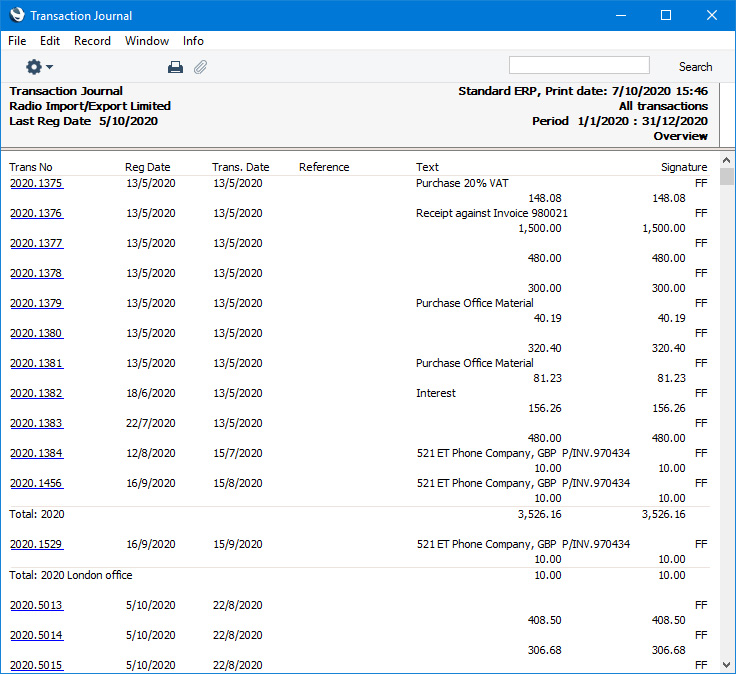
- The Registration Date will not be included if you select the Don't print Registration Date option below. The Signatures of the users who created each Transaction will not be included in Finland (i.e. when the VAT Law in the Company Info setting is "Finnish").
- The Registration Date will not be included if you select the Don't print Registration Date option below. The Signatures of the users who created each Transaction will not be included in Finland (i.e. when the VAT Law in the Company Info setting is "Finnish").
- Detailed
- In addition to the information shown in the Overview, this option lists the Transaction rows individually, showing the Account, Tags/Objects, Description, Additional Description, Debit or Credit Value and VAT Code.
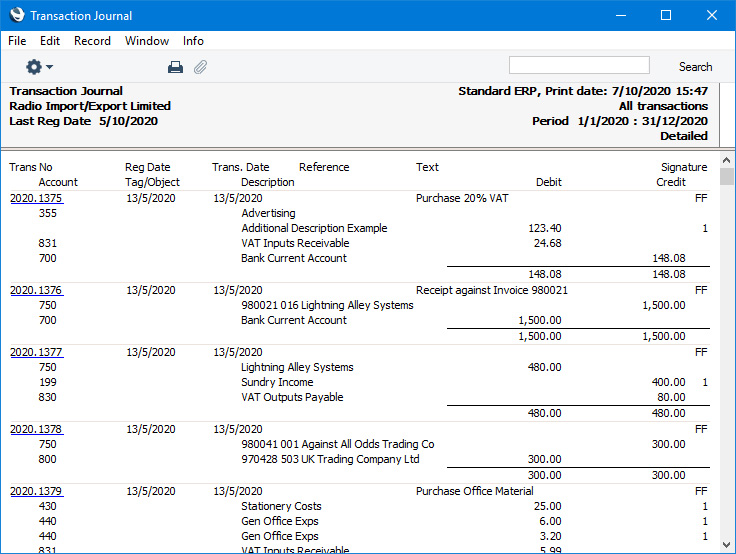
- The VAT Code will not be included if you select the Skip VAT Codes on the Rows option below.
- Overview
- List Transactions
- If you select this option, each Transaction used by the report, together with debit and credit totals, will be listed at the end of the report. If you have restricted the scope of the report using any of the fields above, only those Transactions included in the report will be listed.
- List Accounts
- If you select this option, each Account used by the Transactions in the report, together with debit and credit totals, will be listed at the end of the report. If you have restricted the scope of the report using any of the fields above, only those Accounts affected by the Transactions shown will be listed.
- List VAT Codes
- With this option selected, each VAT Code used by the Transactions in the report, together with debit and credit totals, will be listed at the bottom of the report. If you have restricted the scope of the report using any of the fields above, only those VAT Codes used in the Transactions in the report will be listed.
- Skip VAT Codes on the Rows
- If a Transaction row has a VAT Code, this will usually be shown in the report. Select this option if you do not need VAT Codes to be shown in the report.
- Don't print Registration Date
- The report usually shows both the Transaction Date (as shown in the Transaction header) and the Registration Date (the date when the Transaction record was created). Select this option if you do not need Registration Dates to be included in the report.
- Don't print Transaction Prefix
- Transaction Numbers will usually be printed in the report together with their fiscal year or Sub System prefixes (as shown in the 'Transactions: Browse' window). The Number of a Transaction that you entered directly to the Transaction register, for example, will be printed as "2020.3" while the Number of a Transaction created from a Sub System will be printed as, for example, "S/INV.200003". Select this option if you do not want these prefixes to be printed in the report (i.e. in the examples, to omit "2020." and "S/INV.").
- If you use the 'Lock N/L' Maintenance function to close an accounting period, a Document Number (also known as a Sequence Number) will be assigned permanently to every Transaction in the newly closed period. If you print the report using this option, these Document Numbers will be printed in place of the usual Transaction Numbers. The usual Transaction Number (without prefix) will be printed if there is no Document Number (i.e. when a Transaction belongs to a period that you have not yet closed).
- If you select this option and enter a Legal Ser. No. above, each Transaction will be printed with a number in the sequence beginning with the Legal Ser. No. in place of the usual Transaction Number or Document Number.
- If you use the 'Lock N/L' Maintenance function to close an accounting period, a Document Number (also known as a Sequence Number) will be assigned permanently to every Transaction in the newly closed period. If you print the report using this option, these Document Numbers will be printed in place of the usual Transaction Numbers. The usual Transaction Number (without prefix) will be printed if there is no Document Number (i.e. when a Transaction belongs to a period that you have not yet closed).
- Don't print Trans. for Invalidated Sub System
- By default, a Transaction created from a Sub System record (e.g. from an Invoice) that you then invalidate will be included in the report. Every piece of information will be printed drawn through with a red line, and the total value of the Transaction will be zero. Select this option if you want the Transaction to be excluded from the report altogether.
Reports in the Nominal Ledger:
- Introduction
- Definition of Nominal Ledger Reports
- Drill-down
- The Operations Menu
- Account Reconciliation
- Accrual Report
- Analytical Balance
- Analytical Balance (Fiscal purposes)
- Balance Sheet
- Bank Reconciliation
- Bank Statement
- Bank Transactions
- Base Currency Rate Change
- Budget Journal
- Cash Flow
- Chart of Accounts
- Correction List
- Corresponding Accounts
- Creditors Account
- Currency A/C Rate Change
- Daily Balances
- Debtors Account
- Forward Balance Journal
- Income & Expense Book
- Key Financial Ratios
- Liquidity Forecast
- Multicurrency Accounts Rate Difference
- N/L Accrual Transactions
- N/L Transfer, Subsystems
- Nominal Ledger
- Profit & Loss
- Revised Budget Journal
- Simulation Journal
- Tag/Object Results
- Tag/Object/Quantity Results
- Tax Account Balances
- Tax Calculations
- Tax Transactions for Registers
- Template Transaction Journal
- Test Corresponding Rules
- Transaction Journal
- Transaction Summary
- Trial Balance
- VAT Listing
- VAT Report
- VAT Report Purchases
- VAT Report Sales
- VAT Transaction Journal
- XBRL Report
Go back to:
- Home page for Nominal Ledger manual
- Home page for Standard ERP manual
Transaction Summary
This page describes the Transaction Summary report in the Nominal Ledger.---
The Transaction Summary is a list of Transactions. For the purposes of this report, Transactions are divided into two types. The first type includes Transactions created from Sales and Purchase Invoices, Receipts and Payments. The second type includes all other Transactions.
The report does not list Transactions from the first type individually. Instead it will include summaries of these Transactions. If you choose to sort the report by Number or Transaction Date, the report will contain up to four separate summary sections for Invoices, Receipts, Purchase Invoices and/or Payments (you can choose which of these summaries will be included). These summary sections will show the total debit and credit totals posted to each Account. If you choose to sort the report by Monthly Sumup, the report will contain up to four summaries per month (e.g. separate summary sections for Invoices, Receipts, Purchase Invoices and/or Payments in January, again for February and so on).
Transactions from the second type will be listed individually, showing the Accounts debited and credited, together with the amounts. Transactions resulting from Invoices, Receipts, Purchase Invoices and Payments are not listed.
Transaction Numbers are not shown in the Transaction Summary. Instead, each Transaction or summary will be given a sequential number in a single number series.
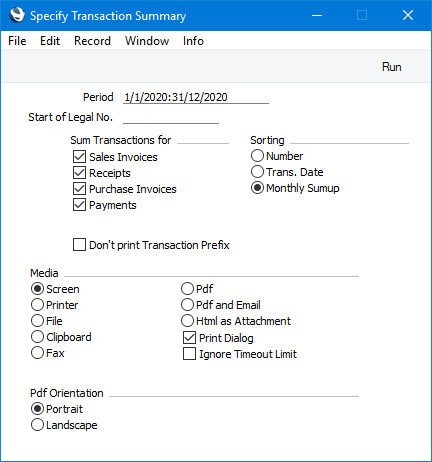
- Period
- Paste Special
Reporting Periods setting, System module
- Enter the period to be covered by the report.
- Start of Legal Nos
- The Transaction Summary report does not show Transaction Numbers, as stored in the Transaction register. Instead, Transactions and summaries will be renumbered to follow a single number series, irrespective of their nature. Enter the first number in the series here. If you do not enter a number, the sequence will start at 1.
- Sum Transactions for
- As described above the illustration, the report can contain separate summary sections showing the debit and credit totals posted to each Account in Transactions resulting from Invoices, Receipts, Purchase Invoices and/or Payments in the report period (monthly summary sections if you choose "Monthly Sumup" as the Sorting option below). Use these options to choose which summary sections are to be included in the report.
- Sorting
- Three sort options are offered:
- Number
- Transactions will be listed in Transaction Number order, as stored in the Transaction register. If included in the report, the four summary sections will be printed at the end.
- Trans. Date
- Transactions will be listed in Transaction Date order. If included in the report, the four summary sections will be printed at the end.
- Monthly Sumup
- Transactions will be listed in Transaction Date order. Instead of printing the four summary sections at the end of the report, this option will print monthly summaries in the appropriate places in the list.
- Number
- Don't print Transaction Prefix
- When listed in the 'Transactions: Browse' window, Transaction Numbers are shown together with prefixes that indicate the type of each Transaction. The Number of a Transaction that you entered directly to the Transaction register, for example, will be shown in the 'Transactions: Browse' window as "2020.3" while the Number of a Transaction created from a Sub System will be shown as, for example, "GREC.200003".
- Although this report does not print Transaction Numbers, their prefixes will be included in the report as an indication of the type of Transaction. Select this option if you do not want these prefixes to be shown in the report (i.e. in the examples, to omit "2020." and "GREC.").
- If included in the report, the four summary sections will be marked with the appropriate prefix. Again, these prefixes will not be printed if you use this option.
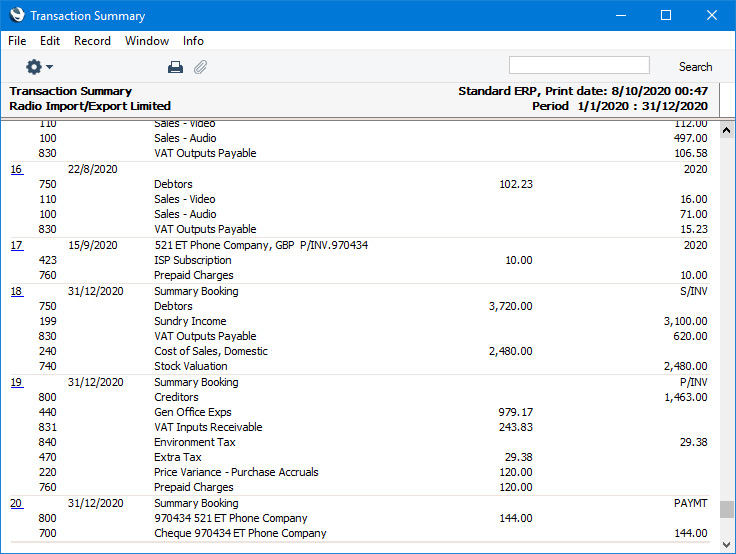
- Although this report does not print Transaction Numbers, their prefixes will be included in the report as an indication of the type of Transaction. Select this option if you do not want these prefixes to be shown in the report (i.e. in the examples, to omit "2020." and "GREC.").
---
Reports in the Nominal Ledger:
- Introduction
- Definition of Nominal Ledger Reports
- Drill-down
- The Operations Menu
- Account Reconciliation
- Accrual Report
- Analytical Balance
- Analytical Balance (Fiscal purposes)
- Balance Sheet
- Bank Reconciliation
- Bank Statement
- Bank Transactions
- Base Currency Rate Change
- Budget Journal
- Cash Flow
- Chart of Accounts
- Correction List
- Corresponding Accounts
- Creditors Account
- Currency A/C Rate Change
- Daily Balances
- Debtors Account
- Forward Balance Journal
- Income & Expense Book
- Key Financial Ratios
- Liquidity Forecast
- Multicurrency Accounts Rate Difference
- N/L Accrual Transactions
- N/L Transfer, Subsystems
- Nominal Ledger
- Profit & Loss
- Revised Budget Journal
- Simulation Journal
- Tag/Object Results
- Tag/Object/Quantity Results
- Tax Account Balances
- Tax Calculations
- Tax Transactions for Registers
- Template Transaction Journal
- Test Corresponding Rules
- Transaction Journal
- Transaction Summary
- Trial Balance
- VAT Listing
- VAT Report
- VAT Report Purchases
- VAT Report Sales
- VAT Transaction Journal
- XBRL Report
Go back to:
- Home page for Nominal Ledger manual
- Home page for Standard ERP manual
Trial Balance
This page describes the Trial Balance report in the Nominal Ledger.---
The Trial Balance is a report that lists the balances of each Account.
The main purpose of the Trial Balance is to confirm that the sum of the debit balances is the same as the sum of the credit balances. The totals of the three columns in the report should each be zero, signifying that in your accounts the total debits and the total credits are equal. If this is not the case, there may be an error in one or more of your Transactions that you should correct immediately. and before producing the Balance Sheet and Profit & Loss reports.
You cannot alter the definition of the Trial Balance report, but you can determine the Transactions that are to be included.
When printed to screen, the Trial Balance has the Standard ERP Drill-down feature. Click (Windows/macOS) or tap (iOS/Android) the Account Number of any Account in the report to open the Nominal Ledger Report for the same Account and period. When in the Nominal Ledger report, you can click or tap any Transaction Number to open an individual Transaction record.
You can specify whether figures in the Trial Balance will be positive or negative depending on Account Type. To do this, use the check boxes in column 2 in the Presentation of Balances setting. For example, figures in the report for Asset Accounts will obey the Assets check box in column 2 in the Presentation of Balances setting. It is recommended that the check boxes in column 2 in this setting should all be ticked or not ticked. If only some of the check boxes in column 2 are ticked, the Trial Balance report will not balance.
To print the Trial Balance, ensure you are in the Nominal Ledger and click or tap the [Reports] button in the Navigation Centre. Then double-click or tap 'Trial Balance' in the 'Reports' list. The 'Specify Trial Balance' window will be opened.
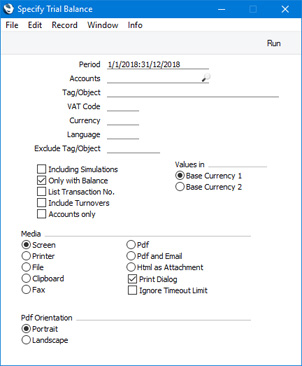
- Period
- Paste Special
Reporting Periods setting, System module
- Enter the period for which you want to produce the Trial Balance. The Account balances in the report will be calculated from postings (i.e. from Transaction rows) recorded during the period specified here. The first period in the Reporting Periods setting is the default value.
- Accounts
- Paste Special
Account register, Nominal Ledger/System module
- Range Reporting Alpha
- Enter an Account Number or a range of Numbers separated by a colon (:) here if you would like specific Accounts to be listed in the report.
- Enter an Account Number or a range of Numbers separated by a colon (:) here if you would like specific Accounts to be listed in the report.
- Tag/Object
- Paste Special
Tag/Object register, Nominal Ledger/System module
- Enter a Tag/Object Code here if you need the Account balances in the report to be calculated from postings with a particular Tag/Object. You can also enter a number of Tags/Objects separated by commas, in which case Account balances will be calculated from postings with all the Tags/Objects listed. If you leave this field empty, Account balances will be calculated from all postings, with and without Tags/Objects.
- VAT Code
- Paste Special
VAT Codes setting, Nominal Ledger
- Enter a VAT Code here if you need if you need the Account balances in the report to be calculated from Transaction rows with a particular VAT Code.
- Currency
- Paste Special
Currency register, System module
- If you specify a Currency here, the Account balances in the report will be calculated only from Transaction rows with the specified Currency shown on flip C. The balances will be calculated using the figures on flip C of those Transaction rows (i.e. they will be in the chosen Currency). If you leave this field blank, all Transaction rows will be included in the calculations. In this case the calculation will use the figures in the Base 1 or Base 2 Debit or Credit fields on flip A (choose which Base Currency is to be used using the Values in options described below).
- Language
- Paste Special
Languages setting, System module
- You can produce the Trial Balance in different Languages: enter the required Language Code here. The appropriate translations of the Account Names will be taken from the 'Texts' card of each Account record.
- If you do not enter a Language here, but you have entered a Language in the Company Info setting in the System module, the report will be produced in that Language if you are using the Account Description in Company Language option in the Transaction Settings setting in the Nominal Ledger.
- If you do not enter a Language here, but you have entered a Language in the Company Info setting in the System module, the report will be produced in that Language if you are using the Account Description in Company Language option in the Transaction Settings setting in the Nominal Ledger.
- Exclude Tag/Object
- Paste Special
Tag/Object register, Nominal Ledger/System module
- Enter a Tag/Object Code here if you need postings with a particular Tag/Object to be excluded from the Account balance calculations.
- Including Simulations
- Select this option if you need to simulated transactions from the Simulation register to be included in the report. Simulation rows in which the Status is "Invalid" and "Transferred" will not be included.
- Only with Balance
- With this option selected, Accounts that have zero balances at the end of the report period will be excluded from the report.
- List Transaction No.
- If you select this option, the Transaction Numbers of all Transactions that fall within the reporting period, together with debit and credit totals, will be listed at the end of the report.
- Include Turnovers
- The standard version of this report has three columns showing for each Account the balance brought forward for each Account, the net change over the report period and the final balance. If you select this option, two additional columns will be included, showing the total debit and credit postings to each Account.
- Accounts only
- In the standard version of the report, the Accounts will be divided into groups, using the first character of the Account Number. Subtotals for each group of Accounts will be shown. For example, the report will list the Accounts in the range 100:199 and then provide subtotals for those Accounts, because they share the same initial character, "1".
- Select this option if you only need a simple list of Accounts with overall totals and so do not need Accounts to be grouped together in this way.
- Select this option if you only need a simple list of Accounts with overall totals and so do not need Accounts to be grouped together in this way.
- Values in
- If you are using the Dual-Base system, use these options to specify whether the values in the report are to be shown in Base Currency 1 or 2.
- If you are not using the Dual-Base system, use the Base Currency 1 option to produce a report in your home Currency.
- If you have entered a Currency in the Currency field above, the figures in the report will be in that Currency.
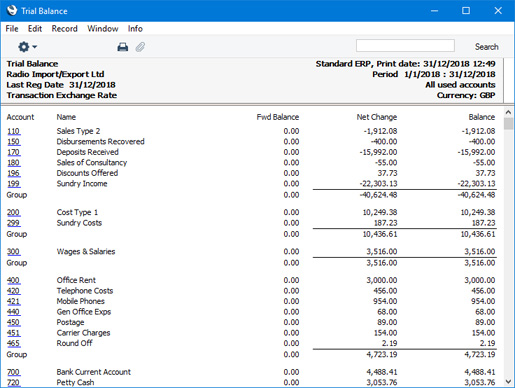
- If you are not using the Dual-Base system, use the Base Currency 1 option to produce a report in your home Currency.
Reports in the Nominal Ledger:
- Introduction
- Definition of Nominal Ledger Reports
- Drill-down
- The Operations Menu
- Account Reconciliation
- Accrual Report
- Analytical Balance
- Analytical Balance (Fiscal purposes)
- Balance Sheet
- Bank Reconciliation
- Bank Statement
- Bank Transactions
- Base Currency Rate Change
- Budget Journal
- Cash Flow
- Chart of Accounts
- Correction List
- Corresponding Accounts
- Creditors Account
- Currency A/C Rate Change
- Daily Balances
- Debtors Account
- Forward Balance Journal
- Income & Expense Book
- Key Financial Ratios
- Liquidity Forecast
- Multicurrency Accounts Rate Difference
- N/L Accrual Transactions
- N/L Transfer, Subsystems
- Nominal Ledger
- Profit & Loss
- Revised Budget Journal
- Simulation Journal
- Tag/Object Results
- Tag/Object/Quantity Results
- Tax Account Balances
- Tax Calculations
- Tax Transactions for Registers
- Template Transaction Journal
- Test Corresponding Rules
- Transaction Journal
- Transaction Summary
- Trial Balance
- VAT Listing
- VAT Report
- VAT Report Purchases
- VAT Report Sales
- VAT Transaction Journal
- XBRL Report
Go back to:
- Home page for Nominal Ledger manual
- Home page for Standard ERP manual
VAT Listing
This page describes the VAT Listing report in the Nominal Ledger.---
The VAT Listing report lists the transactions that will be used to calculate the figures shown in the VAT Report. For each transaction, the total including and excluding VAT, the VAT total, the overall VAT percentage and the Currency will be shown.
This report is compiled from the Sub System records (e.g. Invoices, Purchase Invoices) that are liable for VAT. The VAT Report is compiled from the Nominal Ledger postings to the VAT Accounts. If there is a difference between the two reports, one possible reason is that the connection between a Sub System record and its related Nominal Ledger Transaction is not correct. Perhaps the Nominal Ledger Transaction does not exist at all, or perhaps the VAT Code in a Transaction row posting to a Sales or Purchase/Cost Account is incorrect or missing, in which case that row will not be included in the figure calculated by the VATRESULT or VATBALANCE commands in the VAT Report.
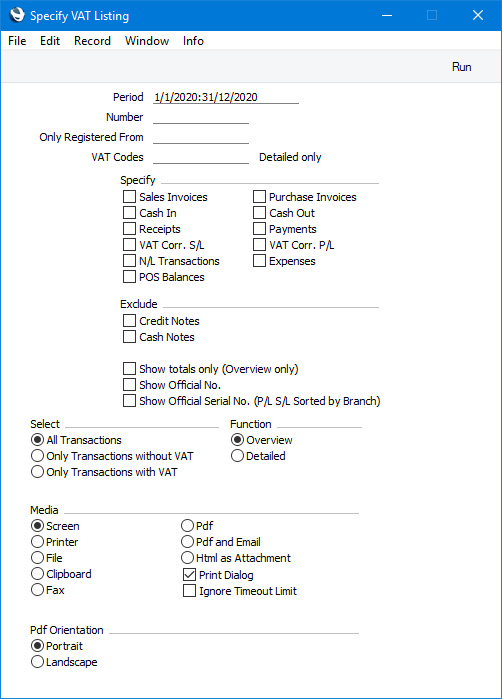
- Period
- Paste Special
Reporting Periods setting, System module
- Enter the period to be covered in the report. The report will list records in the register(s) specified below with Transaction Dates that fall within this period. The first period in the Reporting Periods setting will be offered as the default value.
- Number
- Range Reporting
Numeric
- If you want the report to list records in the register(s) specified below whose serial numbers fall within a particular range, enter that range here.
- Only Registered From
- If you want to list records that you entered on or after a particular date, enter that date here. In the case of a Sub System record, this refers to the date when the resulting Nominal Ledger Transaction was created (i.e. the date when you marked the Sub System record as OK).
- VAT Codes (Detailed only)
- Paste Special
VAT Codes setting, Nominal Ledger
- The Detailed version of the report will list the rows in each Transaction and Sub System record individually. If you only need to list the rows with a particular VAT Code, specify that VAT Code here. You can also enter more than one VAT Code, separated by commas.
- Specify
- You can choose to have Sales Invoices, Purchase Invoices, Expenses, Receipts, Payments, inward and outgoing cash transactions, POS Balances and/or Nominal Ledger Transactions listed in separate sections in the report. You must choose at least one option otherwise the report will be blank.
- The Invoices option depends on whether you are using the Post Receipt VAT option in the Account Usage S/L setting in the Sales Ledger. If you are not using this option, the report will list the Invoices issued during the report period, together with Invoice Dates. If you are using this option (i.e. your VAT calculation is based on Receipts rather than Invoices), the report will list the Invoices paid during the report period, together with the dates they were paid. The Purchase Invoices option will similarly depend on the Post Payment VAT option in the Account Usage P/L setting in the Purchase Ledger.
- The Receipts option will only list Prepayments and On Account Receipts (i.e. Receipts that do not have Invoice Numbers). Similarly, the Payments option will only list Prepayments and On Account Payments.
- The Invoices option depends on whether you are using the Post Receipt VAT option in the Account Usage S/L setting in the Sales Ledger. If you are not using this option, the report will list the Invoices issued during the report period, together with Invoice Dates. If you are using this option (i.e. your VAT calculation is based on Receipts rather than Invoices), the report will list the Invoices paid during the report period, together with the dates they were paid. The Purchase Invoices option will similarly depend on the Post Payment VAT option in the Account Usage P/L setting in the Purchase Ledger.
- Exclude
- If you have specified that the report will list Sales Invoices and/or Purchase Invoices, use these options if you need to exclude Credit Notes and/or Cash Notes from the report.
- Show totals only (Overview only)
- The Overview version of the report will list each Transaction and Sub System record individually, in separate sections for each register. If you don't need to see each record listed and instead only need totals for each register, select this option.
- Show Official Serial No. (P/L S/L Sorted by Branch)
- If you choose to have Sales Invoices listed in the report, select this option if you need the Official Serial Number of each Invoice to be included in the report (in addition to the Invoice Number).
- Select
- The report can show all Transactions and Sub System records or just those with or without VAT.
- Function
- Use these options to determine the level of detail to be included in the report.
- Overview
- This option lists each transaction, showing for each one the date, number, amount excluding VAT, VAT amount, total amount, effective VAT rate and Currency. This is followed by summary totals for each VAT Code.
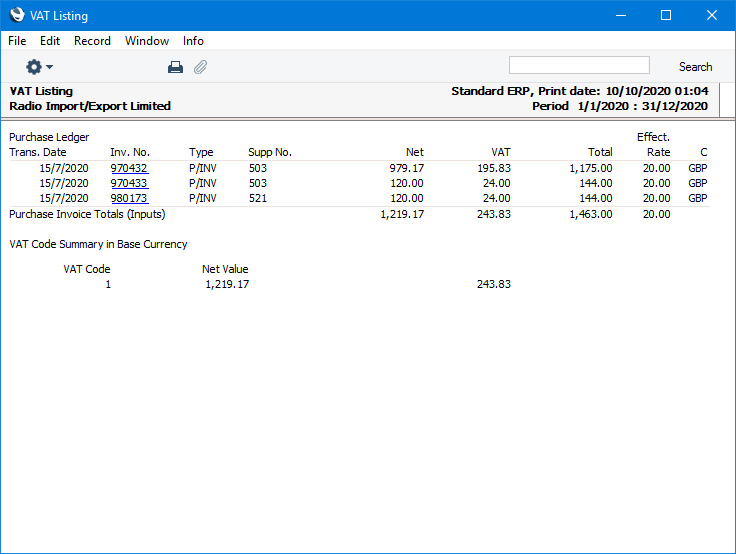
- If you don't need the transactions to be listed and just want a single line summary of each section, use the Show Totals Only option.
- If you don't need the transactions to be listed and just want a single line summary of each section, use the Show Totals Only option.
- Detailed
- This is similar to the Overview, with the addition of VAT Code analysis for each transaction.
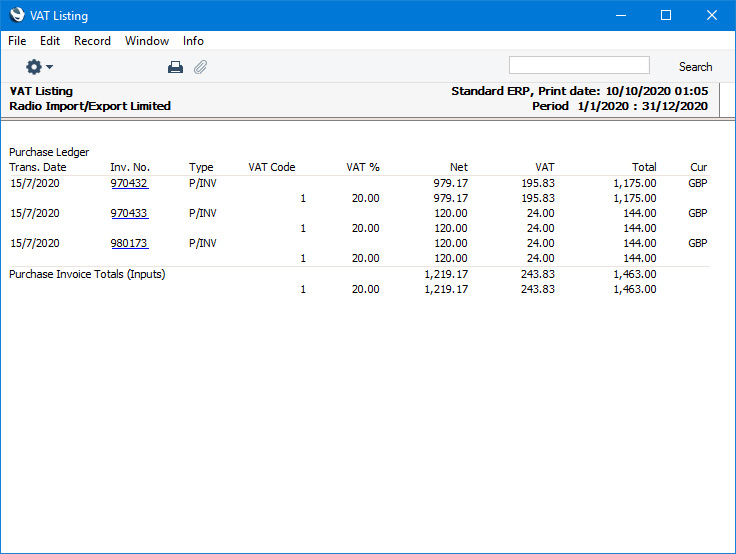
- Overview
Reports in the Nominal Ledger:
- Introduction
- Definition of Nominal Ledger Reports
- Drill-down
- The Operations Menu
- Account Reconciliation
- Accrual Report
- Analytical Balance
- Analytical Balance (Fiscal purposes)
- Balance Sheet
- Bank Reconciliation
- Bank Statement
- Bank Transactions
- Base Currency Rate Change
- Budget Journal
- Cash Flow
- Chart of Accounts
- Correction List
- Corresponding Accounts
- Creditors Account
- Currency A/C Rate Change
- Daily Balances
- Debtors Account
- Forward Balance Journal
- Income & Expense Book
- Key Financial Ratios
- Liquidity Forecast
- Multicurrency Accounts Rate Difference
- N/L Accrual Transactions
- N/L Transfer, Subsystems
- Nominal Ledger
- Profit & Loss
- Revised Budget Journal
- Simulation Journal
- Tag/Object Results
- Tag/Object/Quantity Results
- Tax Account Balances
- Tax Calculations
- Tax Transactions for Registers
- Template Transaction Journal
- Test Corresponding Rules
- Transaction Journal
- Transaction Summary
- Trial Balance
- VAT Listing
- VAT Report
- VAT Report Purchases
- VAT Report Sales
- VAT Transaction Journal
- XBRL Report
Go back to:
- Home page for Nominal Ledger manual
- Home page for Standard ERP manual
VAT Report
This page introduces the VAT Report in the Nominal Ledger.---
Whenever a VAT Return is due you should print a VAT Report. This report will act both as a transaction document for the ledger and as the basis for payment.
The VAT Report is fully user-definable. Using a typical report definition, the report will summarise the postings made to the Input and Output VAT Accounts during the specified period, and will also show the total Inputs (purchases) and Outputs (sales).
Once you have printed a VAT Return for a given period, it is recommended that you enter a Transaction in the Transaction register transferring the VAT amount payable/receivable into the VAT Payments Account (Account 835 in the Chart of Accounts supplied with Standard ERP). This Transaction would debit the VAT Outputs Payable Account (830) and credit the VAT Inputs Receivable Account (831), with a balancing posting to the VAT Payments Account. The date of this Transaction must be within the period it concerns, and preferably it should be the last Transaction of the period. You can then enter a second Transaction transferring the amount payable/receivable to your bank account when you issue or receive payment.
If your company has separate departments or subsidiary companies with different VAT Numbers, you will usually have separate Companies for each VAT entity in your database, or separate databases. You will therefore be able to print separate VAT Reports for each VAT entity from each Company or database. So, although the option is provided, you usually won't need to print different VAT Reports for specific Tags/Objects.
If you do need to print a VAT Report for a specific Tag/Object in a single Company, you should ensure that you are using the Tags/Objects on VAT Account options in the Account Usage S/L and Account Usage P/L settings. When a Nominal Ledger Transaction is created from a Sub System record (e.g. from an Invoice or Purchase Invoice), these options will cause any Tags/Objects used in the Sub System record to be attached to the VAT posting (as well as to the Sales and Cost Accounts). If you are not using these options, Tags/Objects will not be assigned to VAT postings and so the report will not be able to display the balances of the Output and Input VAT Accounts for particular Tags/Objects. You will also need to ensure you use the correct Tags/Objects when manually entering Transactions that post to the VAT Accounts.
Be careful if you are using hierarchical Tag/Object structures in a single Company. Producing separate VAT Returns for each Tag/Object will be prone to error because of the risk of double-counting as each posting can have more than one Tag/Object.
Please follow the links below for more details about the VAT Report:
- The Definition of the VAT Report
- Example VAT Report Definitions
- Printing the VAT Report
- Submitting the VAT Report electronically (UK only)
Reports in the Nominal Ledger:
- Introduction
- Definition of Nominal Ledger Reports
- Drill-down
- The Operations Menu
- Account Reconciliation
- Accrual Report
- Analytical Balance
- Analytical Balance (Fiscal purposes)
- Balance Sheet
- Bank Reconciliation
- Bank Statement
- Bank Transactions
- Base Currency Rate Change
- Budget Journal
- Cash Flow
- Chart of Accounts
- Correction List
- Corresponding Accounts
- Creditors Account
- Currency A/C Rate Change
- Daily Balances
- Debtors Account
- Forward Balance Journal
- Income & Expense Book
- Key Financial Ratios
- Liquidity Forecast
- Multicurrency Accounts Rate Difference
- N/L Accrual Transactions
- N/L Transfer, Subsystems
- Nominal Ledger
- Profit & Loss
- Revised Budget Journal
- Simulation Journal
- Tag/Object Results
- Tag/Object/Quantity Results
- Tax Account Balances
- Tax Calculations
- Tax Transactions for Registers
- Template Transaction Journal
- Test Corresponding Rules
- Transaction Journal
- Transaction Summary
- Trial Balance
- VAT Listing
- VAT Report
- VAT Report Purchases
- VAT Report Sales
- VAT Transaction Journal
- XBRL Report
Go back to:
- Home page for Nominal Ledger manual
- Home page for Standard ERP manual
VAT Report - Defining
This page describes the configuration of the VAT Report.---
Before producing a VAT Report for the first time, you should define how the figures in the report will be calculated and ensure the format of the report suits your specific requirements. This is known as "Defining" the VAT Report.
A file containing an example VAT Report definition is supplied with Standard ERP. If you want to use this example as a template for your own definitions, import the relevant file (named "UKACCS1.TXT" in the UK) as described on the Importing Set-up Data page.
To set or change the report definition of the VAT Report, first ensure you are in the Nominal Ledger. Then, if you are using WIndows or macOS, click (Windows/macOS) or tap (iOS/Android) the [Settings] button in the Navigation Centre. If you are using iOS or Android, select 'Settings' from the 'Tools' menu (with 'wrench' icon). Double-click 'Report Settings' in the subsequent list. Then highlight 'VAT Report' in the list on the left-hand side of the 'Report Settings' window and click or tap the [Definition] button. The 'VAT Report Definition: Inspect' window will be opened.
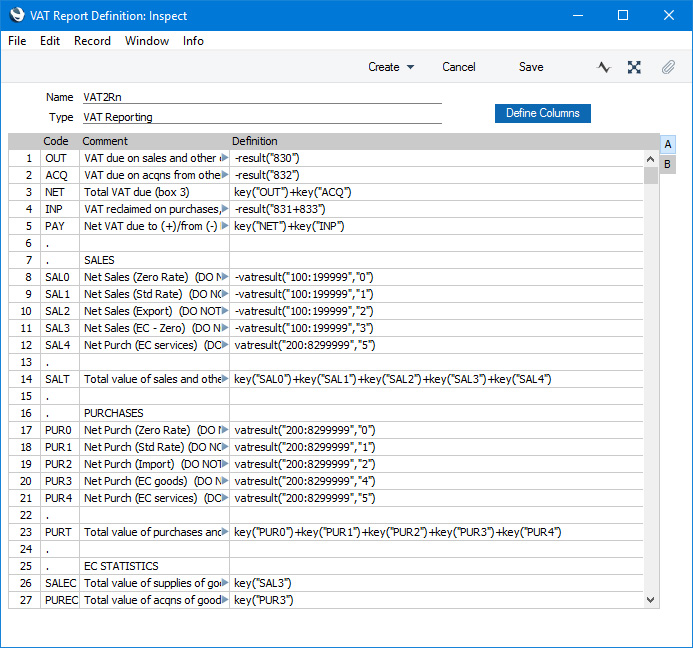
Each row in the definitions list will cause a line to be printed in the VAT Report, as shown in the illustration below:
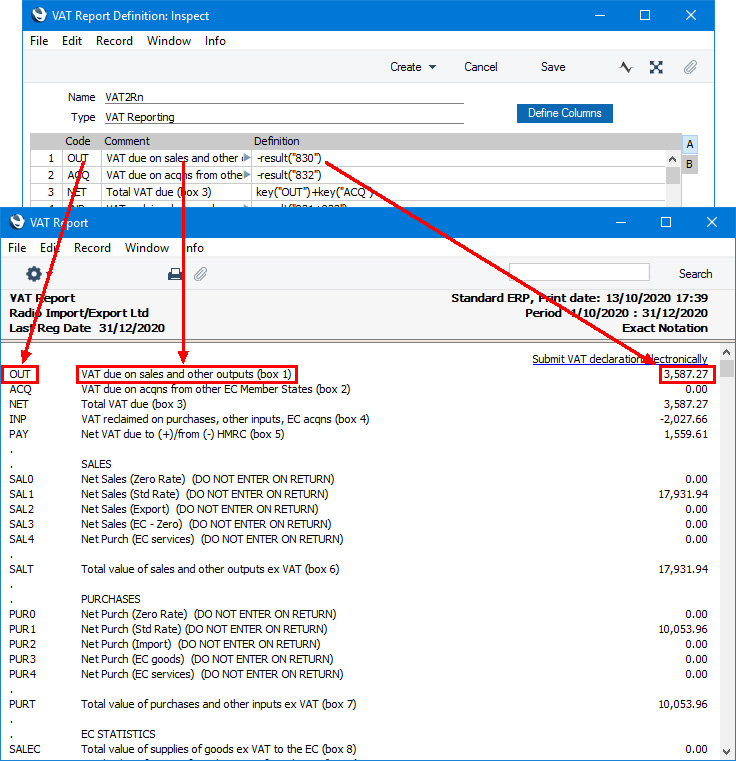
The fields in each row in the VAT Report definition are as follows:
- Code
- Enter a unique code to identify each a row. You can use the Code in the definitions in later rows, as shown in row 3 in the example illustrated.
- Comment
- Enter descriptive text to identify the line in the printed report.
- Definition
- The formula that will be used to calculate the figure that will be printed in the report.
- RESULT("Account Code")
- RESULT prints the net change during the period for the Account specified in the brackets. Some examples of the use of this command are as follows:
- RESULT("830")
- Prints the net change in Account 830 for the specified period. If Account 830 is the Output VAT Account, this will therefore return the output VAT total for the specified period.
- -RESULT("830")
- As the previous example, but the sign of the final figure is changed. This is useful when displaying figures for sales, which are stored as negative figures in Standard ERP. Prefixing the RESULT command with a minus sign will cause sales to be displayed as positive figures in the report.
- RESULT("830+832")
- Adds the net change in Account 830 to the net change in Account 832.
- RESULT("830")
- KEY("Code")
- KEY allows you to include the value of another Key Ratio in a calculation. You must already have defined the Key Ratio that you are referring to, otherwise the result will be a zero value. Therefore, in the example illustration above, the NET line (row 3) must appear below the OUT and ACQ lines (rows 1 and 2 respectively)
- Although the KEY command itself is not case sensitive, the reference to the other Key Ratio is. Thus, in the example illustration, you can use key("OUT") and KEY("OUT"), but not key("out").
- Although the KEY command itself is not case sensitive, the reference to the other Key Ratio is. Thus, in the example illustration, you can use key("OUT") and KEY("OUT"), but not key("out").
- VATRESULT("Account Code","VAT Code")
- VATRESULT is similar to RESULT, but in calculating the net change in the specified Account or Accounts over the specified period, only postings with the specified VAT Code will be taken into account.
- The reference to the VAT Code is not case sensitive.
- Some examples of the use of this command are as follows:
- VATRESULT("100";"1")
- Prints the net change in Account 100 for the specified period, only taking postings with VAT Code 1 into account. If Account 100 is a Sales Account, this will therefore return the total sales with VAT Code 1 posted to that Account during the specified period.
- -VATRESULT("100";"1")
- As the previous example, but the sign of the figure is changed.
- VATRESULT("100:1999";"1")
- Returns the sum of the net changes in Accounts 100 to 1999 for the specified period. The Accounts in the range will be determined using an alpha sort, rather than a numeric one. So, Account 1000001 will be included in the example range, while Account 200 will not. If all Sales Accounts are in the range 100:1999, this will therefore return the total sales with VAT Code 1 posted to all Sales Accounts during the specified period.
- In Transactions created from Sub Systems (e.g. Invoices and Purchase Invoices), the appropriate VAT Code will be copied to the V-Cd field in each Transaction row posting to a Sales or Cost Account. The V-Cd field is the mechanism that allows you to use the VATRESULT command with these Accounts. However, if you are using the Add VAT Code to VAT A/C rows option in the Transaction Settings setting, the appropriate VAT Code will be copied to the V-Cd field in each Transaction row posting to a VAT Account, as well as to the V-Cd field in the rows posting to a Sales or Cost Account. This will allow you to apply the VATRESULT command to the VAT Accounts (e.g. VATRESULT("830","1"), where Account 830 is the Output VAT Account).
- The reference to the VAT Code is not case sensitive.
- All parameters should now be enclosed in quotation marks. For example, you should change RESULT(830) to RESULT("830").
- The order of parameters for the VATRESULT, VATBALANCE, VATCREDRESULT and VATDEBRESULT commands has been transposed. For example, you should change VATRESULT(1,100:199) to VATRESULT("100:199","1").
---
Please follow the links below for more details about the VAT Report:
- Introduction to the VAT Report
- Definition of the VAT Report
- Example VAT Report Definitions
- Printing the VAT Report
- Submitting the VAT Report electronically (UK only)
Reports in the Nominal Ledger:
- Introduction
- Definition of Nominal Ledger Reports
- Drill-down
- The Operations Menu
- Account Reconciliation
- Accrual Report
- Analytical Balance
- Analytical Balance (Fiscal purposes)
- Balance Sheet
- Bank Reconciliation
- Bank Statement
- Bank Transactions
- Base Currency Rate Change
- Budget Journal
- Cash Flow
- Chart of Accounts
- Correction List
- Corresponding Accounts
- Creditors Account
- Currency A/C Rate Change
- Daily Balances
- Debtors Account
- Forward Balance Journal
- Income & Expense Book
- Key Financial Ratios
- Liquidity Forecast
- Multicurrency Accounts Rate Difference
- N/L Accrual Transactions
- N/L Transfer, Subsystems
- Nominal Ledger
- Profit & Loss
- Revised Budget Journal
- Simulation Journal
- Tag/Object Results
- Tag/Object/Quantity Results
- Tax Account Balances
- Tax Calculations
- Tax Transactions for Registers
- Template Transaction Journal
- Test Corresponding Rules
- Transaction Journal
- Transaction Summary
- Trial Balance
- VAT Listing
- VAT Report
- VAT Report Purchases
- VAT Report Sales
- VAT Transaction Journal
- XBRL Report
Go back to:
- Home page for Nominal Ledger manual
- Home page for Standard ERP manual
VAT Report - Example VAT Report Definitions
Please refer to the following pages for example VAT Report Definitions:More details about the VAT Report:
- Introduction
- Definition of the VAT Report
- Example VAT Report Definitions
- Printing the VAT Report
Reports in the Nominal Ledger:
- Introduction
- Definition of Nominal Ledger Reports
- Drill-down
- The Operations Menu
- Account Reconciliation
- Accrual Report
- Analytical Balance
- Analytical Balance (Fiscal purposes)
- Balance Sheet
- Bank Reconciliation
- Bank Statement
- Bank Transactions
- Base Currency Rate Change
- Budget Journal
- Cash Flow
- Chart of Accounts
- Correction List
- Corresponding Accounts
- Creditors Account
- Currency A/C Rate Change
- Daily Balances
- Debtors Account
- Forward Balance Journal
- Income & Expense Book
- Key Financial Ratios
- Liquidity Forecast
- Multicurrency Accounts Rate Difference
- N/L Accrual Transactions
- N/L Transfer, Subsystems
- Nominal Ledger
- Profit & Loss
- Revised Budget Journal
- Simulation Journal
- Tag/Object Results
- Tag/Object/Quantity Results
- Tax Account Balances
- Tax Calculations
- Tax Transactions for Registers
- Template Transaction Journal
- Test Corresponding Rules
- Transaction Journal
- Transaction Summary
- Trial Balance
- VAT Listing
- VAT Report
- VAT Report Purchases
- VAT Report Sales
- VAT Transaction Journal
- XBRL Report
Go back to:
- Home page for Nominal Ledger manual
- Home page for Standard ERP manual
VAT Report - Example VAT Report Definitions - Standard VAT
This page describes an example VAT Report definition that is suitable for use in the UK. Please refer to the following pages for more details about the VAT Report in Standard ERP:- Introduction
- Definition of the VAT Report
- Example VAT Report Definitions, including:
- Standard VAT
- Cash VAT
- Reverse Charge VAT
- Standard VAT
- Printing the VAT Report
A VAT Report definition suitable for use in the UK is illustrated below:
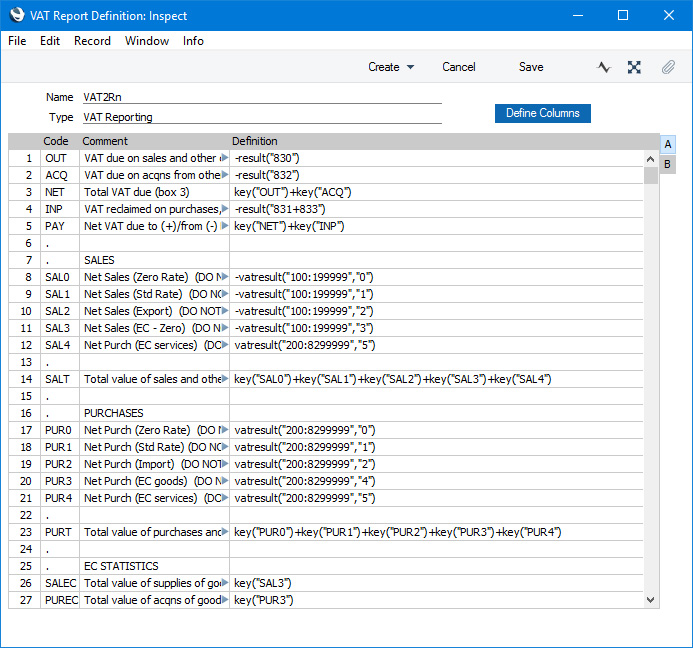
In more detail the calculations in this report definition are as follows:
| Row 1 OUT | -RESULT("830") | 830 is the Output VAT Account, so this row prints the total output VAT on domestic sales made during the report period. Sales figures are stored as negative figures in Standard ERP, so the negative sign will convert them to positive. This figure should be placed in Box 1 on the UK VAT Return. If you have more than one Output VAT Account, you can include them all in the formula (e.g. -RESULT("830+8300")), or you can print the net change in each Account on separate lines and then add them together using the KEY command. |
| Row 2 ACQ | -RESULT("832") | 832 is the Account for output VAT on EU acquisitions of goods, so this row will print the VAT due on acquisitions of goods from other EU member states. This figure should be placed in Box 2 on the UK VAT Return. Please refer to the Reverse Charge VAT example towards the end of this page for more details about EU acquisitions. |
| Row 3 NET | KEY("OUT")+KEY("ACQ") | Prints the total Output VAT due, calculated by adding the previous two figures together. This figure should be placed in Box 3 on the UK VAT Return. |
| Row 4 INP | -RESULT("831+833") | 831 is the Input VAT Account and 833 is the Account for input VAT on EU acquisitions of goods. This row will therefore print the VAT reclaimable on purchases and other inputs (including acquisitions from the EU). The result will be printed as a negative figure. This figure should be placed in Box 4 on the UK VAT Return. |
| Row 5 PAY | KEY("NET")+KEY("INP") | Prints the net VAT to be paid or reclaimed, calculated by adding the figure in row 3 to the (negative) figure in row 4. A positive figure indicates that you are liable for VAT, a negative one signifies that you are owed money by the VAT authority. This figure should be placed in Box 5 on the UK VAT Return. |
| Rows 8-12 SAL0-SAL4 | -VATRESULT("100:1999999","0") -VATRESULT("100:1999999","1") -VATRESULT("100:1999999","2") -VATRESULT("100:1999999","3") -VATRESULT("200:8299999","5") | Accounts 100:199 are the Sales Accounts. These rows print the total values of sales made with each VAT Code. If you sell non-digital services to customers in the EU who are not registered for VAT, you will need to charge VAT at the relevant domestic rate for the type of Item. Place these Customers in the Inside EU (Post VAT) Zone and use the standard VAT Code. This will ensure these sales will be included in the Box 1 figure (row 1) and in the relevant sales turnover figure here. Row 12 will print the value of purchases of services from Suppliers in the Inside EU Zone. This will ensure this figure is included in Box 6 (row 14 below). |
| Row 14 SALT | KEY("SAL0") + KEY("SAL1") + KEY("SAL2") + KEY("SAL3") + KEY("SAL4") | Prints the sum of rows 8-12 i.e. the total value of sales and all other outputs excluding VAT. This figure should be placed in Box 6 on the UK VAT Return. |
| Rows 17-21 PUR0-PUR4 | -VATRESULT("200:8299999","0") -VATRESULT("200:8299999","1") -VATRESULT("200:8299999","2") -VATRESULT("200:8299999","4") -VATRESULT("200:8299999","5") | Accounts 200:829 all represent items that can be purchased by the business. These rows print the total values of purchases made with each VAT Code. The range does not include the VAT Accounts (830:835). If you are using the Add VAT Code to VAT A/C rows option in the Transaction Settings setting, the appropriate VAT Code will be copied to the V-Cd field in each Transaction row posting to a VAT Account, as well as to the V-Cd field in the rows posting to a Sales or Cost Account. If the range included the VAT Accounts, the resulting figures would include VAT when they should exclude it. |
| Row 23 PURT | KEY("PUR0") + KEY("PUR1") + KEY("PUR2") + KEY("PUR3") + KEY("PUR4") | Prints the sum of rows 17-21 i.e. the total value of purchases and all other inputs excluding VAT. This figure should be placed in Box 7 on the UK VAT Return. |
| Row 26 SALEC | KEY("SAL3") | Prints the total value of sales made with VAT Code 3 i.e. the total value of sales to other EU member states. This assumes that sales made to other EU member states will always carry VAT Code 3, and that VAT Code 3 is not used for any other sales. This figure should be placed in Box 8 on the UK VAT Return. (Box 8 should not include sales of services, so a different VAT Code would need to be used for such sales.) |
| Row 27 PUREC | KEY("PUR3") | Prints the total value of purchases made with VAT Code 4 i.e. the total value of purchases of goods from other EU member states. This assumes that purchases of goods made from other EU member states will always carry VAT Code 4, and that VAT Code 4 is not used for any other purchases. This figure should be placed in Box 9 on the UK VAT Return. (Box 9 should not include purchases of services. In the example, VAT Code 5 would be used for such purchases.) |
As previously mentioned, the VAT Report definition illustrated and described above uses the Chart of Accounts and VAT Codes that are supplied with Standard ERP. You will need to amend the VAT Report definition (or start one from scratch) if you have modified the standard Chart of Accounts and/or VAT Codes, or created your own. For example, in the sample Chart of Accounts, the Output VAT Account is 830 and the standard VAT Code is 1. If your Output VAT Account is not 830 (e.g. it is 83010), you must replace every instance of "830" in the report definition with "83010". If your standard VAT Code is not 1 (e.g. it is S), you must replace every instance of "1" in the report definition with "S". It may be for example that you use different VAT Codes for sales and purchases.
Please follow the links below for more details about the VAT Report:
- Introduction to the VAT Report
- Definition of the VAT Report
- Example VAT Report Definitions, including:
- Standard VAT
- Cash VAT
- Reverse Charge VAT
- Standard VAT
- Printing the VAT Report
- Submitting the VAT Report electronically (UK only)
Reports in the Nominal Ledger:
- Introduction
- Definition of Nominal Ledger Reports
- Drill-down
- The Operations Menu
- Account Reconciliation
- Accrual Report
- Analytical Balance
- Analytical Balance (Fiscal purposes)
- Balance Sheet
- Bank Reconciliation
- Bank Statement
- Bank Transactions
- Base Currency Rate Change
- Budget Journal
- Cash Flow
- Chart of Accounts
- Correction List
- Corresponding Accounts
- Creditors Account
- Currency A/C Rate Change
- Daily Balances
- Debtors Account
- Forward Balance Journal
- Income & Expense Book
- Key Financial Ratios
- Liquidity Forecast
- Multicurrency Accounts Rate Difference
- N/L Accrual Transactions
- N/L Transfer, Subsystems
- Nominal Ledger
- Profit & Loss
- Revised Budget Journal
- Simulation Journal
- Tag/Object Results
- Tag/Object/Quantity Results
- Tax Account Balances
- Tax Calculations
- Tax Transactions for Registers
- Template Transaction Journal
- Test Corresponding Rules
- Transaction Journal
- Transaction Summary
- Trial Balance
- VAT Listing
- VAT Report
- VAT Report Purchases
- VAT Report Sales
- VAT Transaction Journal
- XBRL Report
Go back to:
- Home page for Nominal Ledger manual
- Home page for Standard ERP manual
VAT Report - Example VAT Report Definitions - Cash VAT
This page describes an example VAT Report definition that is suitable for use when using the Post Receipt VAT and Post Payment VAT options, with particular reference to the Cash VAT scheme in the UK. Please refer to the following pages for more details about the VAT Report in Standard ERP:- Introduction
- Definition of the VAT Report
- Example VAT Report Definitions, including:
- Standard VAT
- Cash VAT
- Reverse Charge VAT
- Standard VAT
- Printing the VAT Report
In some countries, you can account for output VAT on the basis of the payments you receive, rather than on the Invoices you issue. Similarly, you can account for input VAT on the basis of the payments you issue, rather than on the Purchase Invoices that you receive. This is sometimes known as accounting for VAT on a cash basis or, in the UK, Cash Accounting.
If you need to account for VAT on a cash basis, follow these steps:
- On the sales side, the Account Usage S/L contains two options that you should select, depending on your requirements:
- Select the Post Receipt VAT option if you need VAT to be posted from normal Receipts (i.e. Receipts in which you are receiving payment against Invoices) and On Account Receipts.
- Select the Post Prepayment VAT option if you would like VAT to be posted from Prepayment Receipts. You will also need to specify a Prepayment VAT Account in the same setting.
In the UK only (i.e. when the VAT Law in the Company Info setting is "Default"), you should also specify VAT Base and VAT Base Opposite Accounts. When an Invoice is paid, the VAT Base Account will be credited with the Invoice turnover (i.e. value excluding VAT). The V-Cd field in this posting will be filled in. The purpose of this posting is to allow the Invoice turnover to be added to the value of sales and all other outputs excluding VAT (the Box 6 figure on the UK VAT Return) on the payment date rather than on the Invoice Date. The purpose of the VAT Base Opposite Account is solely to balance the VAT Base Account.
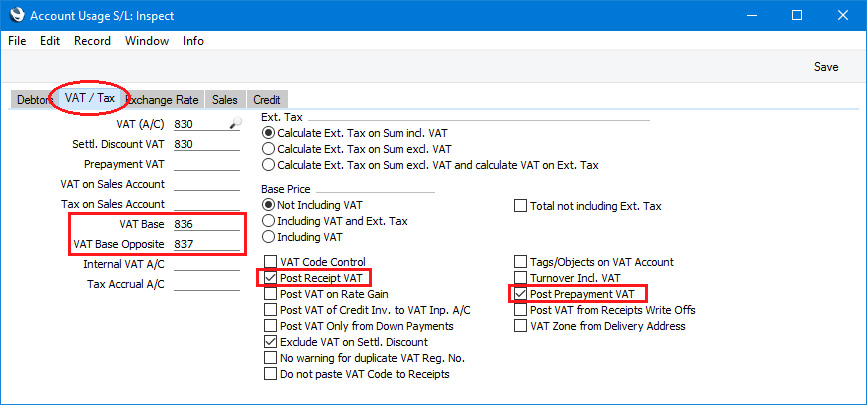
- Select the Post Receipt VAT option if you need VAT to be posted from normal Receipts (i.e. Receipts in which you are receiving payment against Invoices) and On Account Receipts.
- Similarly, on the purchase side, the Account Usage P/L contains two options that you should select, depending on your requirements:
- Select the Post Payment VAT option if you need VAT to be posted from normal Payments (i.e. Payments in which you are issuing payment against Purchase Invoices) and On Account Payments.
- Select one of the Post Prepayment VAT options if you would like VAT to be posted from Prepayment Payments. You will also need to specify On Account VAT and Prepayment VAT Accounts in the same setting and, depending on your requirements, you may also need to select the Prepayment amount excluding VAT option.
In the UK only, you should also specify VAT Base and VAT Base Opposite Accounts. When you pay a Purchase Invoice, the VAT Base Account will be debited with the Invoice turnover (i.e. value excluding VAT). The V-Cd field in this posting will be filled in. The purpose of this posting is to allow the Purchase Invoice turnover to be added to the value of purchases and all other inputs excluding VAT (the Box 7 figure on the UK VAT Return) on the payment date rather than on the Invoice Date. The purpose of the VAT Base Opposite Account is solely to balance the VAT Base Account.
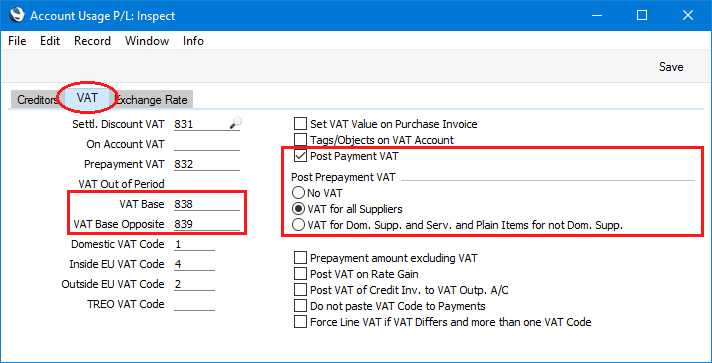
- Select the Post Payment VAT option if you need VAT to be posted from normal Payments (i.e. Payments in which you are issuing payment against Purchase Invoices) and On Account Payments.
- If you need to account for VAT on a cash basis, Sales Invoices will still post to an Output VAT Account as normal, and Purchase Invoices will still post to an Input VAT Account. However, these Accounts will now be treated as preliminary VAT Accounts. When a Customer pays an Invoice, the Transaction from the Receipt will include an extra VAT element in which the VAT is moved from the Output VAT Account to a final Account, known as the O/P Account. On the purchase side, when you pay a Purchase Invoice, the Transaction from the Payment will include an extra VAT element in which the VAT is moved from the Input VAT Account to a final Account, known as the I/P Account.
The next step is to specify the O/P and I/P Accounts, which you should do in the VAT Codes setting:
Note in the rows for VAT Codes 4 and 5 that the Output and O/P Accounts are the same, and the Input and I/P Accounts are the same. VAT Codes 4 and 5 are used for acquisitions from the EU, and in the UK such transactions cannot be included in the Cash Accounting scheme. Standard ERP still requires O/P and I/P Accounts to be specified: using the same Accounts in effect means that acquisition VAT will be immediately be posted to the final Account, without passing through a preliminary Account.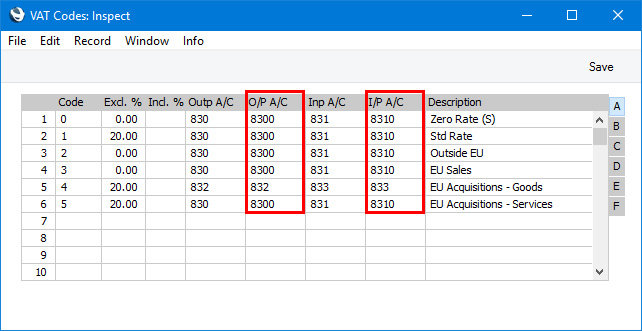
- Finally, you should make two changes to the definition of the VAT Report (in this example, we will add the changes to the example standard VAT Report definition described here). The first change is to ensure that the VAT to be paid or reclaimed will be calculated using the O/P and I/P Accounts instead of the Output and Input Accounts. In the illustration below, we have changed rows 1 and 4:
The second change is to ensure that the values of sales and purchases are calculated from the two VAT Base Accounts. Postings to the sales and cost Accounts should still be included in the calculations, because the value of Invoices that are Cash Notes (i.e. Invoices that are immediately paid and so will not have corresponding Receipts and Payments) will not be posted to the VAT Base Account: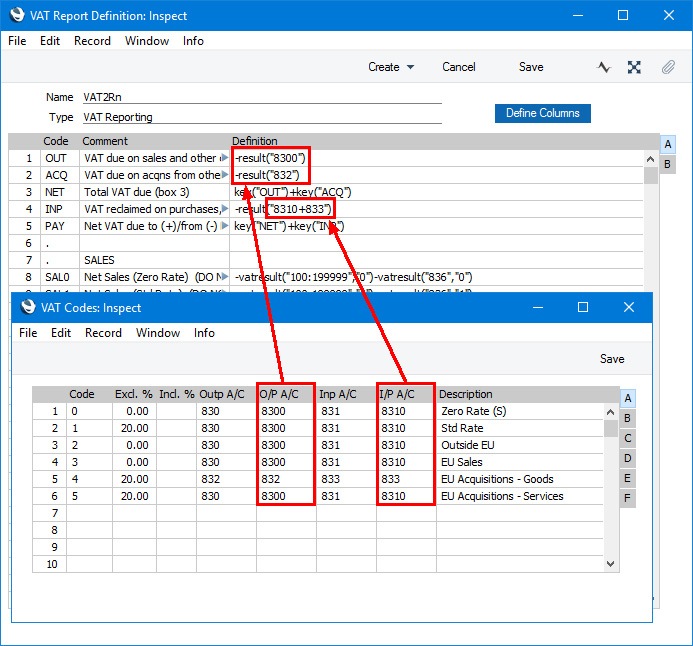
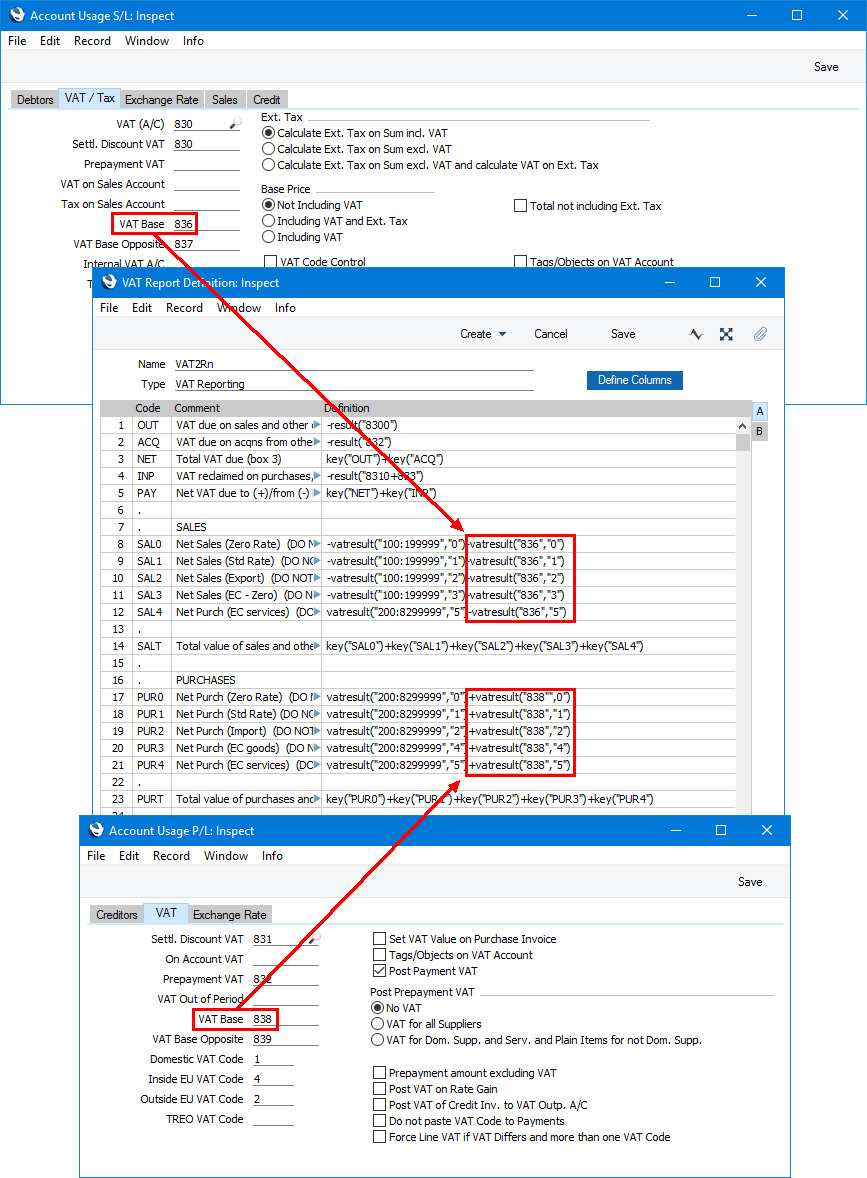
- Illustrated below is an example Invoice together with its Nominal Ledger Transaction. The VAT is posted to the Output Account as normal (row 3), but the posting to the Sales Account (row 2) does not include a VAT Code (V-Cd):
When the Customer pays the Invoice a month later, the Nominal Ledger Transaction shows the VAT being moved from the Output Account to the O/P Account. The sales value excluding VAT is credited to the VAT Base Account and debited to the VAT Base Opposite Account. The posting to the VAT Base Account includes the VAT Code: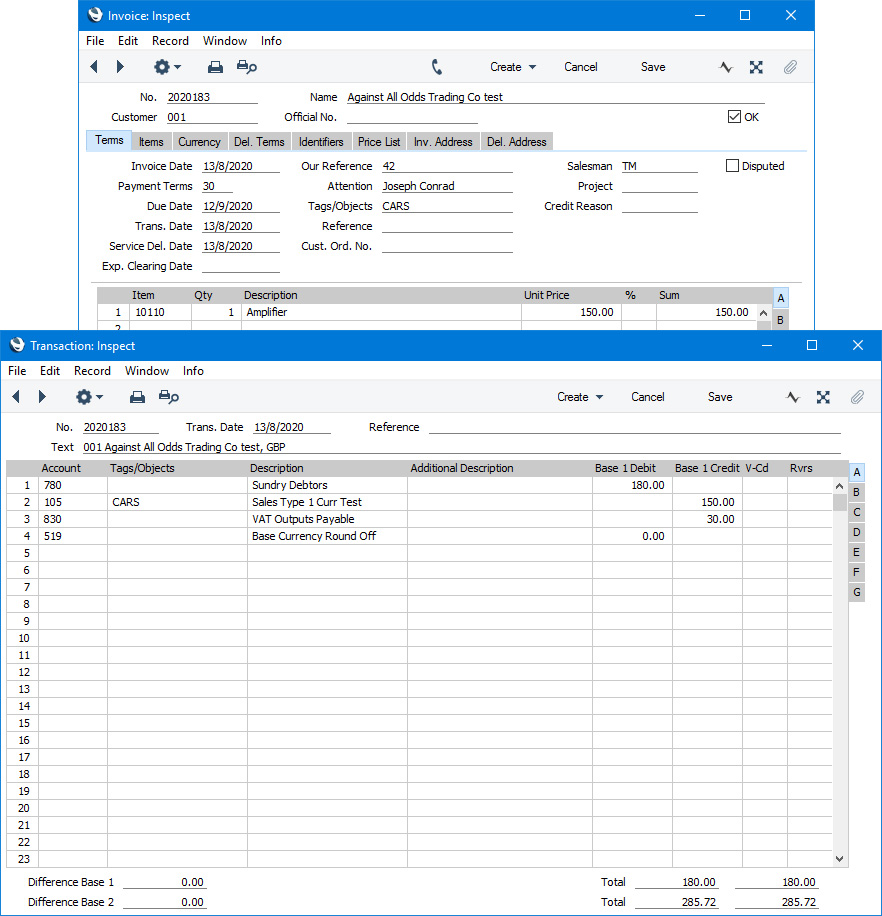
The VAT Report for the month when the Invoice was paid includes the VAT in the payable figure: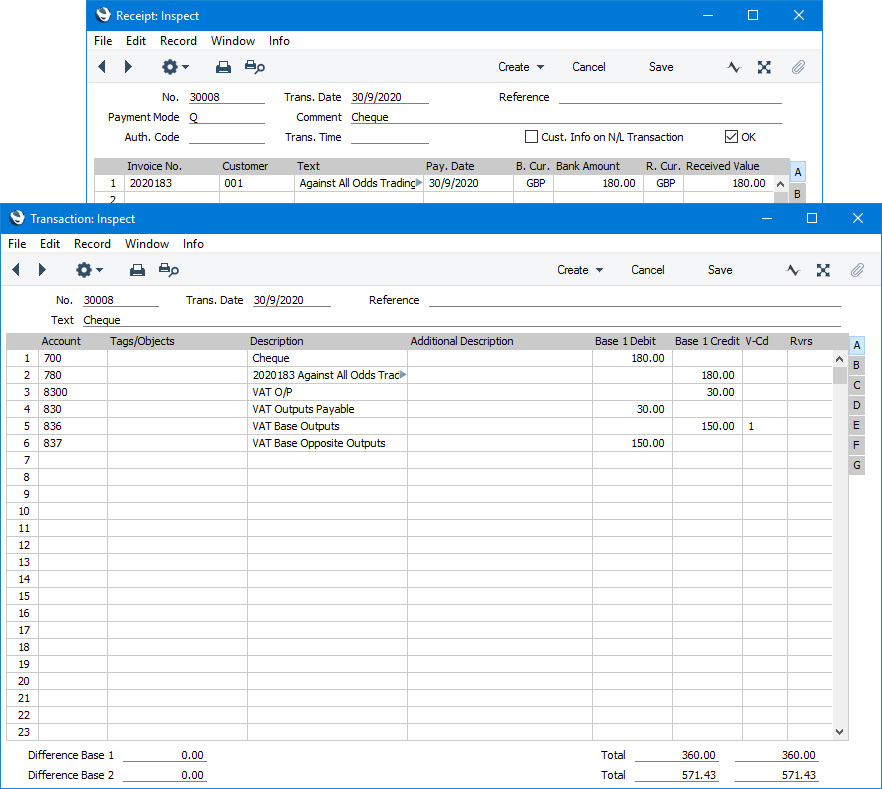
The value of the Invoice is included in rows 8-11 and 14 (SAL0-SAL3 and SALT). As previously described, these rows use the VATRESULT command to print the total values of sales and purchases made with each VAT Code. For example, VATRESULT("100";"1") will print the value of sales posted from Invoices to Account 100 with VAT Code 1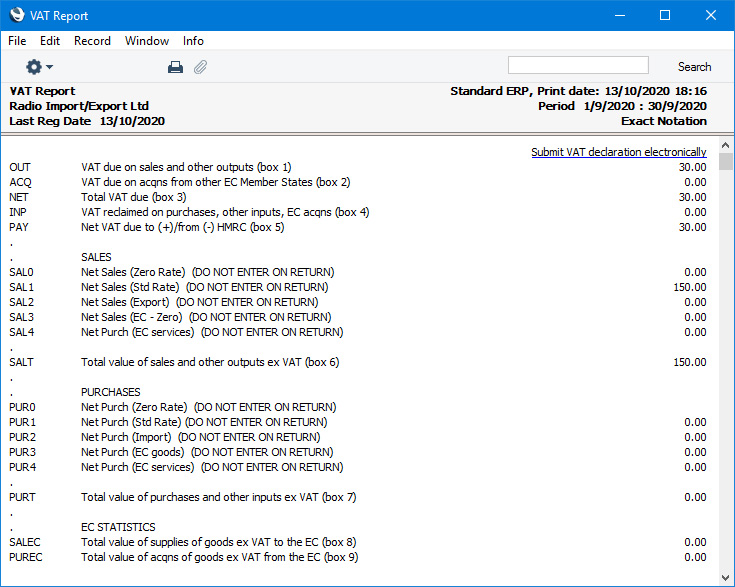
When you are accounting for VAT on a cash basis, you need to be able to establish the total value of sales and purchases by payment date, not by Invoice date. To this end, the VAT Code field in postings to Sales and Cost Accounts in Transactions created from Sales and Purchase Invoices will be empty. Transactions created from Receipts and Payments will include postings to VAT Base Accounts, and VAT Codes will be assigned to these postings. This allows you to use the VATRESULT command to establish the total value of sales and purchases by payment date.
- The next illustration shows an Invoice with a "Cash" Type Payment Term (i.e. a Cash Note) together with its Nominal Ledger Transaction. As the Invoice is a Cash Note there will be no Receipt, so the VAT is posted directly to the O/P Account (row 3) and the posting to the Sales Account (row 2) does include a VAT Code (V-Cd):
On recalculating the VAT Report previously illustrated, it will now include the Cash Note. The value of the Cash Note is included in rows 8-11 and 14 (SAL0-SAL3 and SALT because the figures in these rows are calculated by applying the VATRESULT command to the Sales Accounts as well as to the VAT Base Account: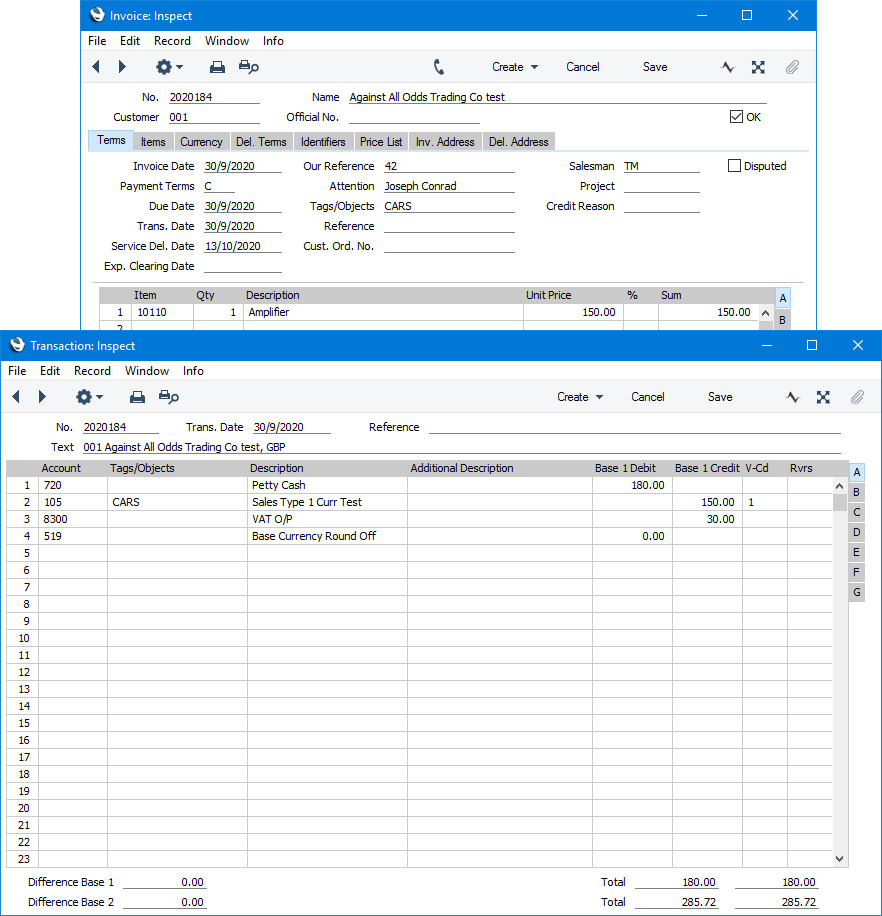
Please follow the links below for more details about the VAT Report: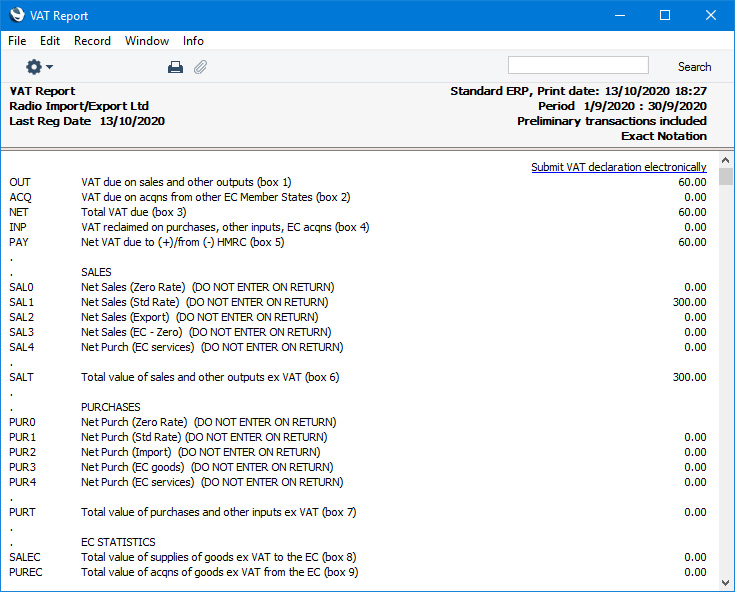
- Introduction to the VAT Report
- Definition of the VAT Report
- Example VAT Report Definitions, including:
- Standard VAT
- Cash VAT
- Reverse Charge VAT
- Standard VAT
- Printing the VAT Report
- Submitting the VAT Report electronically (UK only)
Reports in the Nominal Ledger:
- Introduction
- Definition of Nominal Ledger Reports
- Drill-down
- The Operations Menu
- Account Reconciliation
- Accrual Report
- Analytical Balance
- Analytical Balance (Fiscal purposes)
- Balance Sheet
- Bank Reconciliation
- Bank Statement
- Bank Transactions
- Base Currency Rate Change
- Budget Journal
- Cash Flow
- Chart of Accounts
- Correction List
- Corresponding Accounts
- Creditors Account
- Currency A/C Rate Change
- Daily Balances
- Debtors Account
- Forward Balance Journal
- Income & Expense Book
- Key Financial Ratios
- Liquidity Forecast
- Multicurrency Accounts Rate Difference
- N/L Accrual Transactions
- N/L Transfer, Subsystems
- Nominal Ledger
- Profit & Loss
- Revised Budget Journal
- Simulation Journal
- Tag/Object Results
- Tag/Object/Quantity Results
- Tax Account Balances
- Tax Calculations
- Tax Transactions for Registers
- Template Transaction Journal
- Test Corresponding Rules
- Transaction Journal
- Transaction Summary
- Trial Balance
- VAT Listing
- VAT Report
- VAT Report Purchases
- VAT Report Sales
- VAT Transaction Journal
- XBRL Report
Go back to:
- Home page for Nominal Ledger manual
- Home page for Standard ERP manual
VAT Report - Example VAT Report Definitions - Reverse Charge VAT
This page describes an example VAT Report definition that is suitable for use with Reverse Charge VAT. Please refer to the following pages for more details about the VAT Report in Standard ERP:
- Introduction
- Definition of the VAT Report
- Example VAT Report Definitions, including:
- Standard VAT
- Cash VAT
- Reverse Charge VAT
- Standard VAT
- Printing the VAT Report
- Submitting the VAT Report electronically (UK only)
In a normal transaction, the Supplier should account to the tax authorities for the VAT that is due on the supply. However, in certain situations, it is the Customer who must account for any VAT that is due. If you are the customer in such a situation, you will not pay VAT to the Supplier but instead will pay VAT to the tax authorities at the domestic rate that would apply had you purchased the Items from a local Supplier. This is sometimes known as the "reverse charge" procedure. You can reclaim this VAT, if the purchase relates to VAT taxable supplies that you will go on to make.
One situation when you need to use the reverse charge procedure is when you purchase Items from VAT-registered Suppliers in other countries in the EU. Items that you purchase from other countries in the EU are usually known as "acquisitions" or "arrivals" (the term "imports" usually refers to Items purchased from other countries outside the EU). One method for handling VAT on acquisitions using the reverse charge procedure is described below. An alternative method is to create Internal Invoices from Purchase Invoices for EU Acquisitions. Please refer here for more details.
To include EU Acquisition VAT in the VAT Report, follow these steps:
- In the VAT Codes setting in the Nominal Ledger, create two VAT Codes for VAT on EU Acquisitions. Two VAT Codes are needed because purchases of goods and purchases of services need to be reported differently on the UK VAT Return.
VAT Code 4 in the example illustration below will be used for purchases of goods. VAT will be debited to the Input Account in this VAT Code and credited to the Output Account. It is recommended that you use an Output Account that is not used in any other VAT Code.
VAT Code 5 in the example will be used for purchases of services. In this case, you can use the standard Output and Input Accounts (although you can use dedicated Accounts if you prefer).
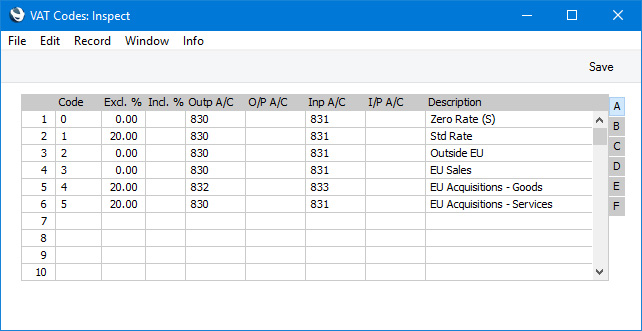
- In a Purchase Invoice for goods received from a Supplier in the Inside EU VAT Zone, enter the total charged by the Supplier (i.e. without VAT) in the TOTAL field and the Amounts in the rows using the VAT Code 4 from step 1. The Calculated VAT field in the footer will be updated automatically. In this example, the Currency in the Invoice is the Euro:
The VAT Code in each row will be chosen as follows: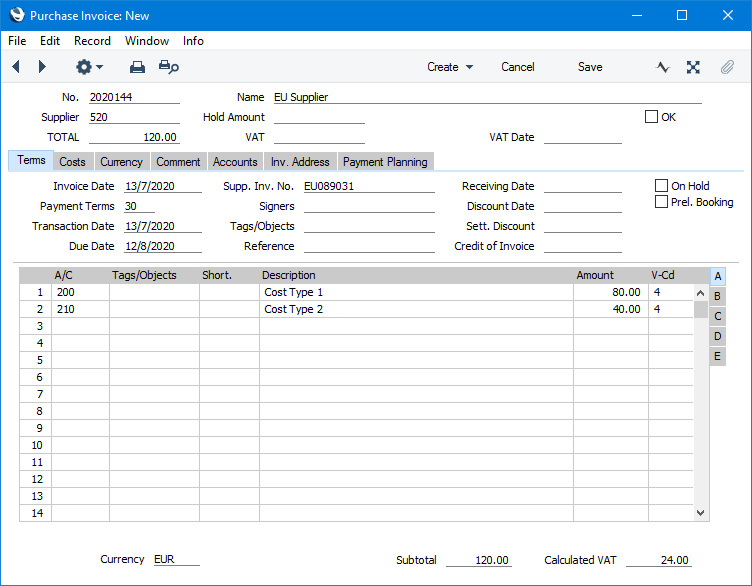
- The Purch. VAT Code for the Supplier will be used.
- It will be taken from the Account record.
- The VAT Code on the 'VAT' card of the Account Usage P/L setting will be used.
In the case of point (ii), you can only specify a single VAT Code in each Account record. It is therefore recommended that you use dedicated Accounts for purchases of goods from the EU, to ensure that the correct VAT Code will be offered as the default. If you use the same Account for non-EU and EU purchases, there is a risk that the wrong VAT Code will be offered by default and that you don't change it.
In the last case, the appropriate VAT Code for the Zone of the Supplier will be used.
- The Purch. VAT Code for the Supplier will be used.
- When you mark the Purchase Invoice as OK and save it, the total charged by the Supplier will be posted to the Creditor Account. Because the Supplier is in the Inside EU VAT Zone, VAT will be debited to the Input Account of the selected VAT Code and credited to the Output Account (EUR figures are shown in the Base 2 Debit and Credit fields, with figures in Base Currency 1 in the Base 1 Debit and Credit fields):
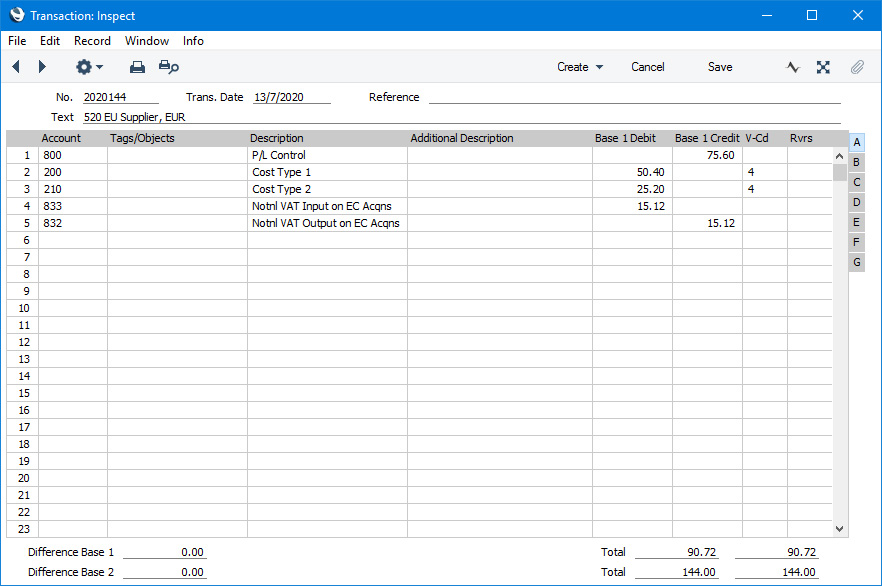
- In the VAT report, you will need to include acquisition VAT when calculating the output VAT that is payable. You will also be able to include it when calculating the input VAT that is reclaimable, if the acquisitions relate to VAT taxable supplies that you make.
In the UK, the output VAT payable on EU goods acquisitions should be included in the VAT report as a separate figure. This has been done in row 2 in the example VAT Report definition illustrated below. In this row, the RESULT command will return the net change in the Output VAT Account used in VAT Code 4, hence the recommendation that this be an Output Account that is not used in any other VAT Code. From there the output VAT will be included in the total output VAT figure in row 3.
It is not necessary to include the input VAT as a separate figure. So, in row 4 the RESULT of the Input VAT Account has been added to that of the domestic Input VAT Account to produce a total figure.
Row 20 uses the VATRESULT command to print the total value of EU acquisitions with VAT Code 4. This figure is then used in rows 23 and 27 (Boxes 7 and 9 on the UK VAT Return).
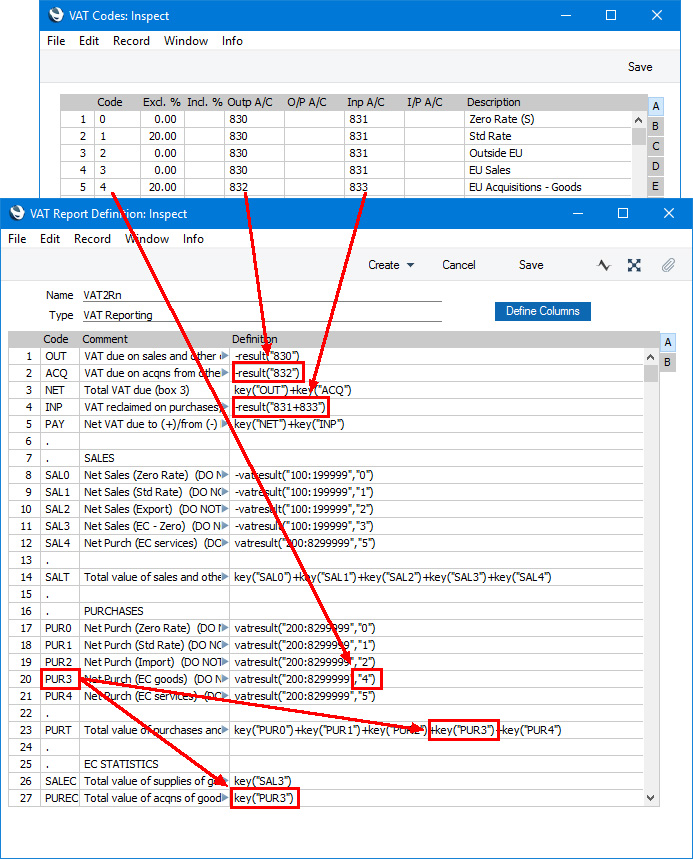
- Using this definition, the Purchase Invoice illustrated above will be included in the VAT Report as shown below:
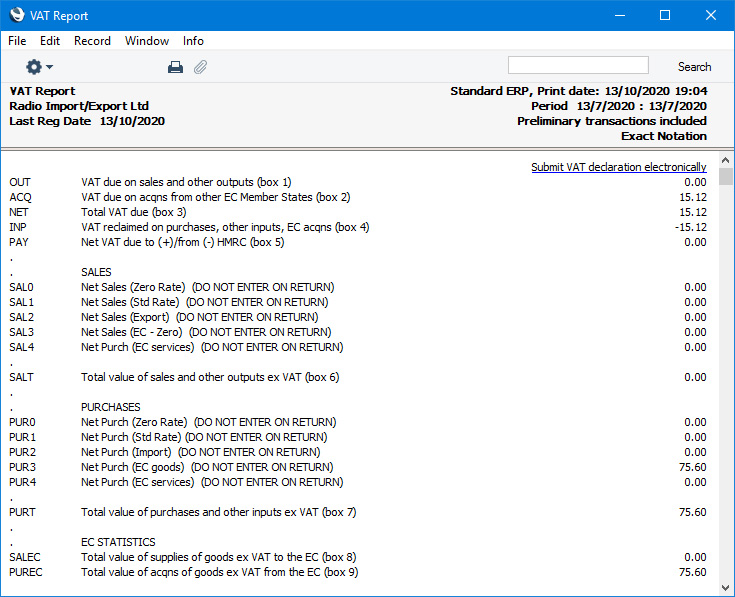
Follow these steps:
- The procedure for entering a Purchase Invoice for services is the same as that for entering a Purchase Invoice for goods. Enter the total charged by the Supplier (i.e. without VAT) in the TOTAL field and the Amounts in the rows using VAT Code 5. Again, it is therefore recommended that you use dedicated Accounts for purchases of services from the EU, to ensure that the correct VAT Code will be offered as the default. The Calculated VAT field in the footer will be updated automatically. In this example, the Currency in the Invoice is the Euro:
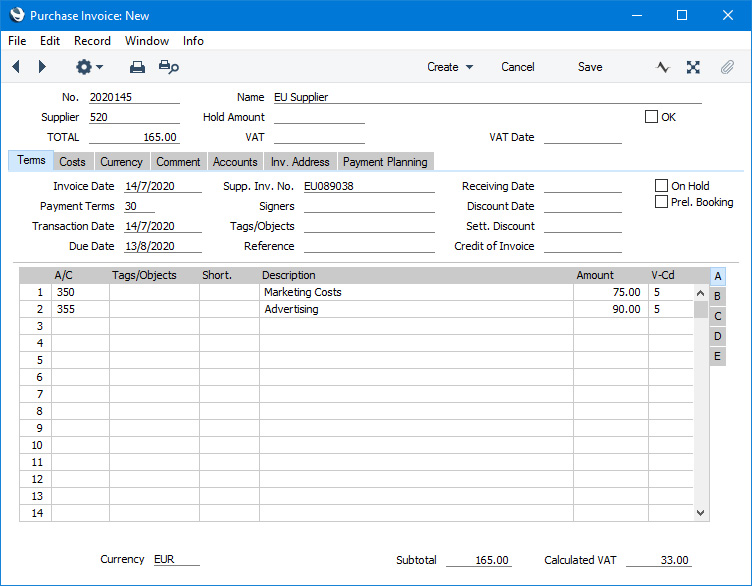
- When you mark the Purchase Invoice as OK and save it, the total charged by the Supplier will be posted to the Creditor Account. Because the Supplier is in the Inside EU VAT Zone, VAT will be debited to the Input Account of the selected VAT Code and credited to the Output Account (EUR figures are shown in the Base 2 Debit and Credit fields, with figures in Base Currency 1 in the Base 1 Debit and Credit fields):
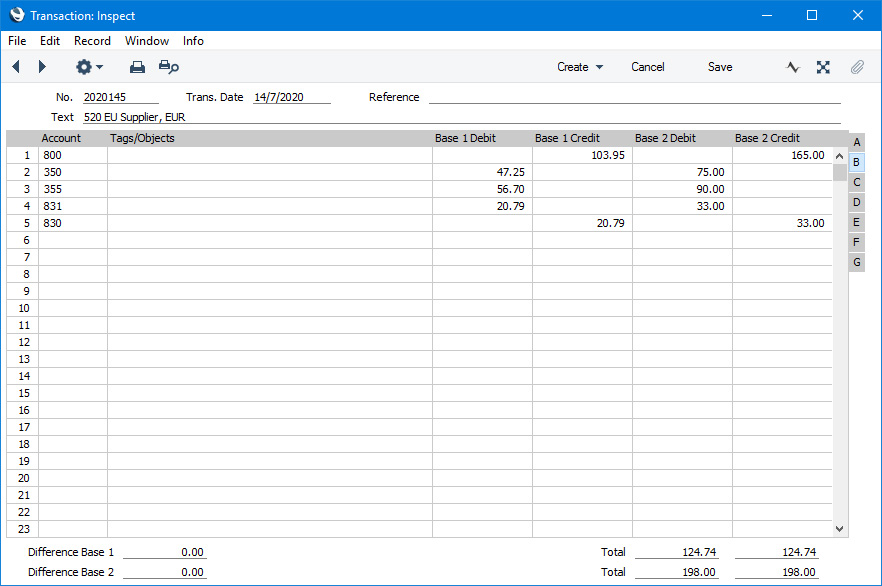
- In the VAT report, you will need to include acquisition VAT when calculating the output VAT that is payable. You will also be able to include it when calculating the input VAT that is reclaimable, if the acquisitions relate to VAT taxable supplies that you make. In this respect, reporting services is similar to reporting goods.
However, in the UK, the output VAT payable on EU services acquisitions should not be included in the VAT report as a separate figure (unlike EU goods acquisitions) i.e. it should be included in box 1 in the UK VAT Return and not box 2. As with goods, the input VAT should be included in box 4. This allows you to use the standard Output and Input Accounts, as in this example. You can use dedicated Accounts if you prefer, but if you do, be sure to include them in the RESULT commands that calculate the Output VAT and Input VAT totals in your VAT Report Definition (rows 1 and 4 in the example).
Purchase of services from Suppliers in the EU VAT Zone need to be included in both the sales totals and the purchase totals on the UK VAT Return (boxes 6 and 7). Using a dedicated VAT Code (VAT Code 5 in the example) will allow you to do this. Rows 12 and 21 in the example VAT Report definition use the VATRESULT command to print the total value of EU acquisitions with VAT Code 5. This figure is then used in rows 14 and 23.
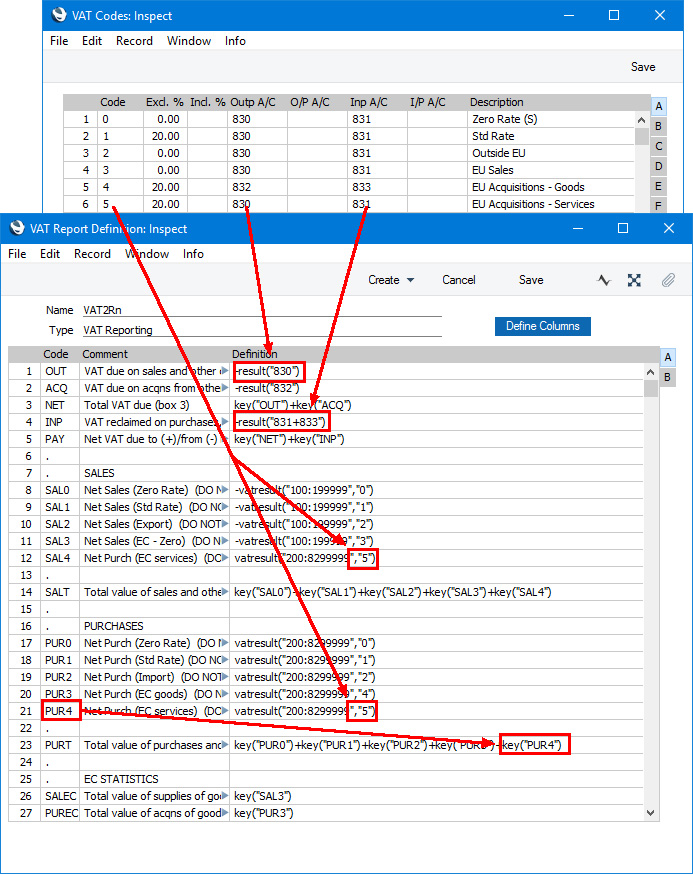
- Using this definition, the Purchase Invoice illustrated above will be included in the VAT Report as shown below:
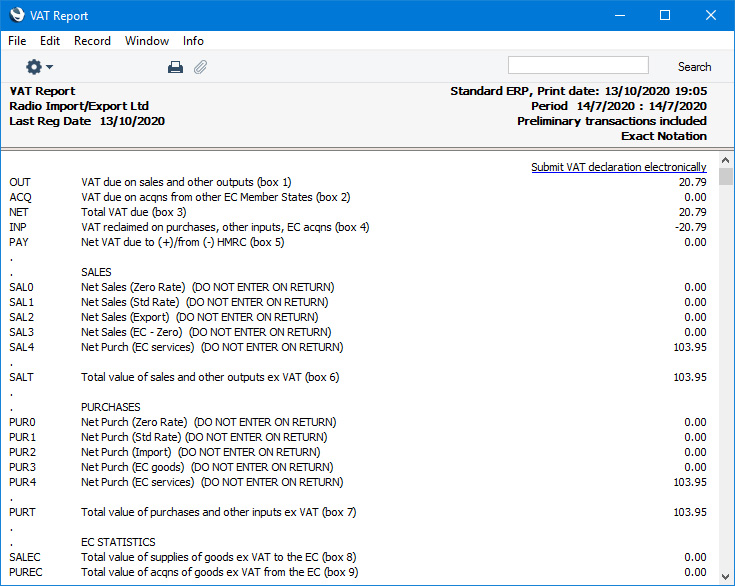
- Create a new record in the Tax Rules setting in the Nominal Ledger. In the VAT Type field, choose "Reversed" using 'Paste Special':
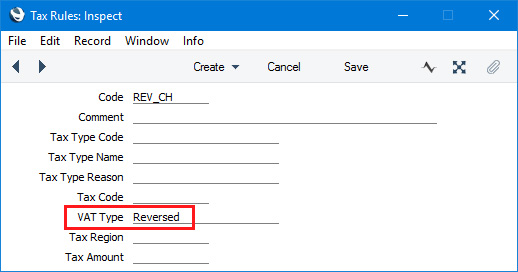
- In the VAT Codes setting, create a VAT Code for reverse charge VAT. Specify Input and Output Accounts and the VAT rate and, in the Tax Rules field on flip B, enter the Tax Rule record that you created in step 10:
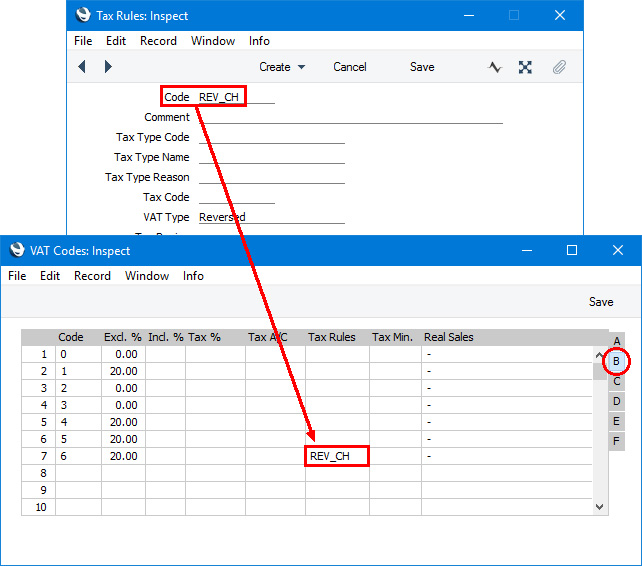
- In a Purchase Invoice that is to be subject to the reverse charge procedure, enter the total charged by the Supplier (i.e. without VAT) in the TOTAL field and the Amounts in the rows using the VAT Code from step 11:
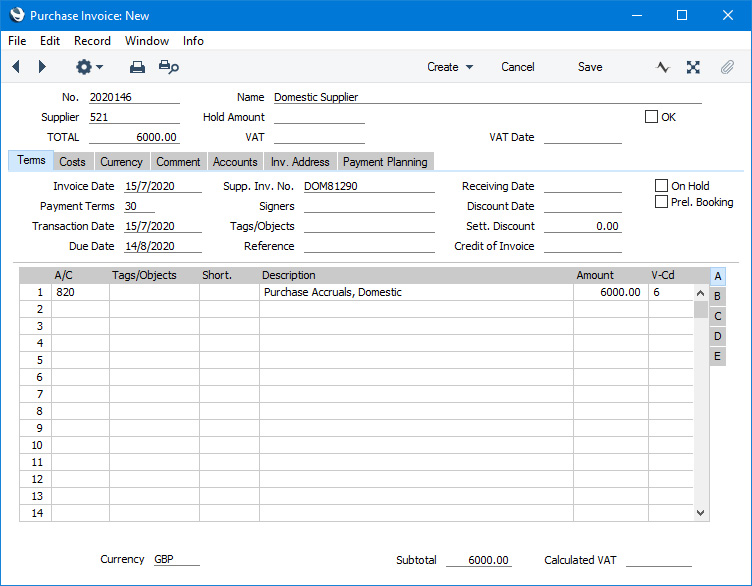
- When you mark the Purchase Invoice as OK and save it, the total charged by the Supplier will be posted to the Creditor Account. Because the Tax Rule in the VAT Code is "Reversed", VAT will be debited to the Input Account of the selected VAT Code and credited to the Output Account, and the VAT Code will be placed in the Rvrs field in the row posting to the Cost Account instead of the V-Cd field:
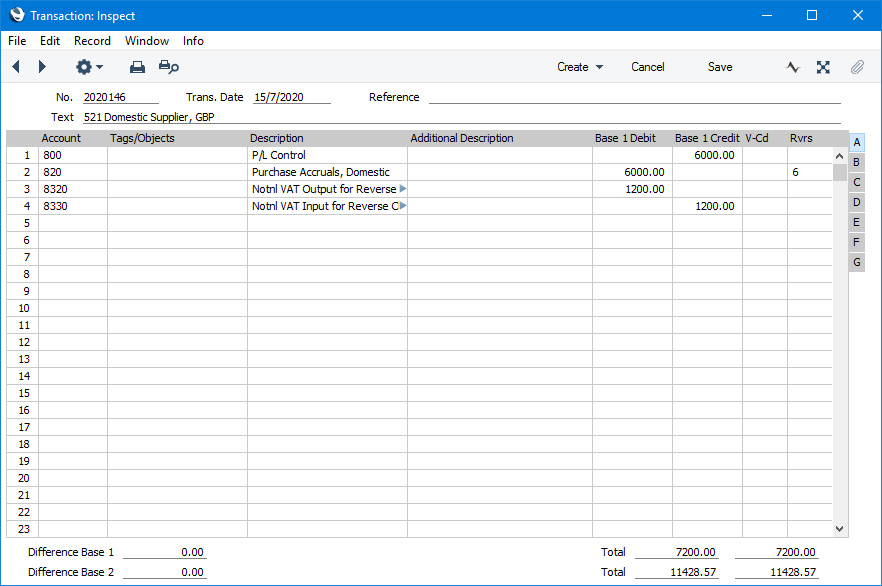
- In the VAT report, you will need to include reverse charge VAT when calculating the output VAT that is payable. Subject to the normal rules, you will also be able to include it when calculating the input VAT that is reclaimable.
In the UK, you must include the output tax payable on purchases under the reverse charge in the output VAT total (box 1 in the UK VAT Return). This has been done in row 1 in the example VAT Report definition illustrated below. In this row, the RESULT command will return the total net change in the standard Output VAT Account (Account 830) and in the Output VAT Account used in VAT Code 6 (Account 8320). From there the output VAT will be included in the total output VAT figure in row 3.
You should not include the VAT exclusive value of the purchases (box 6 on the UK VAT Return). So, rows 8-12 do not include a VATRESULT calculation for VAT Code 6.
If you will reclaim input VAT, you should include it in the input VAT total. In row 4 the RESULT of the Input VAT Account has been added to those of the domestic Input VAT Account and the EU Acquisitions Input Account to produce a total figure.
Row 22 uses the VATRESULT command to calculate the total value of reverse charge purchases with VAT Code 5 (in calculating this figure, VATRESULT will check both the V-Cd and Rvrs fields in Transaction rows). This figure is then used in row 24 (Box 7 on the UK VAT Return).
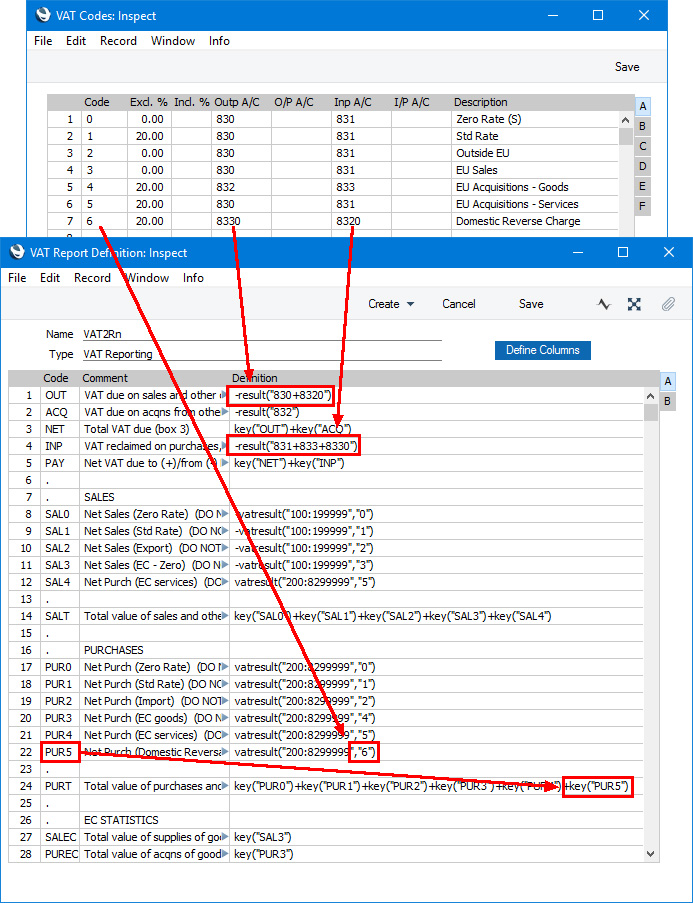
- Using this definition, the Purchase Invoice illustrated above will be included in the VAT Report as shown below:
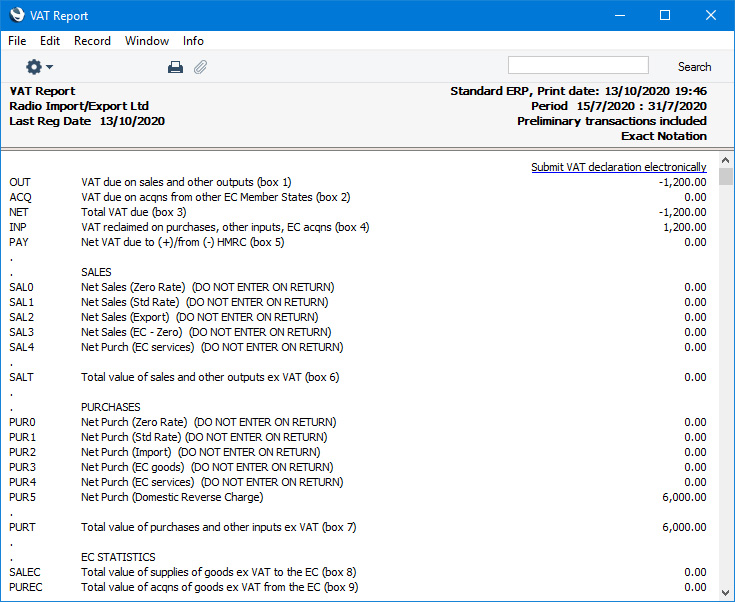
- Introduction to the VAT Report
- Definition of the VAT Report
- Example VAT Report Definitions, including:
- Standard VAT
- Cash VAT
- Reverse Charge VAT
- Standard VAT
- Printing the VAT Report
- Submitting the VAT Report electronically (UK only)
Reports in the Nominal Ledger:
- Introduction
- Definition of Nominal Ledger Reports
- Drill-down
- The Operations Menu
- Account Reconciliation
- Accrual Report
- Analytical Balance
- Analytical Balance (Fiscal purposes)
- Balance Sheet
- Bank Reconciliation
- Bank Statement
- Bank Transactions
- Base Currency Rate Change
- Budget Journal
- Cash Flow
- Chart of Accounts
- Correction List
- Corresponding Accounts
- Creditors Account
- Currency A/C Rate Change
- Daily Balances
- Debtors Account
- Forward Balance Journal
- Income & Expense Book
- Key Financial Ratios
- Liquidity Forecast
- Multicurrency Accounts Rate Difference
- N/L Accrual Transactions
- N/L Transfer, Subsystems
- Nominal Ledger
- Profit & Loss
- Revised Budget Journal
- Simulation Journal
- Tag/Object Results
- Tag/Object/Quantity Results
- Tax Account Balances
- Tax Calculations
- Tax Transactions for Registers
- Template Transaction Journal
- Test Corresponding Rules
- Transaction Journal
- Transaction Summary
- Trial Balance
- VAT Listing
- VAT Report
- VAT Report Purchases
- VAT Report Sales
- VAT Transaction Journal
- XBRL Report
Go back to:
- Home page for Nominal Ledger manual
- Home page for Standard ERP manual
VAT Report - Printing
This page describes printing the VAT Report.
---
Having entered a definition for the VAT Report as described here, you will be ready to print the report. Ensure you are in the Nominal Ledger, click (Windows/macOS) or tap (iOS/Android) the [Reports] button in the Navigation Centre and then double-click or tap 'VAT Report' in the 'Reports' list. The 'Specify VAT Report' window is opened.
- Period
- Paste Special
Reporting Periods setting, System module
- Enter the report period.
- If you are using the Leading Zero before Day, Leading Zero before Month and/or Century options in your Date and Numeric Format, you do not need to type the leading zeros or the century digits as these will be inserted automatically. For example, if you type "1-1-20", this will be converted to "01-01-2020" automatically (if you are using all three of the options mentioned).
- The first period in the Reporting Periods setting will be offered as the default value.
- If you are using the Leading Zero before Day, Leading Zero before Month and/or Century options in your Date and Numeric Format, you do not need to type the leading zeros or the century digits as these will be inserted automatically. For example, if you type "1-1-20", this will be converted to "01-01-2020" automatically (if you are using all three of the options mentioned).
- Tag/Object
- Paste Special
Tag/Object register, Nominal Ledger/System module
- Specify a Tag/Object if you want the figures in the report to be calculated from Transaction rows featuring a particular Tag/Object. If you enter a number of Tags/Objects separated by commas, only those Transaction rows featuring all the Tags/Objects listed will be included in the calculations.
- If you need to print a VAT Report for a specific Tag/Object, you should ensure that you are using the Tags/Objects on VAT Account options in the Account Usage S/L and Account Usage P/L settings. When a Nominal Ledger Transaction is created from a Sub System record (e.g. from an Invoice or Purchase Invoice), these options will cause any Tags/Objects used in the Sub System record to be attached to the VAT posting (as well as to the Sales and Cost Accounts). If you are not using these options, Tags/Objects will not be assigned to VAT postings and so the report will not be able to display the balances of the Output and Input VAT Accounts for particular Tags/Objects. You will also need to ensure you use the correct Tags/Objects when manually entering Transactions that post to the VAT Accounts.
- If you need to print a VAT Report for a specific Tag/Object, you should ensure that you are using the Tags/Objects on VAT Account options in the Account Usage S/L and Account Usage P/L settings. When a Nominal Ledger Transaction is created from a Sub System record (e.g. from an Invoice or Purchase Invoice), these options will cause any Tags/Objects used in the Sub System record to be attached to the VAT posting (as well as to the Sales and Cost Accounts). If you are not using these options, Tags/Objects will not be assigned to VAT postings and so the report will not be able to display the balances of the Output and Input VAT Accounts for particular Tags/Objects. You will also need to ensure you use the correct Tags/Objects when manually entering Transactions that post to the VAT Accounts.
- Values in
- If you are using the Dual-Base system, use these options to specify whether you would like all values in the report to be expressed in Base Currency 1 or Base Currency 2.
- If you are not using the Dual-Base system, use the Base Currency 1 option to produce a report in your home Currency.
- If you are not using the Dual-Base system, use the Base Currency 1 option to produce a report in your home Currency.
- Including Simulations
- Use this option if you would like Simulations to be included in the report. Simulation rows in which the Status is "Invalid" and "Transferred" will not be included.
- List Transactions
- If you select this option, the Transaction Numbers of all Transactions that fall within the reporting period, together with debit and credit totals, will be listed at the end of the report.
- No Header
- Select this option if you want the report to be printed without a header.
---
Please follow the links below for more details about the VAT Report:
- Introduction to the VAT Report
- Definition of the VAT Report
- Example VAT Report Definitions
- Printing the VAT Report
- Submitting the VAT Report electronically (UK only)
Reports in the Nominal Ledger:
- Introduction
- Definition of Nominal Ledger Reports
- Drill-down
- The Operations Menu
- Account Reconciliation
- Accrual Report
- Analytical Balance
- Analytical Balance (Fiscal purposes)
- Balance Sheet
- Bank Reconciliation
- Bank Statement
- Bank Transactions
- Base Currency Rate Change
- Budget Journal
- Cash Flow
- Chart of Accounts
- Correction List
- Corresponding Accounts
- Creditors Account
- Currency A/C Rate Change
- Daily Balances
- Debtors Account
- Forward Balance Journal
- Income & Expense Book
- Key Financial Ratios
- Liquidity Forecast
- Multicurrency Accounts Rate Difference
- N/L Accrual Transactions
- N/L Transfer, Subsystems
- Nominal Ledger
- Profit & Loss
- Revised Budget Journal
- Simulation Journal
- Tag/Object Results
- Tag/Object/Quantity Results
- Tax Account Balances
- Tax Calculations
- Tax Transactions for Registers
- Template Transaction Journal
- Test Corresponding Rules
- Transaction Journal
- Transaction Summary
- Trial Balance
- VAT Listing
- VAT Report
- VAT Report Purchases
- VAT Report Sales
- VAT Transaction Journal
- XBRL Report
Go back to:
- Home page for Nominal Ledger manual
- Home page for Standard ERP manual
VAT Report Purchases
The VAT Report Purchases report, which can also be found in the Purchase Ledger, satisfies a specific requirement for a monthly VAT report in Poland. Please refer to your HansaWorld representative for more details.
---
Reports in the Nominal Ledger:
- Introduction
- Definition of Nominal Ledger Reports
- Drill-down
- The Operations Menu
- Account Reconciliation
- Accrual Report
- Analytical Balance
- Analytical Balance (Fiscal purposes)
- Balance Sheet
- Bank Reconciliation
- Bank Statement
- Bank Transactions
- Base Currency Rate Change
- Budget Journal
- Cash Flow
- Chart of Accounts
- Correction List
- Corresponding Accounts
- Creditors Account
- Currency A/C Rate Change
- Daily Balances
- Debtors Account
- Forward Balance Journal
- Income & Expense Book
- Key Financial Ratios
- Liquidity Forecast
- Multicurrency Accounts Rate Difference
- N/L Accrual Transactions
- N/L Transfer, Subsystems
- Nominal Ledger
- Profit & Loss
- Revised Budget Journal
- Simulation Journal
- Tag/Object Results
- Tag/Object/Quantity Results
- Tax Account Balances
- Tax Calculations
- Tax Transactions for Registers
- Template Transaction Journal
- Test Corresponding Rules
- Transaction Journal
- Transaction Summary
- Trial Balance
- VAT Listing
- VAT Report
- VAT Report Purchases
- VAT Report Sales
- VAT Transaction Journal
- XBRL Report
Go back to:
- Home page for Nominal Ledger manual
- Home page for Standard ERP manual
VAT Report Sales
The VAT Report Sales report, which can also be found in the Sales Ledger, satisfies a specific requirement for a monthly VAT report in Poland. Please refer to your HansaWorld representative for more details.
---
Reports in the Nominal Ledger:
- Introduction
- Definition of Nominal Ledger Reports
- Drill-down
- The Operations Menu
- Account Reconciliation
- Accrual Report
- Analytical Balance
- Analytical Balance (Fiscal purposes)
- Balance Sheet
- Bank Reconciliation
- Bank Statement
- Bank Transactions
- Base Currency Rate Change
- Budget Journal
- Cash Flow
- Chart of Accounts
- Correction List
- Corresponding Accounts
- Creditors Account
- Currency A/C Rate Change
- Daily Balances
- Debtors Account
- Forward Balance Journal
- Income & Expense Book
- Key Financial Ratios
- Liquidity Forecast
- Multicurrency Accounts Rate Difference
- N/L Accrual Transactions
- N/L Transfer, Subsystems
- Nominal Ledger
- Profit & Loss
- Revised Budget Journal
- Simulation Journal
- Tag/Object Results
- Tag/Object/Quantity Results
- Tax Account Balances
- Tax Calculations
- Tax Transactions for Registers
- Template Transaction Journal
- Test Corresponding Rules
- Transaction Journal
- Transaction Summary
- Trial Balance
- VAT Listing
- VAT Report
- VAT Report Purchases
- VAT Report Sales
- VAT Transaction Journal
- XBRL Report
Go back to:
- Home page for Nominal Ledger manual
- Home page for Standard ERP manual
VAT Transaction Journal
This page describes the VAT Transaction Journal report in the Nominal Ledger.
---
The VAT Transaction Journal is a list of journal postings (i.e. Transaction rows) that have VAT Codes. The list is sorted by Account and then by date. The report shows the Transaction Number (including fiscal year or Sub System prefix), the debit or credit value (with debits being shown as negative, the VAT value and total. This report should not be used if it will include Transaction rows with reverse VAT (e.g. in Transactions created from Purchase Invoices for goods in the Inside EU VAT Zone).
When printed to screen, the VAT Transaction Journal has the Standard ERP Drill-down feature. Click (Windows/macOS) or tap (iOS/Android) an Account Number in the report to open an Account record, or on a Transaction Number to open an individual Transaction record.
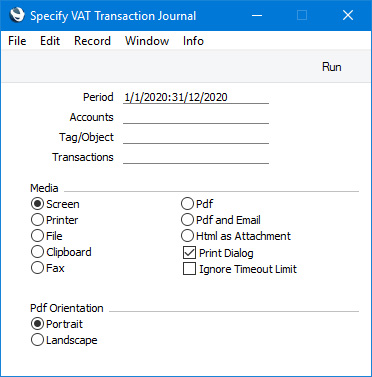
- Period
- Paste Special
Reporting Periods setting, System module
- Specify here a period for the report. The report will list rows with VAT Codes from Transactions dated during this period.
- Accounts
- Paste Special
Account register, Nominal Ledger/System module
- Range Reporting Alpha
- If you need the report to list Transaction rows posting to a particular Account, specify that Account here. You can also enter a range of Accounts separated by a colon (:).
- If you need the report to list Transaction rows posting to a particular Account, specify that Account here. You can also enter a range of Accounts separated by a colon (:).
- Tag/Object
- Paste Special
Tag/Object register, Nominal Ledger/System module
- If you need the report to list Transaction rows with a particular Tag/Object, specify that Tag/Object here. You can also enter a number of Tags/Objects separated by commas, in which case the report will list Transaction rows with all the Tags/Objects listed.
- Transactions
- Range Reporting
Numeric
- If you need the report to list rows with VAT Codes from Transactions in a particular range, enter the first and the last Transaction Numbers in the range, separated by a colon (:). If you leave the field blank, rows from every Transaction from the specified period will be included in the report.
- When entering a Transaction Number here, you must include the fiscal year or Sub System prefix (as shown in the 'Transactions: Browse' window. To include a Transaction that you entered directly to the Transaction register in the report, enter, for example, "2020.3" or, for a range, "2020.3:2020.10". To include a Transaction that was created from a Sub System in the report, enter, for example, "S/INV.200003" or "S/INV.200003:S/INV.200010" for a range.
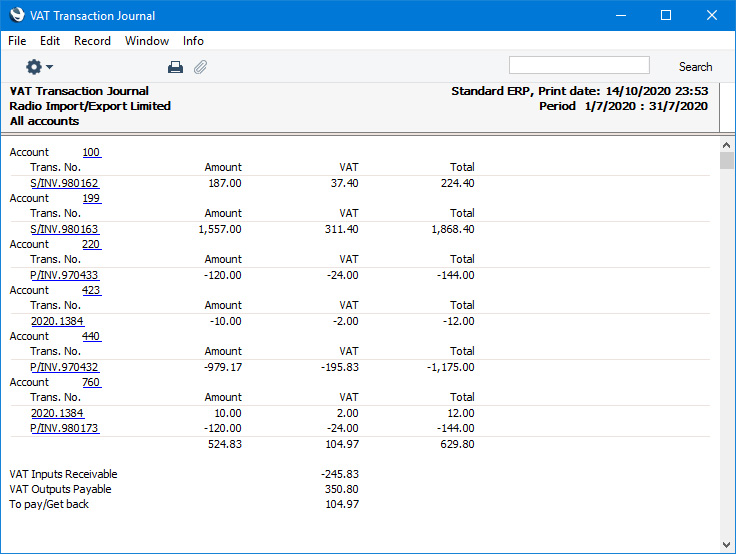
- When entering a Transaction Number here, you must include the fiscal year or Sub System prefix (as shown in the 'Transactions: Browse' window. To include a Transaction that you entered directly to the Transaction register in the report, enter, for example, "2020.3" or, for a range, "2020.3:2020.10". To include a Transaction that was created from a Sub System in the report, enter, for example, "S/INV.200003" or "S/INV.200003:S/INV.200010" for a range.
Reports in the Nominal Ledger:
- Introduction
- Definition of Nominal Ledger Reports
- Drill-down
- The Operations Menu
- Account Reconciliation
- Accrual Report
- Analytical Balance
- Analytical Balance (Fiscal purposes)
- Balance Sheet
- Bank Reconciliation
- Bank Statement
- Bank Transactions
- Base Currency Rate Change
- Budget Journal
- Cash Flow
- Chart of Accounts
- Correction List
- Corresponding Accounts
- Creditors Account
- Currency A/C Rate Change
- Daily Balances
- Debtors Account
- Forward Balance Journal
- Income & Expense Book
- Key Financial Ratios
- Liquidity Forecast
- Multicurrency Accounts Rate Difference
- N/L Accrual Transactions
- N/L Transfer, Subsystems
- Nominal Ledger
- Profit & Loss
- Revised Budget Journal
- Simulation Journal
- Tag/Object Results
- Tag/Object/Quantity Results
- Tax Account Balances
- Tax Calculations
- Tax Transactions for Registers
- Template Transaction Journal
- Test Corresponding Rules
- Transaction Journal
- Transaction Summary
- Trial Balance
- VAT Listing
- VAT Report
- VAT Report Purchases
- VAT Report Sales
- VAT Transaction Journal
- XBRL Report
Go back to:
- Home page for Nominal Ledger manual
- Home page for Standard ERP manual
XBRL Report
Please refer to the description of the two XBRL Reporting settings for details about the XBRL Report.
---
Reports in the Nominal Ledger:
- Introduction
- Definition of Nominal Ledger Reports
- Drill-down
- The Operations Menu
- Account Reconciliation
- Accrual Report
- Analytical Balance
- Analytical Balance (Fiscal purposes)
- Balance Sheet
- Bank Reconciliation
- Bank Statement
- Bank Transactions
- Base Currency Rate Change
- Budget Journal
- Cash Flow
- Chart of Accounts
- Correction List
- Corresponding Accounts
- Creditors Account
- Currency A/C Rate Change
- Daily Balances
- Debtors Account
- Forward Balance Journal
- Income & Expense Book
- Key Financial Ratios
- Liquidity Forecast
- Multicurrency Accounts Rate Difference
- N/L Accrual Transactions
- N/L Transfer, Subsystems
- Nominal Ledger
- Profit & Loss
- Revised Budget Journal
- Simulation Journal
- Tag/Object Results
- Tag/Object/Quantity Results
- Tax Account Balances
- Tax Calculations
- Tax Transactions for Registers
- Template Transaction Journal
- Test Corresponding Rules
- Transaction Journal
- Transaction Summary
- Trial Balance
- VAT Listing
- VAT Report
- VAT Report Purchases
- VAT Report Sales
- VAT Transaction Journal
- XBRL Report
Go back to:
- Home page for Nominal Ledger manual
- Home page for Standard ERP manual
- Introduction to the VAT Report