Structure of HansaWorld Enterprise
A HansaWorld Enterprise system consists of two or more modules that interact with each other. Each module contains a number of registers in which information of a particular type is stored. For example, information about Customers and Suppliers is stored in a Contact register, information about Items is stored in an Item register and so on. The smallest system (the Accounting package) consists of four modules with the following registers: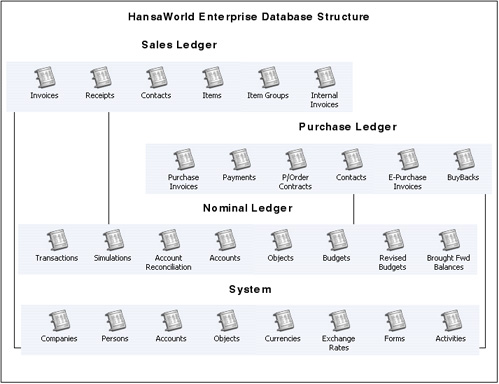
Registers contain the information with which you will be working daily, such as Customers, Suppliers, Sales Orders and Invoices. Each module also contains a number of preferences, known as "Settings". Settings can contain information that will be used in 'look-up' tables. Settings can also be used to control how particular functions or features operate.
Larger HansaWorld Enterprise systems have a more complex structure. The Contact and Item registers, for example, are included in several modules - Quotations, Sales Orders, Sales Ledger, Stock, Contracts and Job Costing.
---
In this chapter:
- Introduction
- Workflow
- Multi-year Database
Workflow
The administration of a company is always associated with a certain flow of tasks and work. In a typical trading company, items are purchased from a group of suppliers, goods are received and put into stock, sales orders are processed, stock levels are checked, goods are shipped and invoices issued, and payments are made and received. All transactions are logged and recorded, and financial events are recorded in the accounting subsystem.A modern financial system like HansaWorld Enterprise is designed to automate as many administrative tasks as possible. If you enter information in one part of the system, there is no need to enter it again elsewhere. Information will be recorded for re-use, and it will be available throughout the system immediately.
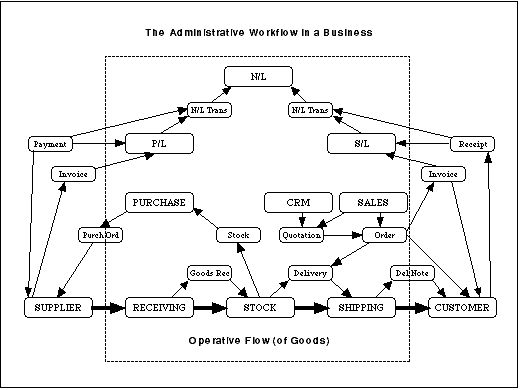
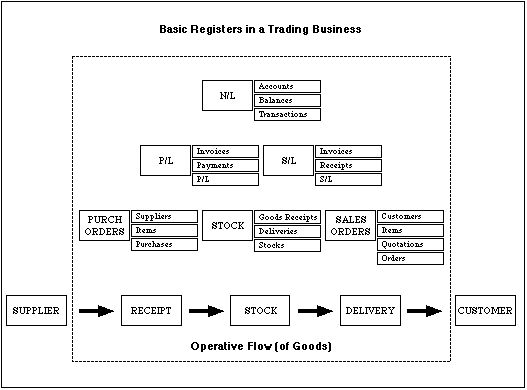
One of the tasks of the administration is to keep the organisation's "memory". This is done with the help of files and registers, where information about business events is kept. The following picture shows the same structure as above, but the messages have been removed and are replaced by the registers kept by the business.
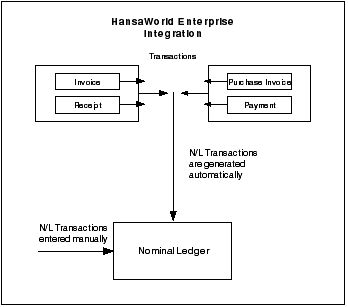
HansaWorld Enterprise is an integrated accounting system. The different parts of the system interact with each other. The Sales Ledger is for example integrated with the Nominal Ledger so that as soon as an Invoice has been approved, all ledgers in the company's accounts are automatically and immediately updated, and the new information will be available to all users.
In many cases, this integration means that you will not notice the actual creation of Nominal Ledger Transactions from the Sales and Purchase Ledgers as the process is completely automatic. These Transactions constitute about 80% of the Nominal Ledger transactions in a manual system - you simply can forget them, together with all the hassle of reconciling the ledgers with each other. HansaWorld Enterprise does all this automatically. The picture below illustrates the integration process.
In this chapter:
- Introduction
- Workflow
- Multi-year Database
Multi-year Database
HansaWorld Enterprise uses a multi-year database. This means that Transactions, Invoices etc. from several years are stored in the same database. Closing balances for all balance sheet accounts at the end of one financial year are automatically converted into opening balances for the beginning of the next. The multi-year database thus simplifies your end-of-year procedures.A HansaWorld Enterprise database is continuous. There is no requirement to divide a fiscal year into periods, and therefore no requirement to lock a period before you can open the next one. It is possible to extract reports for completely arbitrary periods. However, when you come to the end of a month or quarter and have printed the Profit & Loss and Balance Sheet reports, you may want to prevent the posting of further accounting transactions, because doing so will change the results of that month or quarter. To do this, you can specify Lock dates. A Lock date can be any date during the year. No transactions whose Transaction Date is on or before the Lock date will be permitted.
Each set of transactions has its own Number Series. There is no limit to the number of series, which you can define in each module using the 'Settings' function.
---
In this chapter:
- Introduction
- Workflow
- Multi-year Database